
Free Safe Operating Procedure (Nature Strip Mowing) Template
Establish clear safety guidelines for maintaining public grass verges with our free Safe Operating Procedure (Nature Strip Mowing) Template. Download now.
Free Safe Operating Procedure (Nature Strip Mowing) Template
DOCX • 126 KB + PDF
Updated Oct 2026
No signup required
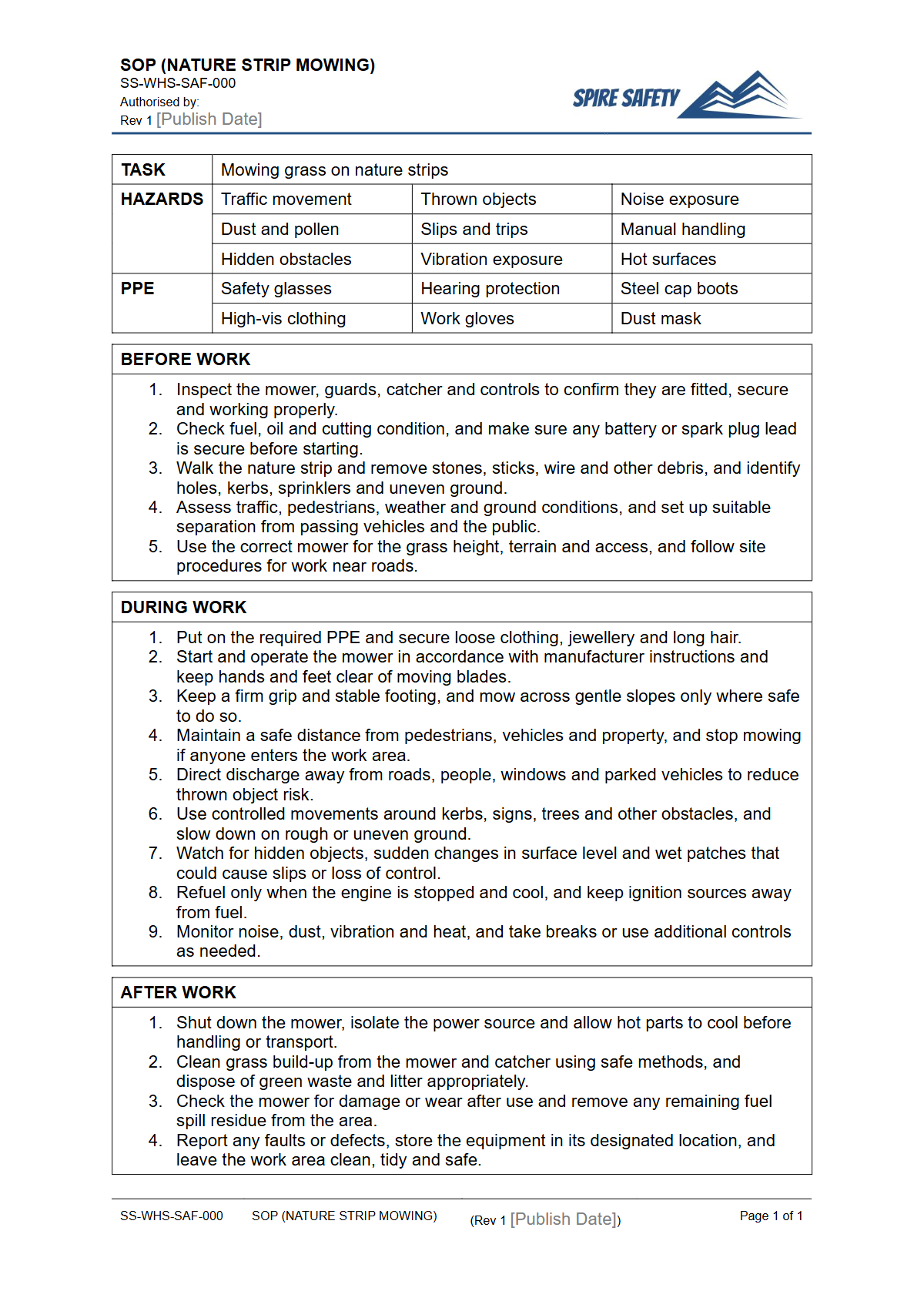
Purpose of the Free Safe Operating Procedure (Nature Strip Mowing) Template
Mowing nature strips, verges, and other public grassed areas presents a unique set of risks that must be managed. Our free Safe Operating Procedure (Nature Strip Mowing) Template provides a structured starting point for your organisation to document the step-by-step process for performing this task safely.
This document helps you outline key hazards and control measures, addressing risks such as flying debris, interactions with traffic and pedestrians, noise exposure, and musculoskeletal injuries. Using a formal SOP ensures that all operators follow a consistent, safe method of work, which is a fundamental part of fulfilling your duty of care as a Person Conducting a Business or Undertaking (PCBU).
This template is designed to be a key component within your broader safety framework. A well-documented procedure helps standardise training, simplifies incident investigations, and demonstrates a proactive approach to workplace health and safety. Integrating specific SOPs into your overall operations is a cornerstone of effective WHS management systems.
Video walkthrough
How to use the Free Safe Operating Procedure (Nature Strip Mowing) Template
This resource is available as a fully editable DOCX file and a print-ready PDF. To use it, download the file and systematically work through each section, adapting the content to reflect the specific context of your workplace.
This includes detailing the exact make and model of mowers used, the types of environments your teams work in (e.g., residential streets, main roads, industrial areas), and your organisation's specific emergency procedures.
Important: This is a template, not a finished document. You must customise it to suit your business.
While we have aligned it with common Australian WHS principles, its effectiveness depends on how accurately you adapt it to your specific equipment, site conditions, personnel, and local regulations. A generic procedure is not sufficient to manage risk effectively.
When to use it
A Safe Operating Procedure for nature strip mowing should be used in several key situations. It forms the basis for initial worker training and competency assessment before an operator is authorised to undertake the task.
It should also be readily available at the worksite as a reference tool for operators and supervisors. The SOP is a critical document to review during pre-start meetings or toolbox talks, especially when conditions change, such as working in a new location or after heavy rain.
Furthermore, it should be consulted and reviewed following any incident, near miss, or when new equipment is introduced. This ensures the procedure remains relevant and effective.
For related groundwork tasks, you might also require documents like a free Trencher SOP to cover all high-risk activities.
Who should use it
This Safe Operating Procedure should be used by multiple people within an organisation.
Primary users are the workers or operators who perform the mowing task. They must be trained on the procedure and follow it diligently. Supervisors and team leaders use the SOP to induct new workers, monitor work practices, and ensure the documented safety controls are being implemented correctly. Performing regular checks against the SOP is a practical part of site safety oversight, similar in principle to formal WHS compliance auditing.
WHS Managers and Business Owners (PCBUs) use the SOP as a tool to meet their legal obligations. They are responsible for ensuring that such safe systems of work are developed, implemented, and regularly reviewed.
Developing task-specific procedures for all high-risk equipment is crucial; for example, workers who also use portable power tools on-site would need a separate free Circular Saw SOP to guide their safe use.
Just as you would require a specific procedure for a large piece of mobile plant, smaller equipment also warrants a documented process. For instance, teams involved in civil or agricultural projects might also reference our free Grader SOP for larger-scale ground finishing tasks.
Having a library of specific, relevant SOPs strengthens your entire safety system.
By customising and implementing this template, you create a safer environment for your employees and the public. You can find more templates and checklists like this one in our complete free WHS resources library to help build out your safety documentation.
Common mistakes
Common mistakes to avoid
- Failing to walk the area first to identify and remove hazards like rocks, bottles, or sprinkler heads.
- Neglecting to wear appropriate PPE, particularly safety glasses and hearing protection.
- Using a ride-on mower incorrectly on steep slopes, which significantly increases the risk of rollover.
- Not establishing an adequate exclusion zone or traffic management when working near roads and footpaths.
Legal references
Legal considerations
The following legal requirements may be relevant to this type of work.
- Work Health and Safety Act (Harmonised) — Provides the primary duties for protecting workers and other people from work health and safety risks.
- Work Health and Safety Regulations (Harmonised) — Sets out requirements supporting the management of workplace hazards and risks.
The following codes may be relevant to this type of work.
- Managing WHS Risks Code of Practice — Provides practical guidance on identifying hazards, assessing risks and applying effective controls.
- Work Health and Safety Consultation, Cooperation and Coordination Code of Practice — Provides practical guidance on consulting workers and coordinating with other duty holders.
- Managing the Work Environment and Facilities Code of Practice — Provides practical guidance on safe work environments, workplace facilities and related controls.
Did you know
Local Council Rules
Many local councils in Australia have specific by-laws regarding nature strip maintenance, which can dictate who is responsible and the standards required. These may impact your work procedures.
Mower Noise Levels
A standard petrol lawnmower can generate noise levels between 90 and 105 decibels. Under Australian WHS regulations, mandatory hearing protection is required for exposure to noise above an 8-hour average of 85 decibels.
FAQ
Frequently asked questions
01What hazards should a nature strip mowing SOP cover?
02Is a Safe Operating Procedure a legal requirement for mowing in Australia?
03How often should we review our Nature Strip Mowing SOP?
04Can this template be used for both ride-on and push mowers?
Share this resource
Free Safe Operating Procedure (Nature Strip Mowing) Template
Browse Categories
How To Use It
- 1Download and open in Word or PDF.
- 2Replace the placeholders with your business details.
- 3Get it reviewed by a WHS specialist before rollout.
Need it customised?
Our WHS consultants can adapt this template to your site, run a gap analysis, or audit what you already have in place.
Book a Free Consultation WHS consulting servicesor call 1300 156 382
Related templates
- Free Safe Operating Procedure (Needle Scaler) Template
- Free Safe Operating Procedure (Netball Court Cleaning) Template
- Free Safe Operating Procedure (Noise Dosimeter) Template
- Free Safe Operating Procedure (Non-Slip Mat Cleaning) Template
- Free Safe Operating Procedure (Notching Machine) Template
- Free Safe Operating Procedure (Nursery Bench Cleaning) Template