
Free Safe Operating Procedure (Multimeter Use) Template
Download our Free Safe Operating Procedure for Multimeter Use to formalise safety protocols for electrical testing.
Free Safe Operating Procedure (Multimeter Use) Template
DOCX • 126 KB + PDF
Updated Oct 2026
No signup required
Purpose of the Free Safe Operating Procedure (Multimeter Use) Template
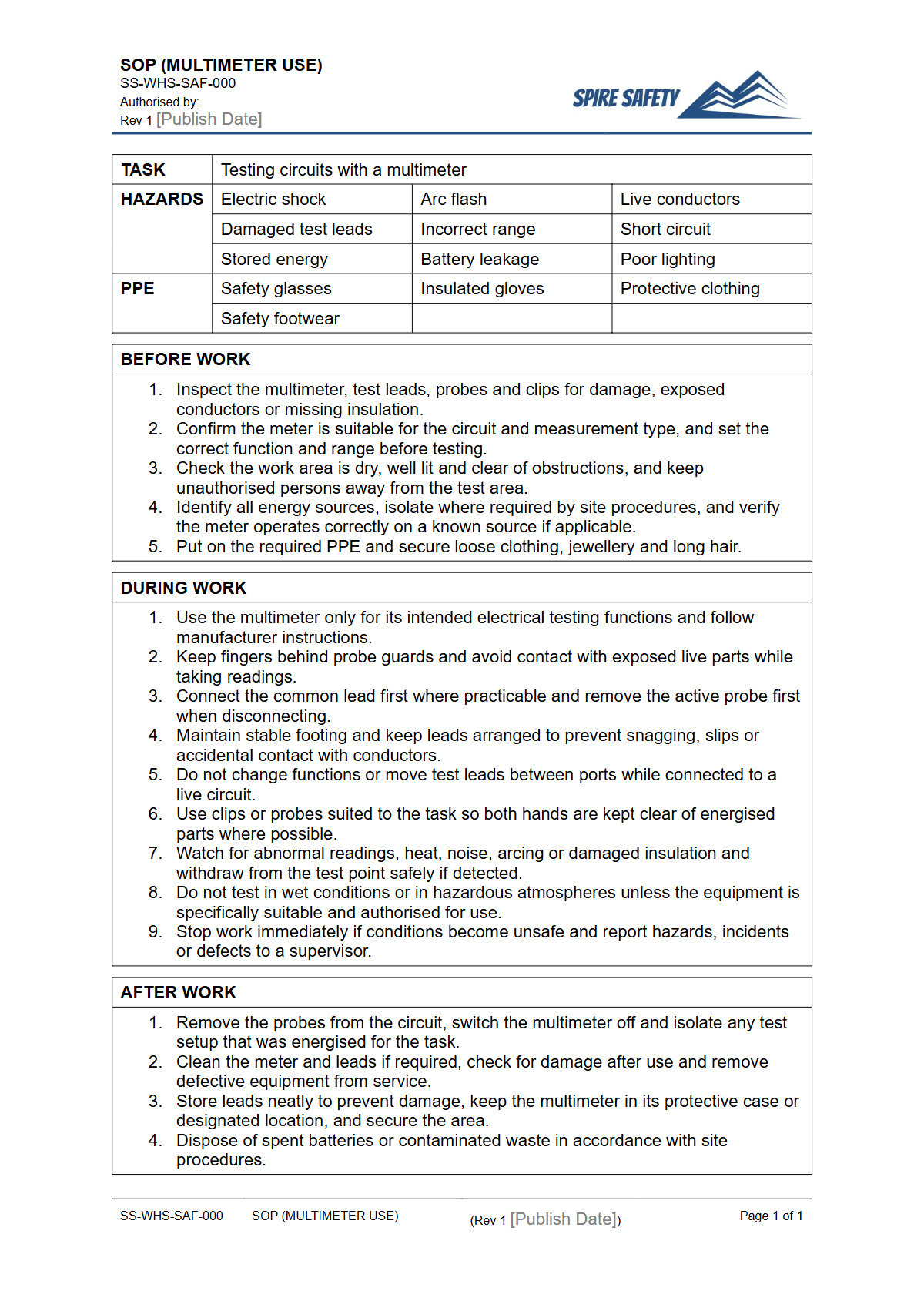
Using a multimeter for electrical testing and fault-finding is a common task, but it carries significant risks, including electric shock, arc flash, and equipment damage. This Free Safe Operating Procedure (Multimeter Use) Template provides a structured framework for outlining the required steps to perform these tasks safely.
It helps organisations meet their duty of care under Australian WHS laws by formalising procedures, ensuring consistency, and providing a reliable tool for worker training and competency assessment.
A documented SOP is a critical control measure for managing electrical hazards. It ensures that all workers, regardless of experience level, follow a standardised, pre-approved method for using multimeters.
This reduces the likelihood of accidents caused by procedural errors or forgotten steps. Similar to how you would formalise processes for other electrical equipment, such as with a Safe Operating Procedure for deep fryer operation, documenting multimeter use is a fundamental part of a safe system of work.
Video walkthrough
How to use the Free Safe Operating Procedure (Multimeter Use) Template
This document is provided in both DOCX and PDF formats for your convenience. The DOCX file is fully editable, allowing you to tailor it to your specific workplace requirements.
To effectively implement this Safe Operating Procedure, you should download the template and work through each section in consultation with competent persons, such as licensed electricians and experienced technicians who regularly use multimeters.
Pay close attention to sections requiring site-specific information, such as the makes and models of multimeters used, the specific types of electrical systems being tested, and the required personal protective equipment (PPE). Integrating this SOP into your broader WHS management systems ensures it aligns with your overall safety strategy.
Remember to obtain final sign-off from relevant managers or supervisors before issuing the SOP for use.
Important: This document is a template and must be customised for your workplace. We are not responsible for the outcomes of its use.
You must consult with your team and adapt the content to reflect the specific equipment, processes, and risks present in your operational environment. If you are unsure how to conduct the necessary risk assessments, consider seeking specialist WHS consulting to ensure your procedures are robust and effective.
When to use it
A Safe Operating Procedure for multimeter use should be consulted before any task involving electrical measurement begins. It serves as a critical pre-start checklist and procedural guide for workers.
Its primary application is during live electrical testing, diagnostics, and verification of de-energisation. The SOP should also be a central document for initial worker training, competency assessments, and periodic refresher courses to reinforce safe work habits.
Furthermore, this procedure should be reviewed and referenced during incident investigations involving electrical work and as part of regular safety audits. It's a living document that supports a proactive safety culture, much like any other task-specific procedure, such as our free Circular Saw SOP, which guides the safe use of power tools.
Who should use it
This Safe Operating Procedure is intended for all personnel who are required to use a multimeter as part of their job role. This typically includes qualified electricians, electrical engineers, apprentices, maintenance technicians, HVAC specialists, and other competent persons authorised to perform electrical work.
Supervisors and WHS managers should also be thoroughly familiar with the SOP to effectively oversee work, conduct inspections, and ensure procedures are being followed correctly.
Using this SOP helps demonstrate that workers have been provided with clear instruction and training on how to perform their tasks safely. The contents of the SOP, along with records of training and competency, are key evidence points that may be reviewed during WHS compliance auditing to verify that safety obligations are being met.
Key Components of a Multimeter SOP
A comprehensive multimeter SOP should include several key sections to guide the user from start to finish. Our template is structured to cover these critical areas:
- Pre-Operational Checks: Detailing visual inspection of the multimeter, test leads, and probes for damage; verifying the correct battery level; and confirming the meter's CAT rating is appropriate for the task.
- Personal Protective Equipment (PPE): Specifying the required PPE, which may include insulated gloves, eye protection, and arc-rated clothing, depending on the risk assessment.
- Step-by-Step Operating Procedure: Providing clear, sequential instructions for selecting the correct function and range, connecting the probes, taking a reading, and interpreting the results safely.
- Post-Operational Checks: Outlining steps for cleaning and correctly storing the multimeter and its accessories.
- Emergency Procedures: Describing the immediate actions to take in the event of an electric shock or arc flash incident.
Each of these components is vital for creating a holistic safe system of work. The structured approach is applicable to many types of equipment, as seen in other resources like our free Air Compressor SOP, which also follows a logical pre-use, use, and post-use format.
You can explore our complete free WHS resources library for more templates to support your safety management system.
Common mistakes
Common mistakes to avoid
- Using a multimeter with a low Category (CAT) rating for high-energy circuits (e.g., using a CAT II meter on a switchboard).
- Failing to visually inspect test leads and probes for cracks, fraying, or other damage before every use.
- Attempting to measure current while the test leads are still plugged into the voltage/resistance jacks.
- Neglecting to wear appropriate PPE, such as insulated gloves and safety glasses, when working on or near live circuits.
Legal references
Legal considerations
The following legal requirements may be relevant to this type of work.
- Work Health and Safety Act (Harmonised) — Provides the primary duties for protecting workers and other people from work health and safety risks.
- Work Health and Safety Regulations (Harmonised) — Sets out requirements supporting the management of workplace hazards and risks.
The following codes may be relevant to this type of work.
- Managing WHS Risks Code of Practice — Provides practical guidance on identifying hazards, assessing risks and applying effective controls.
- Work Health and Safety Consultation, Cooperation and Coordination Code of Practice — Provides practical guidance on consulting workers and coordinating with other duty holders.
- Managing the Work Environment and Facilities Code of Practice — Provides practical guidance on safe work environments, workplace facilities and related controls.
Did you know
Arc Flash Danger
An arc flash, which can be triggered by incorrect multimeter use, can reach temperatures of up to 20,000°C. This is four times the surface temperature of the sun and can cause severe burns and vaporise metal instantly.
Ghost Voltages
High-impedance digital multimeters can sometimes display 'ghost voltages' on de-energised circuits due to capacitive coupling from nearby live wires. Always use a low-impedance meter or a dedicated voltage tester to confirm a circuit is truly dead.
FAQ
Frequently asked questions
01Is a Safe Operating Procedure for multimeter use legally required in Australia?
02What are the main hazards of using a multimeter?
03How often should multimeter SOPs and related training be reviewed?
04Can this template be used for all types of multimeters?
Share this resource
Free Safe Operating Procedure (Multimeter Use) Template
Browse Categories
How To Use It
- 1Download and open in Word or PDF.
- 2Replace the placeholders with your business details.
- 3Get it reviewed by a WHS specialist before rollout.
Need it customised?
Our WHS consultants can adapt this template to your site, run a gap analysis, or audit what you already have in place.
Book a Free Consultation WHS consulting servicesor call 1300 156 382
Related templates
- Free Safe Operating Procedure (Municipal Litter Pickup) Template
- Free Safe Operating Procedure (Nail Gun) Template
- Free Safe Operating Procedure (Nail Salon Cleanup) Template
- Free Safe Operating Procedure (Nature Strip Mowing) Template
- Free Safe Operating Procedure (Needle Scaler) Template
- Free Safe Operating Procedure (Netball Court Cleaning) Template