
Free Safe Operating Procedure (Municipal Litter Pickup) Template
Manage the risks of council and public space clean-up tasks with our structured Safe Operating Procedure for municipal litter pickup. Download the template.
Free Safe Operating Procedure (Municipal Litter Pickup) Template
DOCX • 126 KB + PDF
Updated Oct 2026
No signup required
Purpose of the Free Safe Operating Procedure (Municipal Litter Pickup) Template
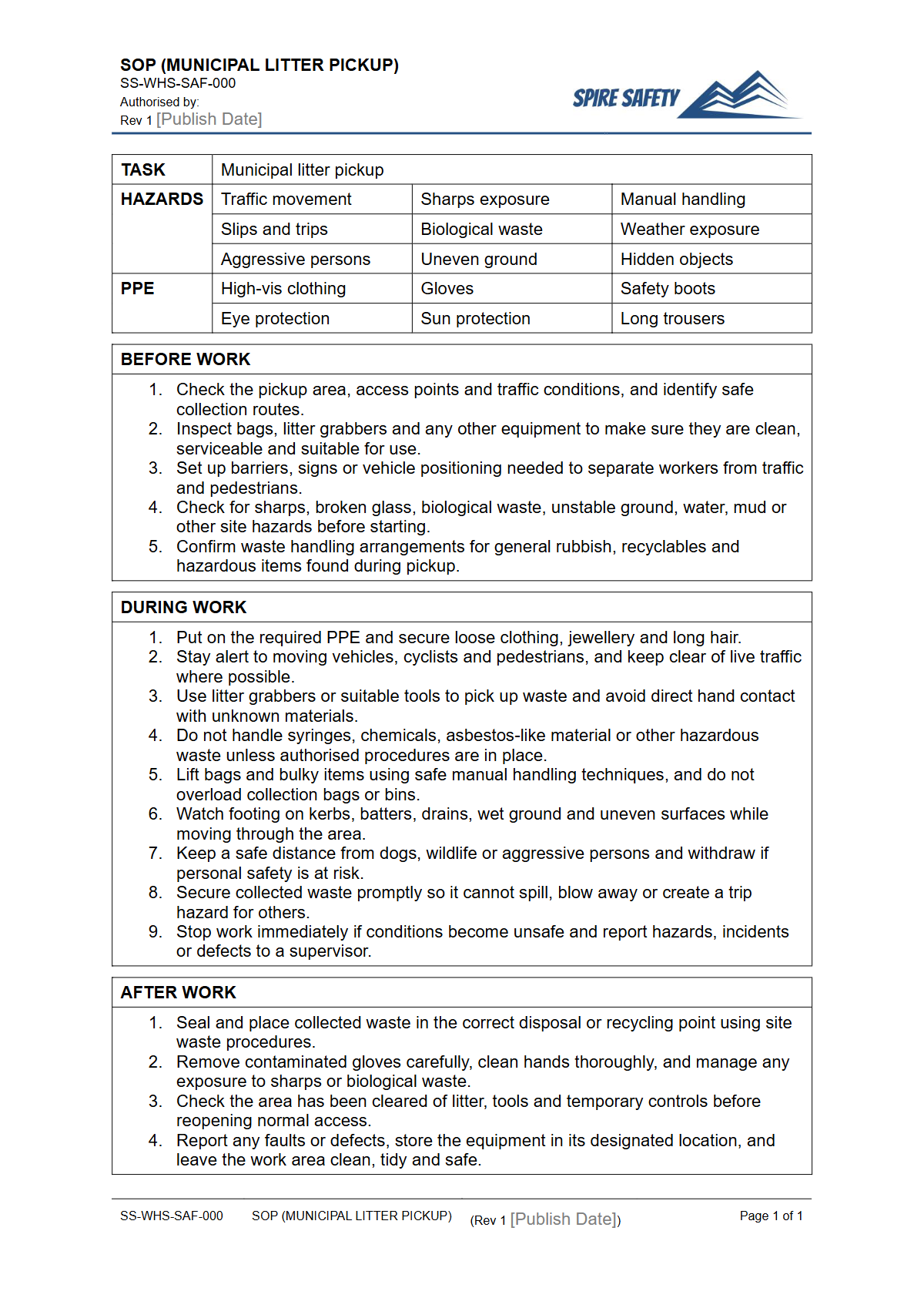
Managing the health and safety of workers involved in public space clean-up is a critical responsibility for municipal bodies. Our Free Safe Operating Procedure (Municipal Litter Pickup) Template provides a comprehensive starting point for documenting the required steps to perform this task safely and systematically.
This SOP template is designed to help you outline the risks and control measures associated with collecting litter from parks, roadsides, and public areas. It provides a structured format to detail pre-operational checks, step-by-step procedures, and emergency responses.
Using a formalised procedure helps standardise safe work practices across all teams and demonstrates a commitment to a robust WHS management system. The goal is to minimise worker exposure to hazards such as sharps, biological waste, traffic, hazardous substances, and manual handling injuries.
Video walkthrough
How to use the Free Safe Operating Procedure (Municipal Litter Pickup) Template
Download the template in your preferred format—DOCX for easy editing or PDF for straightforward distribution. This document is aligned with Australian WHS principles but must be customised to reflect the specific conditions of your workplace and operations.
We have provided a general framework, but you must consult with your workers and adapt it to your unique equipment (e.g., litter pickers, vehicles), local council bylaws, specific collection routes, and identified hazards. A generic SOP is insufficient for ensuring safety. An effective procedure is one that is practical, specific, and actively used by your team.
Regular reviews, often as part of your internal WHS compliance auditing schedule, ensure the document remains relevant and effective over time.
When to use it
A Safe Operating Procedure for municipal litter pickup should be used in several key situations. It is an essential tool for inducting and training new employees or contractors, ensuring they understand the approved method for the task from day one.
It should also be used for refresher training for existing staff, particularly when new hazards are identified or procedures change. The SOP serves as a daily reference point before starting a collection run, reinforcing safety checks and PPE requirements.
It is also a foundational document when conducting a task-specific risk assessment or investigating an incident. For other common council activities, specific procedures are also necessary, such as those outlined in our FREE Spreader SOP Template for grounds maintenance.
Who should use it
This procedure is intended for use by a range of personnel within a municipal or contracting organisation. WHS Managers and Safety Officers will use it to develop, implement, and review safety protocols as part of their broader safety framework.
Team Leaders and Supervisors are responsible for ensuring their crews understand and adhere to the SOP during daily operations, conducting toolbox talks, and monitoring compliance. The workers performing the litter pickup are the primary end-users; they must be trained on the procedure and follow it to protect their own health and safety.
The principles of safe operation extend to related tasks; for example, if moving large quantities of collected waste, referring to a FREE Telehandler SOP Template can provide valuable guidance on safe lifting and transport.
The SOP should also detail post-operational tasks, such as secure waste disposal, vehicle clean-down, and equipment maintenance. For instance, cleaning tools with high-pressure air requires specific safety measures, which are covered in resources like our Free Air Compressor SOP Template. By documenting every stage of the work cycle, you create a complete and effective safety document. For more templates and safety guides, explore our complete free WHS resources library.
Common mistakes
Common mistakes to avoid
- Failing to customise the template for specific local hazards (e.g., known high-risk areas for sharps).
- Not providing or enforcing the use of adequate Personal Protective Equipment (PPE) like puncture-resistant gloves and high-visibility clothing.
- Neglecting to properly train workers on the procedure, especially emergency protocols for sharps injuries or hazardous spills.
- Forgetting to include procedures for safely managing interactions with the public or dealing with aggressive behaviour.
Legal references
Legal considerations
The following legal requirements may be relevant to this type of work.
- Work Health and Safety Act (Harmonised) — Provides the primary duties for protecting workers and other people from work health and safety risks.
- Work Health and Safety Regulations (Harmonised) — Sets out requirements supporting the management of workplace hazards and risks.
The following codes may be relevant to this type of work.
- Managing WHS Risks Code of Practice — Provides practical guidance on identifying hazards, assessing risks and applying effective controls.
- Work Health and Safety Consultation, Cooperation and Coordination Code of Practice — Provides practical guidance on consulting workers and coordinating with other duty holders.
- Managing the Work Environment and Facilities Code of Practice — Provides practical guidance on safe work environments, workplace facilities and related controls.
Did you know
Hidden Hazards
Discarded needles and syringes are a significant risk in municipal litter collection. A single needlestick injury can potentially transmit over 20 different blood-borne diseases, highlighting the need for puncture-resistant gloves and correct disposal procedures.
Manual Handling Risk
According to Safe Work Australia, injuries from manual handling are a leading cause of serious workers' compensation claims. Proper lifting techniques for heavy rubbish bags are critical for preventing musculoskeletal disorders among collection workers.
FAQ
Frequently asked questions
01What key hazards should an SOP for municipal litter pickup cover?
02Is this template ready to use immediately after download?
03Who is responsible for implementing the litter pickup SOP?
04How often should a Safe Operating Procedure be reviewed?
Share this resource
Free Safe Operating Procedure (Municipal Litter Pickup) Template
Browse Categories
How To Use It
- 1Download and open in Word or PDF.
- 2Replace the placeholders with your business details.
- 3Get it reviewed by a WHS specialist before rollout.
Need it customised?
Our WHS consultants can adapt this template to your site, run a gap analysis, or audit what you already have in place.
Book a Free Consultation WHS consulting servicesor call 1300 156 382
Related templates
- Free Safe Operating Procedure (Nail Gun) Template
- Free Safe Operating Procedure (Nail Salon Cleanup) Template
- Free Safe Operating Procedure (Nature Strip Mowing) Template
- Free Safe Operating Procedure (Needle Scaler) Template
- Free Safe Operating Procedure (Netball Court Cleaning) Template
- Free Safe Operating Procedure (Noise Dosimeter) Template