
Free Safe Operating Procedure (Mulch Bed Maintenance) Template
Establish clear, safe work methods for mulch bed upkeep with our customisable template. Download your free Safe Operating Procedure to get started.
Free Safe Operating Procedure (Mulch Bed Maintenance) Template
DOCX • 126 KB + PDF
Updated Oct 2026
No signup required
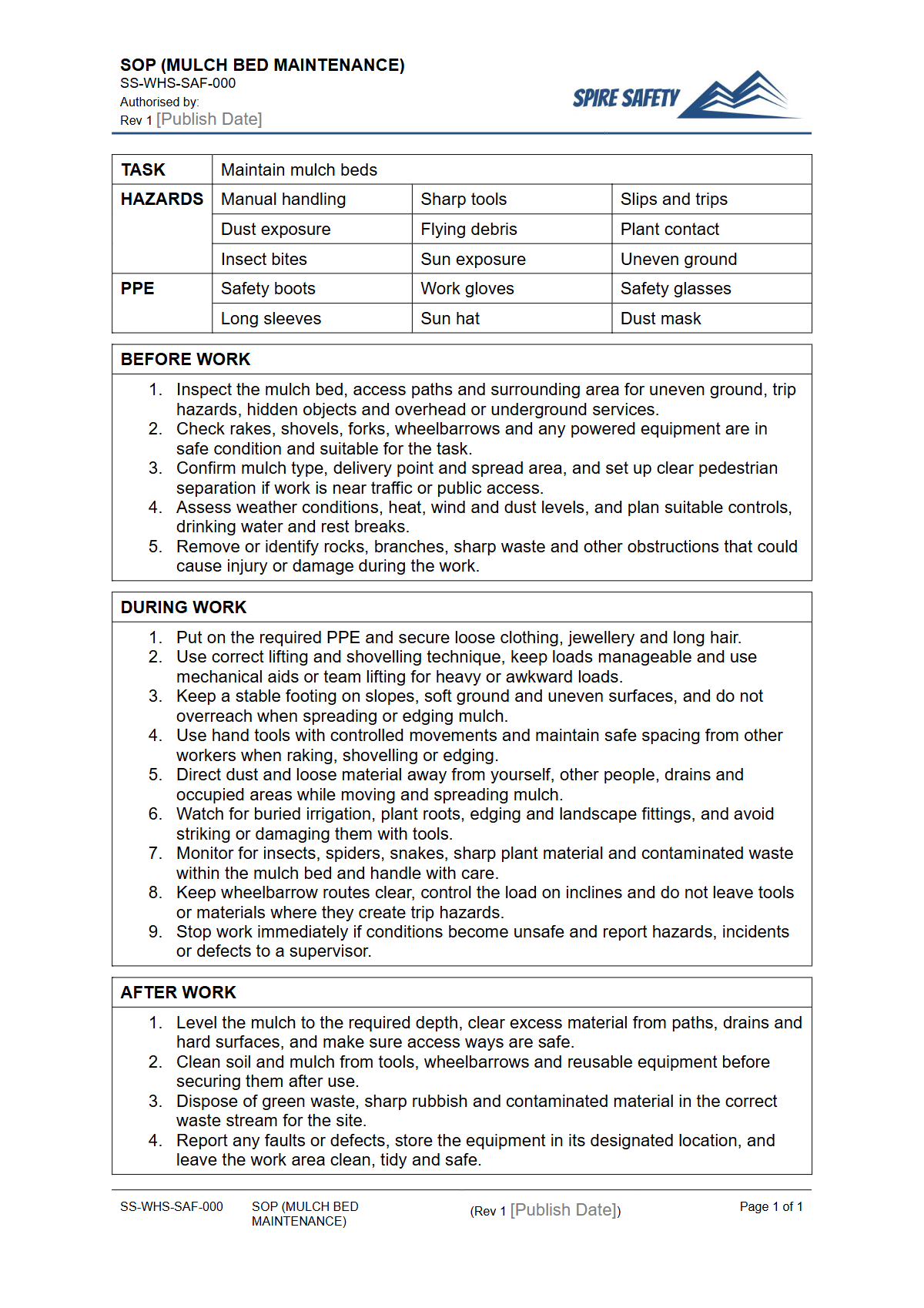
Purpose of the Free Safe Operating Procedure (Mulch Bed Maintenance) Template
This Safe Operating Procedure (SOP) template provides a structured framework for documenting the hazards and control measures associated with maintaining mulch beds in gardens and landscapes. Its purpose is to standardise the task, ensuring all workers follow a consistent, safe method.
By clearly outlining steps for preparation, execution, and clean-up, this document helps minimise risks such as manual handling injuries, exposure to biological hazards, and misuse of tools. Formalising your process is a key step in a robust safety system and simplifies training and competency assessments for your team.
A well-defined SOP also serves as a critical reference point during safety reviews and incident investigations. It demonstrates a commitment to proactive risk management and provides a benchmark for performance evaluations.
This process aligns with the continuous improvement cycle fundamental to effective WHS management systems, ensuring your safety protocols evolve with your operational needs.
Video walkthrough
How to use the Free Safe Operating Procedure (Mulch Bed Maintenance) Template
To gain value from this resource, you must adapt it to the specific context of your workplace. Download the DOCX file and systematically work through each section, replacing the placeholder text with details relevant to your site, equipment, materials, and personnel.
Pay close attention to specifying the exact types of mulch used, the tools required (manual and powered), and the Personal Protective Equipment (PPE) needed to control identified risks like dust, splinters, or chemical exposure.
It is critical that you customise this template. We provide this document as a starting point, not a finished product.
Your organisation is responsible for ensuring the final SOP is comprehensive and accurately reflects the risks and control measures applicable to your specific operations. Involve experienced workers in the drafting process to ensure the procedure is practical and effective.
For tasks involving specific machinery, you may need to integrate details from other documents, such as our FREE Spreader SOP Template if you use mechanical spreaders.
When to use it
A Safe Operating Procedure for mulch bed maintenance should be an active part of your daily operations. It is not a document to be filed away and forgotten.
Use it during worker induction and training to establish a baseline for safe work practices from day one. It should also be readily available at the work site for easy reference by supervisors and workers before commencing the task.
The SOP is a vital tool for pre-start meetings or toolbox talks to review hazards and controls relevant to the day's work.
Furthermore, the procedure should be formally reviewed whenever there is a change in the work process, such as the introduction of new equipment, mulch types, or chemicals. If an incident or near-miss occurs during mulch maintenance, the SOP must be reviewed as part of the investigation to identify any gaps or weaknesses.
Regular scheduled reviews, typically annually, are also essential to ensure it remains current. If your work involves related ground preparation, consulting a resource like our FREE Trencher SOP Template can help inform new procedures.
Who should use it
This SOP is intended for a range of personnel within any organisation that performs landscaping or groundskeeping duties. Primary users include the workers directly performing the task, such as landscapers, gardeners, and maintenance staff.
They rely on the SOP to understand the approved, safe method for completing their work. It provides clear, step-by-step instructions that reduce ambiguity and the likelihood of unsafe shortcuts.
Supervisors and team leaders use the SOP to oversee work, conduct safety observations, and ensure team members are adhering to the established procedure. They also use it as a basis for providing instruction and corrective feedback.
For WHS managers and coordinators, the document is a key component of the overall safety management system, used for risk assessments, training planning, and demonstrating due diligence. Workers performing related tasks, such as cutting garden sleepers, may need to consult other specific procedures like a FREE Circular Saw SOP Template.
By standardising procedures for common tasks, you build a safer and more predictable work environment. You can explore our complete free WHS resources library for more templates to support your safety system.
Common mistakes
Common mistakes to avoid
- Failing to specify the required PPE for dust inhalation, eye protection, and skin contact.
- Not including procedures for the safe use and maintenance of specific tools like rakes, shovels, and wheelbarrows.
- Overlooking biological hazards like mould, fungi, bacteria, or pests that may be present in the mulch.
- Using the generic template without customising it for the specific work site, mulch type, and tasks involved.
Legal references
Legal considerations
The following legal requirements may be relevant to this type of work.
- Work Health and Safety Act (Harmonised) — Provides the primary duties for protecting workers and other people from work health and safety risks.
- Work Health and Safety Regulations (Harmonised) — Sets out requirements supporting the management of workplace hazards and risks.
The following codes may be relevant to this type of work.
- Managing WHS Risks Code of Practice — Provides practical guidance on identifying hazards, assessing risks and applying effective controls.
- Work Health and Safety Consultation, Cooperation and Coordination Code of Practice — Provides practical guidance on consulting workers and coordinating with other duty holders.
- Managing the Work Environment and Facilities Code of Practice — Provides practical guidance on safe work environments, workplace facilities and related controls.
Did you know
Mulch and Fungi
Some mulches can harbour fungi like the Artillery Fungus, which forcefully ejects spore masses that can stain nearby surfaces like walls and cars. Proper maintenance and mulch selection help manage this risk.
Manual Handling Risk
A standard bag of mulch can weigh over 20kg, posing a significant manual handling risk. A thorough SOP should include controls like team lifting, using wheelbarrows, or specifying smaller bag sizes to mitigate injury.
FAQ
Frequently asked questions
01What common hazards should be included in a mulch bed maintenance SOP?
02Does this SOP cover the use of powered equipment like blowers or tillers?
03How often should a Safe Operating Procedure for mulch maintenance be reviewed?
04Can I use this template for a commercial landscaping business?
Share this resource
Free Safe Operating Procedure (Mulch Bed Maintenance) Template
Browse Categories
How To Use It
- 1Download and open in Word or PDF.
- 2Replace the placeholders with your business details.
- 3Get it reviewed by a WHS specialist before rollout.
Need it customised?
Our WHS consultants can adapt this template to your site, run a gap analysis, or audit what you already have in place.
Book a Free Consultation WHS consulting servicesor call 1300 156 382
Related templates
- Free Safe Operating Procedure (Mulch Handling) Template
- Free Safe Operating Procedure (Mulch Spreading) Template
- Free Safe Operating Procedure (Mulcher) Template
- Free Safe Operating Procedure (Multimeter Use) Template
- Free Safe Operating Procedure (Municipal Litter Pickup) Template
- Free Safe Operating Procedure (Nail Gun) Template