
Free Safe Operating Procedure (Mulch Handling) Template
Manage mulch handling risks with our free Safe Operating Procedure template. Download the customisable DOCX to formalise your safety processes today.
Free Safe Operating Procedure (Mulch Handling) Template
DOCX • 126 KB + PDF
Updated Oct 2026
No signup required
Purpose of the Free Safe Operating Procedure (Mulch Handling) Template
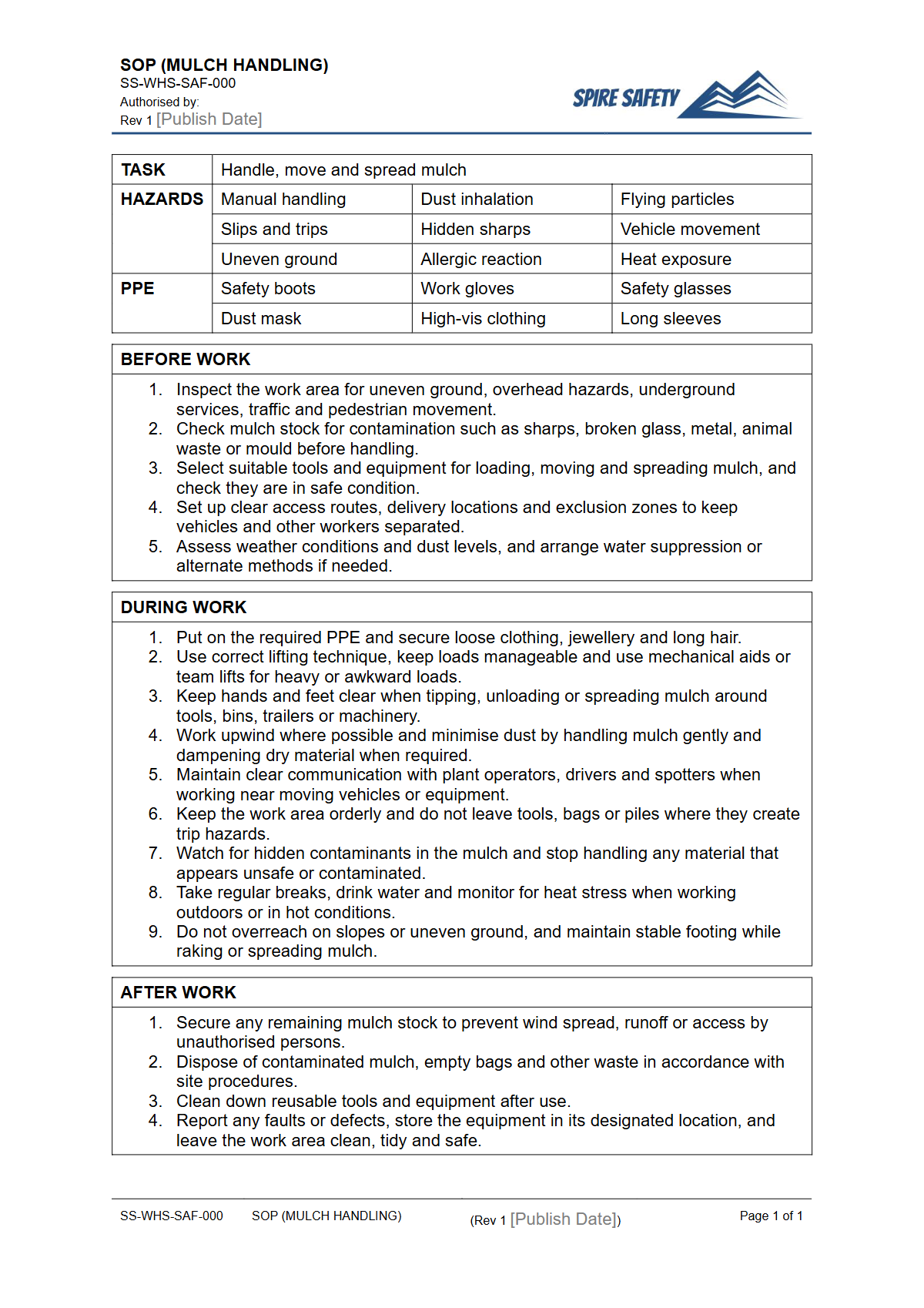
Handling mulch, whether in bags or bulk, introduces a range of workplace hazards. Our Free Safe Operating Procedure (Mulch Handling) Template provides a structured starting point for organisations to document a safe system of work for this common task.
This document is designed to help you identify risks and outline clear, step-by-step controls for workers to follow. It prompts consideration of hazards such as musculoskeletal injuries from manual handling, respiratory issues from dust and organic matter, and entanglement or collision risks when using machinery.
By implementing a formal SOP, you create a consistent operational standard that supports worker training, supervision, and your overall safety management efforts. This template is a foundational component for building robust WHS management systems, helping your business meet its duty of care under Australian WHS legislation.
It provides a practical tool for managing risks associated with pre-operational checks, task execution, and post-operational clean-up.
Video walkthrough
How to use the Free Safe Operating Procedure (Mulch Handling) Template
This document is available as a fully editable DOCX file, allowing for complete customisation to your specific workplace. Simply download the template and modify the content to align with your equipment, mulch types (e.g., treated pine bark, organic compost), and environmental conditions.
It is crucial to conduct a site-specific risk assessment and incorporate your findings directly into the procedure. The goal is to create a document that is practical, relevant, and easily understood by your workers.
Please note: This document is a template and must be customised to reflect the specific plant, materials, and work environment at your site. We recommend a competent person, such as a manager or safety officer, consults with workers and validates the final SOP before it is implemented.
When handling mulch with machinery, you may also need to reference a specific Spreader SOP template to cover all operational risks.
When to Use This Safe Operating Procedure
A Safe Operating Procedure for mulch handling should be used as a primary reference document before, during, and after the task is performed. It is an essential tool for new worker inductions and for providing refresher training to experienced personnel.
The SOP should be readily accessible in the work area for quick reference. It also serves as a benchmark for safety observations and workplace inspections, helping supervisors confirm that prescribed safety controls are being followed correctly.
Following any incident or near miss, the SOP should be reviewed as part of the investigation process to identify any potential gaps or areas for improvement. For tasks involving heavy lifting with equipment, it's also wise to consult equipment-specific procedures, such as a telehandler SOP.
Who Should Use It
This SOP is intended for use by multiple roles within an organisation. PCBUs (Persons Conducting a Business or Undertaking) and managers can use it to fulfil their legislative duties to provide safe work systems.
WHS advisors, supervisors, and team leaders will find it invaluable for training staff and monitoring on-the-job safety performance. Most importantly, workers who directly handle mulch must be trained in the SOP's contents so they understand the approved methods for performing the task safely.
This ensures everyone has a clear understanding of the risks and the controls required to protect themselves and others. If mulch is moved via fixed plant, a specific Conveyer System SOP would also be a necessary reference.
Integrating SOPs into Your Safety Framework
A standalone SOP is effective, but its value multiplies when integrated into a broader safety system. This includes linking it to training records, risk assessments, and maintenance schedules for any machinery involved.
Regular reviews and updates ensure the procedure remains relevant as equipment, substances, or processes change. Integrating your procedures into a scheduled review cycle is a key activity in any effective safety system, often verified through WHS compliance auditing to ensure ongoing effectiveness and identify opportunities for improvement.
Spire Safety offers a wide range of templates and documents to support your organisation. Explore our complete free WHS resources library for more tools to help you build a safer workplace.
Common mistakes
Common mistakes to avoid
- Failing to assess the specific type of mulch (e.g., treated wood, organic compost) for chemical or biological hazards.
- Using incorrect manual handling techniques for lifting and carrying heavy bags, leading to sprains and strains.
- Neglecting dust suppression measures, such as wetting down piles before moving them, exposing workers to airborne particles.
- Providing inadequate training or competency verification for workers operating machinery like loaders or spreaders.
Legal references
Legal considerations
The following legal requirements may be relevant to this type of work.
- Work Health and Safety Act (Harmonised) — Provides the primary duties for protecting workers and other people from work health and safety risks.
- Work Health and Safety Regulations (Harmonised) — Sets out requirements supporting the management of workplace hazards and risks.
The following codes may be relevant to this type of work.
- Managing WHS Risks Code of Practice — Provides practical guidance on identifying hazards, assessing risks and applying effective controls.
- Work Health and Safety Consultation, Cooperation and Coordination Code of Practice — Provides practical guidance on consulting workers and coordinating with other duty holders.
- Managing the Work Environment and Facilities Code of Practice — Provides practical guidance on safe work environments, workplace facilities and related controls.
Did you know
Hidden Respiratory Risks
Organic mulch can harbour thermophilic actinomycetes, mould, and fungal spores. Inhaling these can cause respiratory irritation or serious conditions like Hypersensitivity Pneumonitis, highlighting the need for appropriate respiratory protection.
Spontaneous Combustion
Large, deep piles of decomposing mulch can generate enough internal heat to spontaneously combust, especially in dry conditions. Proper storage, including pile size limits and moisture management, are critical fire prevention controls.
FAQ
Frequently asked questions
01What are the main hazards of handling mulch?
02Is a Safe Operating Procedure a legal requirement for handling mulch?
03How often should our Mulch Handling SOP be reviewed?
04Can I use this template for both bagged and bulk mulch?
Share this resource
Free Safe Operating Procedure (Mulch Handling) Template
Browse Categories
How To Use It
- 1Download and open in Word or PDF.
- 2Replace the placeholders with your business details.
- 3Get it reviewed by a WHS specialist before rollout.
Need it customised?
Our WHS consultants can adapt this template to your site, run a gap analysis, or audit what you already have in place.
Book a Free Consultation WHS consulting servicesor call 1300 156 382
Related templates
- Free Safe Operating Procedure (Mulch Spreading) Template
- Free Safe Operating Procedure (Mulcher) Template
- Free Safe Operating Procedure (Multimeter Use) Template
- Free Safe Operating Procedure (Municipal Litter Pickup) Template
- Free Safe Operating Procedure (Nail Gun) Template
- Free Safe Operating Procedure (Nail Salon Cleanup) Template