
Free Safe Operating Procedure (Mud Pump) Template
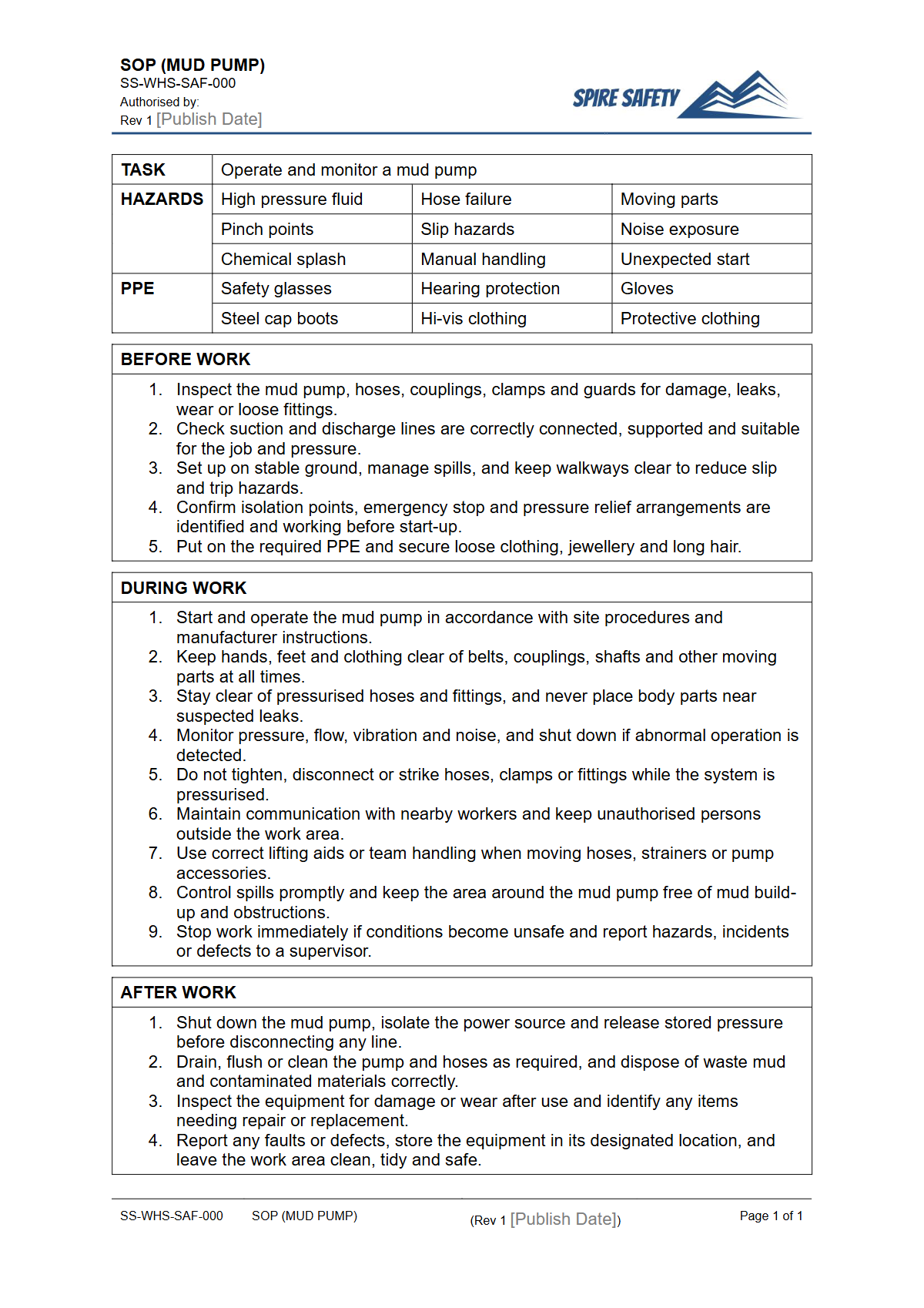
Download our free Safe Operating Procedure (Mud Pump) template. This structured DOCX and PDF helps you document safe work methods for mud pump operations.
Free Safe Operating Procedure (Mud Pump) Template
DOCX • 126 KB + PDF
Updated Oct 2026
No signup required
Purpose of the Free Safe Operating Procedure (Mud Pump) Template
A mud pump is powerful, high-pressure equipment essential in drilling operations, but it also introduces significant workplace hazards. This Free Safe Operating Procedure (Mud Pump) Template provides a structured framework for documenting the safe use of this machinery.
Its purpose is to help Persons Conducting a Business or Undertaking (PCBUs) outline step-by-step instructions for tasks, identify potential hazards, and implement effective control measures to minimise risk. Properly developed, an SOP is a critical tool for ensuring workers understand and follow established safety protocols, reducing the likelihood of incidents involving high-pressure fluid injection, mechanical entanglement, or chemical exposure.
By clearly defining pre-start checks, shutdown procedures, and emergency responses, the SOP serves as a practical guide for operators. This process of documenting safe work methods is fundamental to managing risks associated with heavy plant.
The principles are similar whether you are preparing a safe operating procedure for a boom pump or documenting processes for other site equipment.
Video walkthrough
How to use the Free Safe Operating Procedure (Mud Pump) Template
To effectively use this resource, download the DOCX file and adapt it to your specific operational context. While the template is aligned with Australian WHS best practices, it is designed as a starting point, not a finished document.
It is crucial to conduct a site-specific risk assessment for your mud pump operations and incorporate your findings into the SOP. This includes specifying the exact make and model of the pump, the types of drilling fluids used, and the unique environmental conditions of your workplace.
We stress that you must customise this template to reflect your specific equipment, work environment, tasks, and control measures. A generic document is not sufficient for demonstrating compliance or ensuring worker safety.
For the SOP to be effective, it should be developed in consultation with the workers who operate the equipment daily. Once finalised, it should be integrated into your organisation's broader WHS management systems as a key training and operational control document.
When to use this Safe Operating Procedure
A Safe Operating Procedure for a mud pump is not a document to be filed away and forgotten. It is an active tool used in various daily and periodic activities to reinforce safe work behaviours. Key times to use the SOP include:
- Training and Induction: It should be a core document for training new operators and verifying their competency before they are authorised to use the equipment.
- Pre-operational Planning: Supervisors and operators should review the SOP during pre-start meetings or toolbox talks to reinforce key safety steps and address any task-specific hazards.
- Refresher Training: Use the SOP as the basis for periodic refresher training to ensure long-term employees have not become complacent.
- Incident Investigations: Following an incident or near-miss, the SOP should be reviewed to determine if procedures were followed and if the document itself needs revision.
The SOP also serves as a benchmark during safety observations and formal reviews. Integrating it into a schedule of regular WHS compliance auditing helps verify that documented procedures are being followed in practice.
Who should use this document
Multiple roles within an organisation have a responsibility to use and refer to the mud pump SOP to ensure a safe system of work is maintained. This ensures safety is a shared responsibility, from management to the operator at the controls.
Key users include:
- Operators: As a direct, step-by-step guide for performing their work safely every day.
- Supervisors and Managers: To train workers, monitor procedural adherence, and lead safety discussions.
- WHS Personnel: For developing, reviewing, and updating safety documentation as part of the overall risk management process. This process is similar for other plant, such as when creating a trencher SOP.
- Maintenance Crew: To understand safe isolation, lockout/tagout, and de-energisation procedures before commencing maintenance or repair work. The energy sources for a mud pump can differ significantly from those outlined in a safe operating procedure for an air compressor.
For organisations managing a wide range of plant and equipment, maintaining a consistent and high-quality set of SOPs can be challenging. Our WHS consulting services can assist in developing and implementing comprehensive safety systems tailored to your specific needs.
Common mistakes
Common mistakes to avoid
- Failing to conduct a thorough pre-start inspection of all hoses, guards, and pressure-relief valves.
- Neglecting to customise the SOP for the specific model of pump and type of drilling fluid being used.
- Not properly isolating and de-energising the pump before performing maintenance (Lockout/Tagout).
- Inadequate training on emergency shutdown procedures and response to high-pressure fluid leaks.
Legal references
Legal considerations
The following legal requirements may be relevant to this type of work.
- Work Health and Safety Act (Harmonised) — Provides the primary duties for protecting workers and other people from work health and safety risks.
- Work Health and Safety Regulations (Harmonised) — Sets out requirements supporting the management of workplace hazards and risks.
The following codes may be relevant to this type of work.
- Managing WHS Risks Code of Practice — Provides practical guidance on identifying hazards, assessing risks and applying effective controls.
- Work Health and Safety Consultation, Cooperation and Coordination Code of Practice — Provides practical guidance on consulting workers and coordinating with other duty holders.
- Managing the Work Environment and Facilities Code of Practice — Provides practical guidance on safe work environments, workplace facilities and related controls.
Did you know
Extreme Pressure
Triplex mud pumps used in oil and gas drilling can generate fluid pressures exceeding 7,500 psi. A high-pressure injection injury from this equipment can be catastrophic, causing severe tissue damage far from the initial entry point.
Drilling 'Mud'
The term 'mud' is an oversimplification. Drilling fluids are complex, engineered mixtures of water, oil, clays, and chemicals designed to cool the drill bit, control pressure, and carry rock cuttings to the surface.
FAQ
Frequently asked questions
01What are the main hazards of operating a mud pump?
02How often should a Safe Operating Procedure for a mud pump be reviewed?
03Is a Safe Operating Procedure the same as a risk assessment for a mud pump?
04Can this mud pump SOP template be used for any model?
Share this resource
Free Safe Operating Procedure (Mud Pump) Template
Browse Categories
How To Use It
- 1Download and open in Word or PDF.
- 2Replace the placeholders with your business details.
- 3Get it reviewed by a WHS specialist before rollout.
Need it customised?
Our WHS consultants can adapt this template to your site, run a gap analysis, or audit what you already have in place.
Book a Free Consultation WHS consulting servicesor call 1300 156 382
Related templates
- Free Safe Operating Procedure (Mulch Bed Maintenance) Template
- Free Safe Operating Procedure (Mulch Handling) Template
- Free Safe Operating Procedure (Mulch Spreading) Template
- Free Safe Operating Procedure (Mulcher) Template
- Free Safe Operating Procedure (Multimeter Use) Template
- Free Safe Operating Procedure (Municipal Litter Pickup) Template