
Free Safe Operating Procedure (Mortar Pump) Template
Establish clear safety protocols for mortar pump use with our free template. This customisable document helps you define and manage risks for your team.
Free Safe Operating Procedure (Mortar Pump) Template
DOCX • 126 KB + PDF
Updated Oct 2026
No signup required
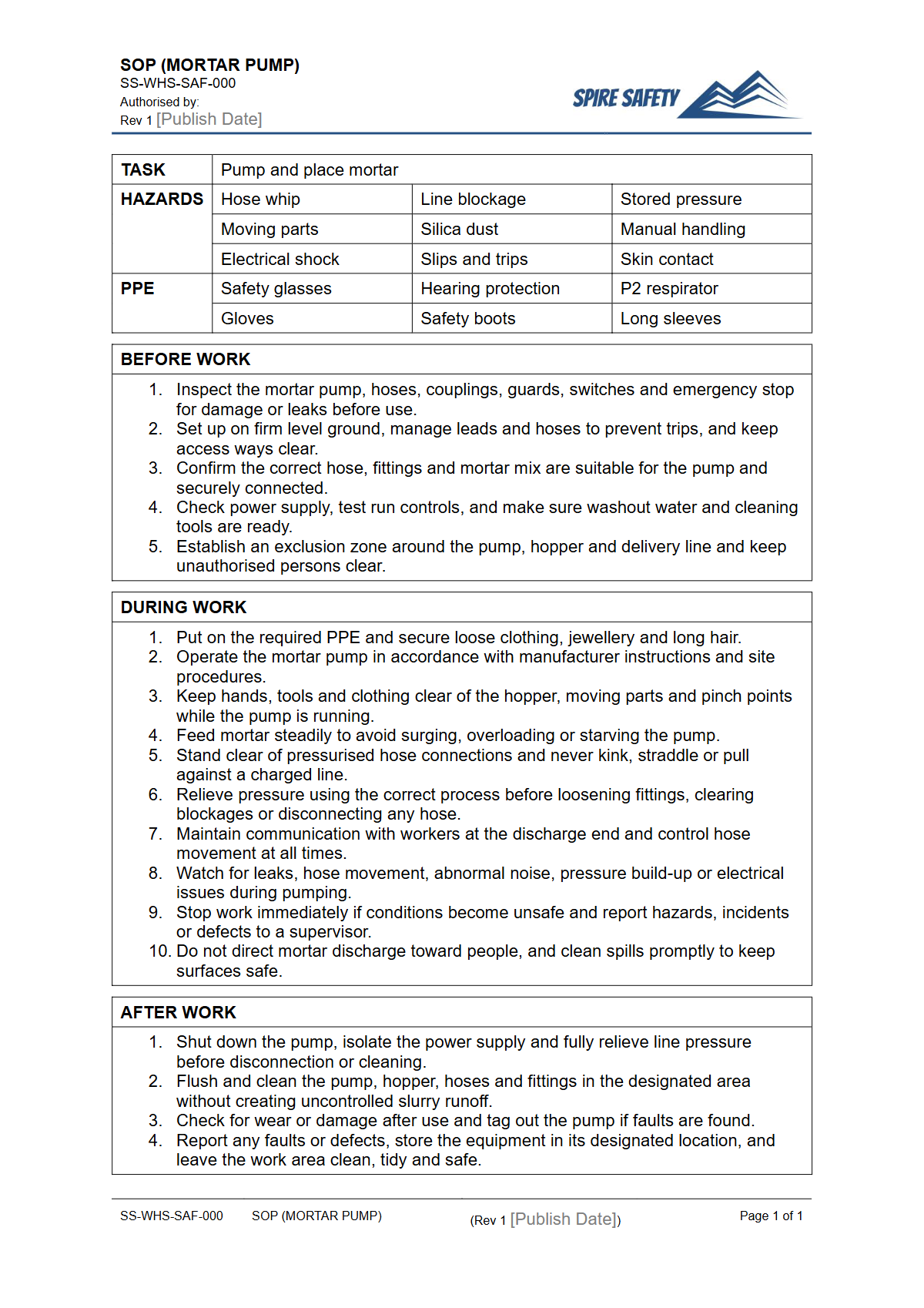
Purpose of the Free Safe Operating Procedure (Mortar Pump) Template
Operating a mortar pump involves significant risks, including high-pressure injection injuries, mechanical entanglement, and exposure to hazardous materials. This Free Safe Operating Procedure (Mortar Pump) Template provides a structured framework for documenting the required steps to operate this machinery safely.
It is an essential administrative control measure that helps your organisation meet its duty of care by outlining potential hazards, defining pre-start checks, detailing safe operational steps, and establishing emergency protocols. A well-developed SOP is a cornerstone of worker training, competency assessment, and ongoing supervision, ensuring tasks are performed consistently and safely every time.
Using this template as a starting point helps formalise your safety processes, reducing the likelihood of incidents and demonstrating a proactive approach to risk management. It complements your broader safety system by providing clear, task-specific instructions that operators can follow.
For similar machinery, you may also find our free Boom Pump SOP a useful reference for managing pumped materials on site.
Video walkthrough
How to use the Free Safe Operating Procedure (Mortar Pump) Template
This document is designed to be a comprehensive starting point, not a final product. To make it effective, you must adapt it to your specific operational context.
Download the DOCX file and systematically work through each section, consulting with operators and supervisors who use the equipment daily. Their direct experience is invaluable for identifying practical hazards and effective controls.
Key customisation steps include:
- Adding the specific make and model of the mortar pump(s) used at your workplace.
- Detailing site-specific hazards and environmental conditions.
- Listing the exact Personal Protective Equipment (PPE) required for mixing, operating, and cleaning.
- Incorporating your organisation’s specific emergency contacts and procedures.
- Ensuring the steps align with the manufacturer's operating manual.
Important: This template provides a structured foundation based on Australian WHS principles, but it must be customised to your workplace. We strongly recommend you edit every section to reflect your unique machinery, tasks, risks, and control measures.
A generic, uncustomised SOP offers little practical safety value and may not adequately address your legal obligations.
Once customised, the SOP should be formally approved, and all relevant personnel must be trained on its contents. Regular reviews and updates are also necessary to keep it relevant.
Integrating this process within a comprehensive WHS management system ensures that procedures like this are consistently maintained and improved over time.
When to use it
A mortar pump SOP should be a living document, actively used in daily operations. It is not a 'file and forget' compliance document. Use it:
- Before any operation: As a checklist for pre-start inspections to ensure the pump and its components are in safe working order.
- During training: As a primary training document for new operators to learn the correct, safe sequence of tasks.
- For competency assessments: As a benchmark to verify that an operator can perform the task as required by the procedure.
- As a reference tool: Supervisors and operators should have easy access to it to clarify steps or safety requirements on the job.
- After an incident: As a key document to review during an incident investigation to determine if procedural gaps contributed to the event.
For equipment often found on the same worksites, consider developing similar procedures using our Telehandler SOP or Air Compressor SOP templates.
Who should use it
Multiple roles within an organisation have a responsibility to engage with this Safe Operating Procedure to ensure its effectiveness. This collaborative approach reinforces a positive safety culture.
- Operators: The primary users who must follow the procedure for every task involving the mortar pump. They should be involved in its development and review to ensure it is practical and clear.
- Supervisors and Forepersons: Responsible for ensuring operators are trained on and adhere to the SOP. They must enforce its use and provide supervision.
- WHS Managers/Advisors: Responsible for facilitating the development, review, and integration of the SOP into the broader safety management system. They may also lead training sessions on the procedure.
- Maintenance Personnel: Must be familiar with the SOP, particularly sections related to safe isolation, cleaning, and preparation for maintenance tasks.
By ensuring all relevant parties understand and use the SOP, your organisation creates multiple layers of defence against potential incidents. Spire Safety can assist with the implementation and review of your safety documents through our WHS consulting services, helping you build a robust and practical safety framework.
Common mistakes
Common mistakes to avoid
- Using a generic SOP without customising it for the specific pump and worksite.
- Failing to conduct and document pre-start operational checks before each use.
- Attempting to clear blockages or perform maintenance while the system is still under pressure.
- Neglecting to wear appropriate Personal Protective Equipment (PPE), especially eye and skin protection.
Legal references
Legal considerations
The following legal requirements may be relevant to this type of work.
- Work Health and Safety Act (Harmonised) — Provides the primary duties for protecting workers and other people from work health and safety risks.
- Work Health and Safety Regulations (Harmonised) — Sets out requirements supporting the management of workplace hazards and risks.
The following codes may be relevant to this type of work.
- Managing WHS Risks Code of Practice — Provides practical guidance on identifying hazards, assessing risks and applying effective controls.
- Work Health and Safety Consultation, Cooperation and Coordination Code of Practice — Provides practical guidance on consulting workers and coordinating with other duty holders.
- Managing the Work Environment and Facilities Code of Practice — Provides practical guidance on safe work environments, workplace facilities and related controls.
Did you know
Pressure Hazard
Mortar and concrete pumps can generate extremely high pressures, capable of injecting material through skin and causing severe injuries. This is why strict exclusion zones and correct handling are critical.
Blockage Risks
Blockages are a common operational hazard with mortar pumps. The stored energy in a pressurised, blocked hose can release violently if cleared improperly, posing a serious risk to operators.
FAQ
Frequently asked questions
01What should be included in a mortar pump SOP?
02How often should a Safe Operating Procedure be reviewed?
03Is an SOP enough to ensure mortar pump safety?
04Can a generic SOP be used for all mortar pumps?
Share this resource
Free Safe Operating Procedure (Mortar Pump) Template
Browse Categories
How To Use It
- 1Download and open in Word or PDF.
- 2Replace the placeholders with your business details.
- 3Get it reviewed by a WHS specialist before rollout.
Need it customised?
Our WHS consultants can adapt this template to your site, run a gap analysis, or audit what you already have in place.
Book a Free Consultation WHS consulting servicesor call 1300 156 382
Related templates
- Free Safe Operating Procedure (Mortising Machine) Template
- Free Safe Operating Procedure (Motel Room Turnaround) Template
- Free Safe Operating Procedure (Mould Surface Treatment) Template
- Free Safe Operating Procedure (Moving Walkway) Template
- Free Safe Operating Procedure (Mud Mixing System) Template
- Free Safe Operating Procedure (Mud Pump) Template