
Free Safe Operating Procedure (Mould Surface Treatment) Template
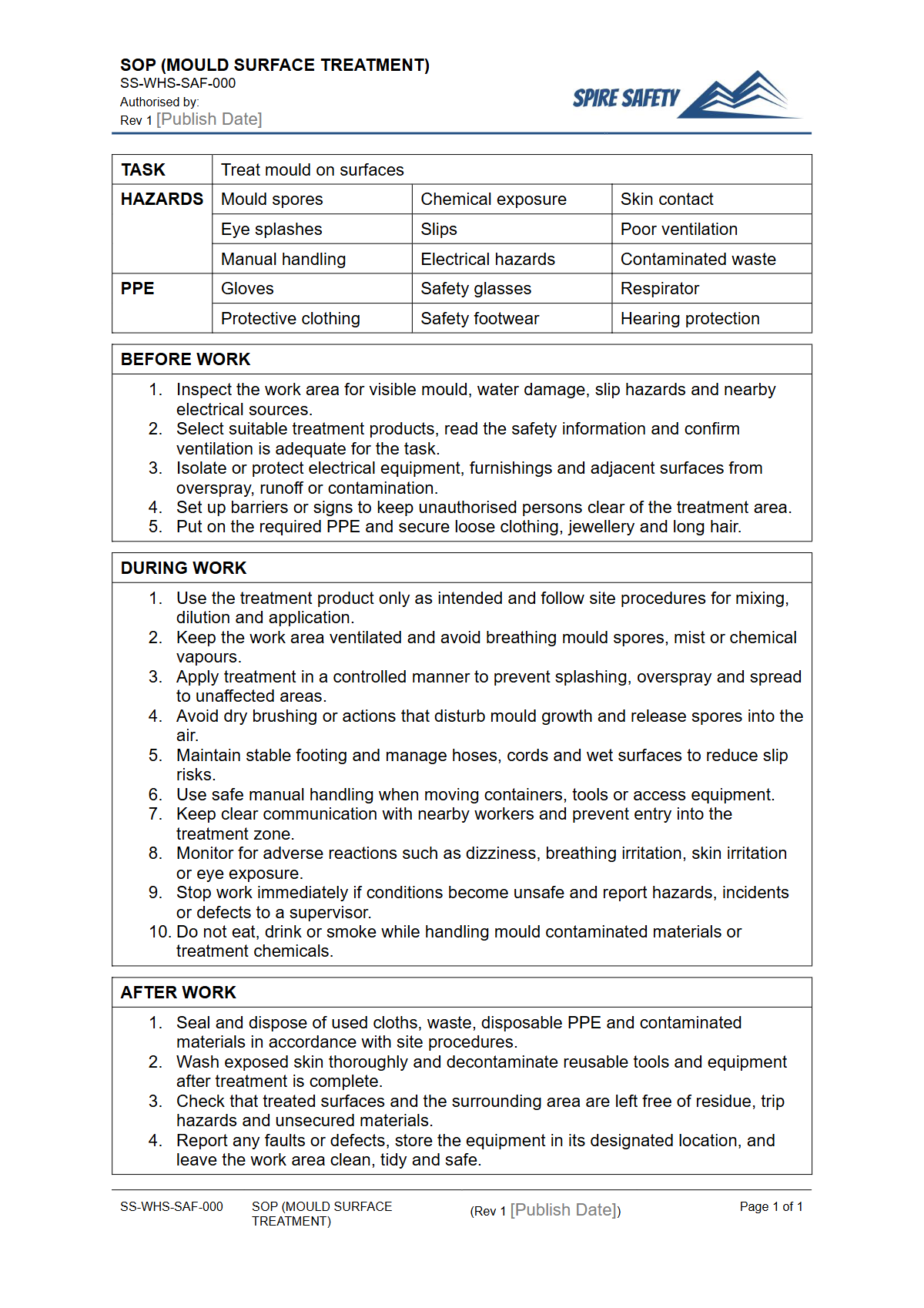
Download our Free Safe Operating Procedure (Mould Surface Treatment) Template. This document provides a structured framework for safely managing mould hazards.
Free Safe Operating Procedure (Mould Surface Treatment) Template
DOCX • 126 KB + PDF
Updated Oct 2026
No signup required
Purpose of the Free Safe Operating Procedure (Mould Surface Treatment) Template
Effectively managing mould requires a systematic approach to protect workers and building occupants from biological and chemical hazards. Our Free Safe Operating Procedure (Mould Surface Treatment) Template provides a structured starting point for organisations to develop a site-specific procedure.
This document helps you outline the essential steps for identifying hazards, controlling risks, and performing mould remediation tasks safely. It is aligned with Australian WHS principles and designed to be adapted to your unique operational needs.
Using this template helps ensure that all aspects of the job are considered, from initial assessment and containment to the safe use of chemicals and final cleanup. Documenting your process is a key part of demonstrating WHS due diligence and providing clear, unambiguous instructions to your workers.
Properly managing mould not only protects health but also prevents long-term damage to building materials.
How to use the Free Safe Operating Procedure (Mould Surface Treatment) Template
This resource is available as a DOCX file for easy editing and a PDF for universal access. To use the template effectively, you should download the DOCX version and thoroughly adapt it to your workplace.
It's crucial to replace all placeholder text, such as [Your Company Name] and [Specific Chemical Name], with details relevant to your specific task. Remember, this document is a template, not a completed procedure.
Important Note: We have created this template as a guide. You must customise it to reflect the specific equipment, chemicals, site conditions, and control measures unique to your workplace.
The final SOP should be integrated into your overall WHS management systems and used as a tool for training and supervision.
Video walkthrough
When to Use a Mould Treatment SOP
A Safe Operating Procedure for mould treatment should be used whenever workers are required to remediate mould on surfaces. This applies to a wide range of scenarios, from minor cleaning of isolated mould patches in a commercial kitchen to large-scale abatement projects following significant water damage.
It is particularly important when using specialised biocides or fungicides where incorrect use could pose a significant health risk.
For large or complex remediation projects, it's good practice to have the process and its outcomes validated. A formal review can ensure controls are effective and compliance is maintained, often forming part of a scheduled WHS compliance auditing program.
This SOP is intended for surface treatment; significant structural contamination may require consultation with an occupational hygienist and more extensive engineering controls.
Who Should Use It
This template is designed for any Person Conducting a Business or Undertaking (PCBU) whose workers perform mould remediation tasks. This includes facilities managers, maintenance supervisors, property management companies, and specialised cleaning or restoration contractors.
WHS managers and coordinators will find it a valuable tool for formalising safety protocols and meeting their obligations under WHS legislation.
The finalised SOP should be read, understood, and followed by all personnel involved in the treatment process. It serves as a critical training document to ensure every worker, from the team leader to the operator, understands the risks and the required safety measures.
If the remediation involves cutting away contaminated building materials, workers must also be trained on the tools used, with separate procedures like our FREE Circular Saw SOP Template being essential.
A well-documented procedure demonstrates a commitment to health and safety. Every distinct task within your organisation should have a similar, specific procedure.
For example, the detailed steps for sanitation in a food service environment would be captured in a document like our Safe Operating Procedure for a deep fryer, showcasing how procedures are tailored to the specific hazard. You can find more examples across various industries in our free WHS resources library.
Common mistakes
Common mistakes to avoid
- Failing to identify and rectify the underlying moisture source, leading to rapid regrowth.
- Using incorrect or insufficient Personal Protective Equipment (PPE), especially respiratory protection.
- Inadequate containment, allowing mould spores to spread to other areas of the building.
- Using inappropriate chemicals (e.g., bleach on porous surfaces) that are ineffective or create new hazards.
Legal references
Legal considerations
The following legal requirements may be relevant to this type of work.
- Work Health and Safety Act (Harmonised) — Provides the primary duties for protecting workers and other people from work health and safety risks.
- Work Health and Safety Regulations (Harmonised) — Sets out requirements supporting the management of workplace hazards and risks.
The following codes may be relevant to this type of work.
- Managing WHS Risks Code of Practice — Provides practical guidance on identifying hazards, assessing risks and applying effective controls.
- Work Health and Safety Consultation, Cooperation and Coordination Code of Practice — Provides practical guidance on consulting workers and coordinating with other duty holders.
- Managing the Work Environment and Facilities Code of Practice — Provides practical guidance on safe work environments, workplace facilities and related controls.
Did you know
Not Just an Eyesore
Some mould species produce mycotoxins, which are toxic compounds that can cause serious health effects. Effective containment and removal are critical to prevent occupant and worker exposure.
Water Is the Source
Mould cannot grow without moisture. The most critical step in preventing recurrence is identifying and fixing the source of water intrusion or dampness that is feeding the growth.
FAQ
Frequently asked questions
01Is this mould treatment SOP suitable for all types of mould?
02What PPE is required for mould surface treatment?
03Do I need to be a professional to use this template?
04Can I use household bleach for mould treatment?
Share this resource
Free Safe Operating Procedure (Mould Surface Treatment) Template
Browse Categories
How To Use It
- 1Download and open in Word or PDF.
- 2Replace the placeholders with your business details.
- 3Get it reviewed by a WHS specialist before rollout.
Need it customised?
Our WHS consultants can adapt this template to your site, run a gap analysis, or audit what you already have in place.
Book a Free Consultation WHS consulting servicesor call 1300 156 382
Related templates
- Free Safe Operating Procedure (Moving Walkway) Template
- Free Safe Operating Procedure (Mud Mixing System) Template
- Free Safe Operating Procedure (Mud Pump) Template
- Free Safe Operating Procedure (Mulch Bed Maintenance) Template
- Free Safe Operating Procedure (Mulch Handling) Template
- Free Safe Operating Procedure (Mulch Spreading) Template