
Free Safe Operating Procedure (Moving Walkway) Template
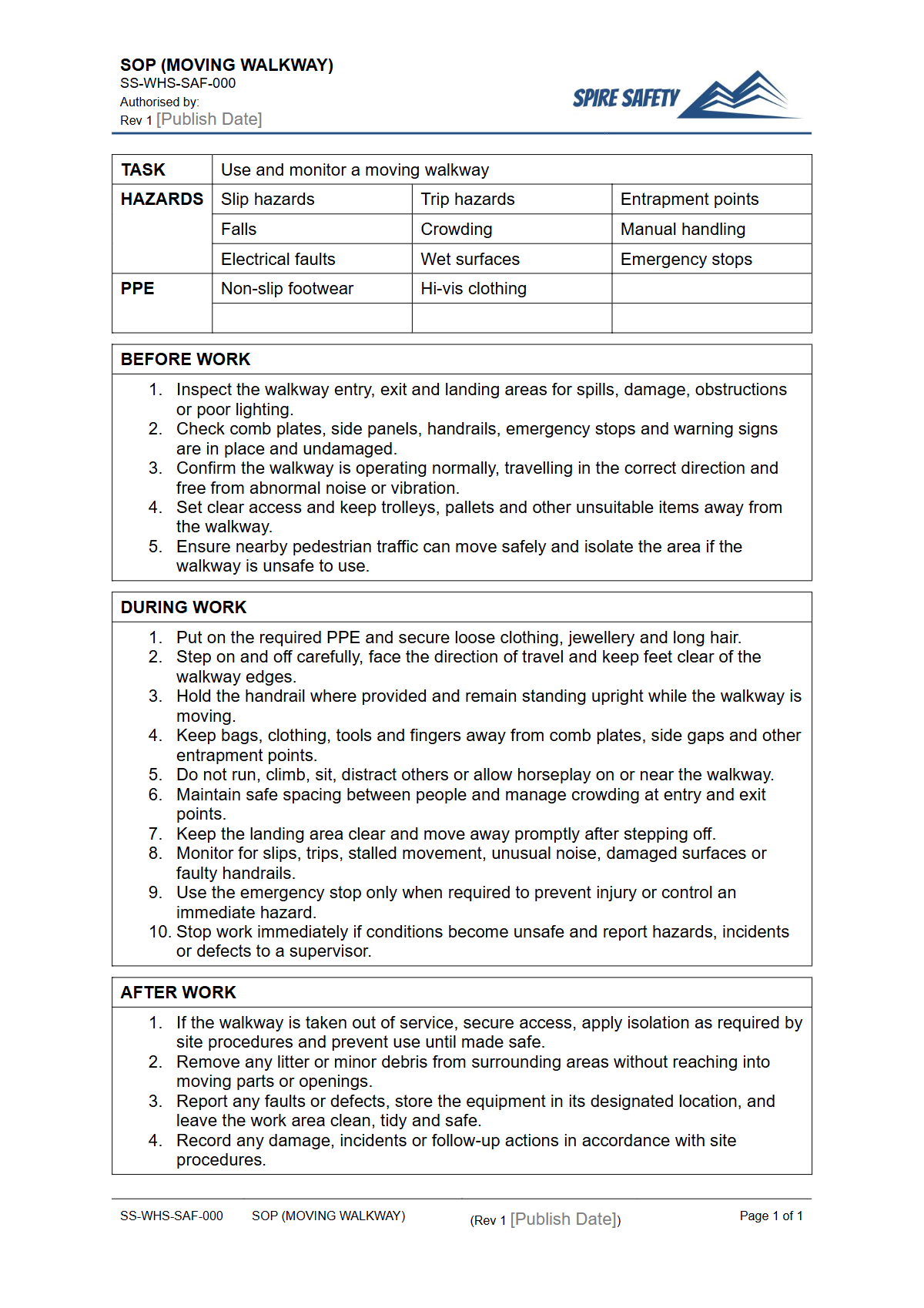
Manage risks associated with moving walkways using our free template. Download our Safe Operating Procedure for moving walkways to get started.
Free Safe Operating Procedure (Moving Walkway) Template
DOCX • 126 KB + PDF
Updated Oct 2026
No signup required
Purpose of the Free Safe Operating Procedure (Moving Walkway) Template
A Safe Operating Procedure (SOP) for a moving walkway is a critical safety document that provides clear, step-by-step instructions for its safe use. Moving walkways, also known as travelators, present risks such as slips, trips, falls, and potential entrapment.
The primary purpose of this procedure is to standardise operations and minimise these risks for both workers and the public. This Free Safe Operating Procedure (Moving Walkway) Template serves as a structured starting point for your organisation to document its specific safety protocols, control measures, and emergency responses.
Implementing robust SOPs is a fundamental part of an effective safety framework, helping to build a positive safety culture. These procedures are key components of broader WHS management systems, ensuring that risks are consistently managed across the organisation.
Video walkthrough
How to use the Free Safe Operating Procedure (Moving Walkway) Template
To begin, download the template in your preferred format. The DOCX file allows for easy editing and customisation, while the PDF version serves as a fixed reference.
The document is logically structured to guide you through defining responsibilities, outlining pre-operational checks, detailing safe operating steps, and specifying emergency actions. Because moving walkways are a specific type of horizontal transport, you may also find our FREE Conveyer System SOP a useful reference for similar principles.
For expert assistance in adapting this template and ensuring it aligns perfectly with your operational needs, consider engaging professional WHS consulting services.
Important: It is essential to recognise that this document is a guide, not a finished procedure. We strongly advise that you customise it to reflect the specific moving walkway models, workplace layout, and unique environmental factors of your site.
Your final SOP must be based on a thorough, site-specific risk assessment and consultation with your workers.
When to use a Safe Operating Procedure
An SOP for a moving walkway should be a living document used in several key situations. It is essential during the induction and training of new employees who may work near or be responsible for the equipment.
It also serves as the basis for refresher training to ensure standards are maintained. The SOP should be readily accessible as a daily reference for workers and supervisors.
It becomes particularly crucial following an incident or near-miss, providing a benchmark against which to review and improve existing practices. Furthermore, documented procedures like this are vital evidence of systematic risk management during a WHS compliance auditing process.
Who should use this Safe Operating Procedure
This Safe Operating Procedure template is designed for a range of personnel within an organisation. A Person Conducting a Business or Undertaking (PCBU), such as a building owner or facilities manager, will use it to fulfil their primary duty of care.
WHS Managers and Safety Officers will use it to develop, implement, and review safety systems. Supervisors will use the finalised procedure to train and oversee workers, ensuring they adhere to the established safety protocols.
Finally, workers themselves should be familiar with the SOP to understand the correct procedures for use, cleaning, and how to respond in an emergency. For additional tools to support your safety management efforts, explore our complete free WHS resources library.
Common mistakes
Common mistakes to avoid
- Using the template 'as-is' without conducting a site-specific risk assessment to add relevant details.
- Failing to adequately train all relevant workers and supervisors on the final, customised procedure.
- Omitting clear instructions for emergency procedures, including the location and use of all stop buttons.
- Not placing appropriate visual signage near the walkway for public users (e.g., 'Hold Handrail', 'No Trolleys').
Legal references
Legal considerations
The following legal requirements may be relevant to this type of work.
- Work Health and Safety Act (Harmonised) — Provides the primary duties for protecting workers and other people from work health and safety risks.
- Work Health and Safety Regulations (Harmonised) — Sets out requirements supporting the management of workplace hazards and risks.
The following codes may be relevant to this type of work.
- Managing WHS Risks Code of Practice — Provides practical guidance on identifying hazards, assessing risks and applying effective controls.
- Work Health and Safety Consultation, Cooperation and Coordination Code of Practice — Provides practical guidance on consulting workers and coordinating with other duty holders.
- Managing the Work Environment and Facilities Code of Practice — Provides practical guidance on safe work environments, workplace facilities and related controls.
Did you know
The 'Trottoir Roulant'
The first moving walkway debuted at the 1900 Paris Exposition. It was a major attraction, featuring a slow-moving and a fast-moving section for fairgoers to navigate the expansive grounds.
FAQ
Frequently asked questions
01What's the main difference between a moving walkway and an escalator?
02Does this SOP cover detailed maintenance and repair work?
03Who is responsible for enforcing the moving walkway SOP?
04How often should we review our Moving Walkway SOP?
Share this resource
Free Safe Operating Procedure (Moving Walkway) Template
Browse Categories
How To Use It
- 1Download and open in Word or PDF.
- 2Replace the placeholders with your business details.
- 3Get it reviewed by a WHS specialist before rollout.
Need it customised?
Our WHS consultants can adapt this template to your site, run a gap analysis, or audit what you already have in place.
Book a Free Consultation WHS consulting servicesor call 1300 156 382
Related templates
- Free Safe Operating Procedure (Mud Mixing System) Template
- Free Safe Operating Procedure (Mud Pump) Template
- Free Safe Operating Procedure (Mulch Bed Maintenance) Template
- Free Safe Operating Procedure (Mulch Handling) Template
- Free Safe Operating Procedure (Mulch Spreading) Template
- Free Safe Operating Procedure (Mulcher) Template