
Free Safe Operating Procedure (Mortising Machine) Template
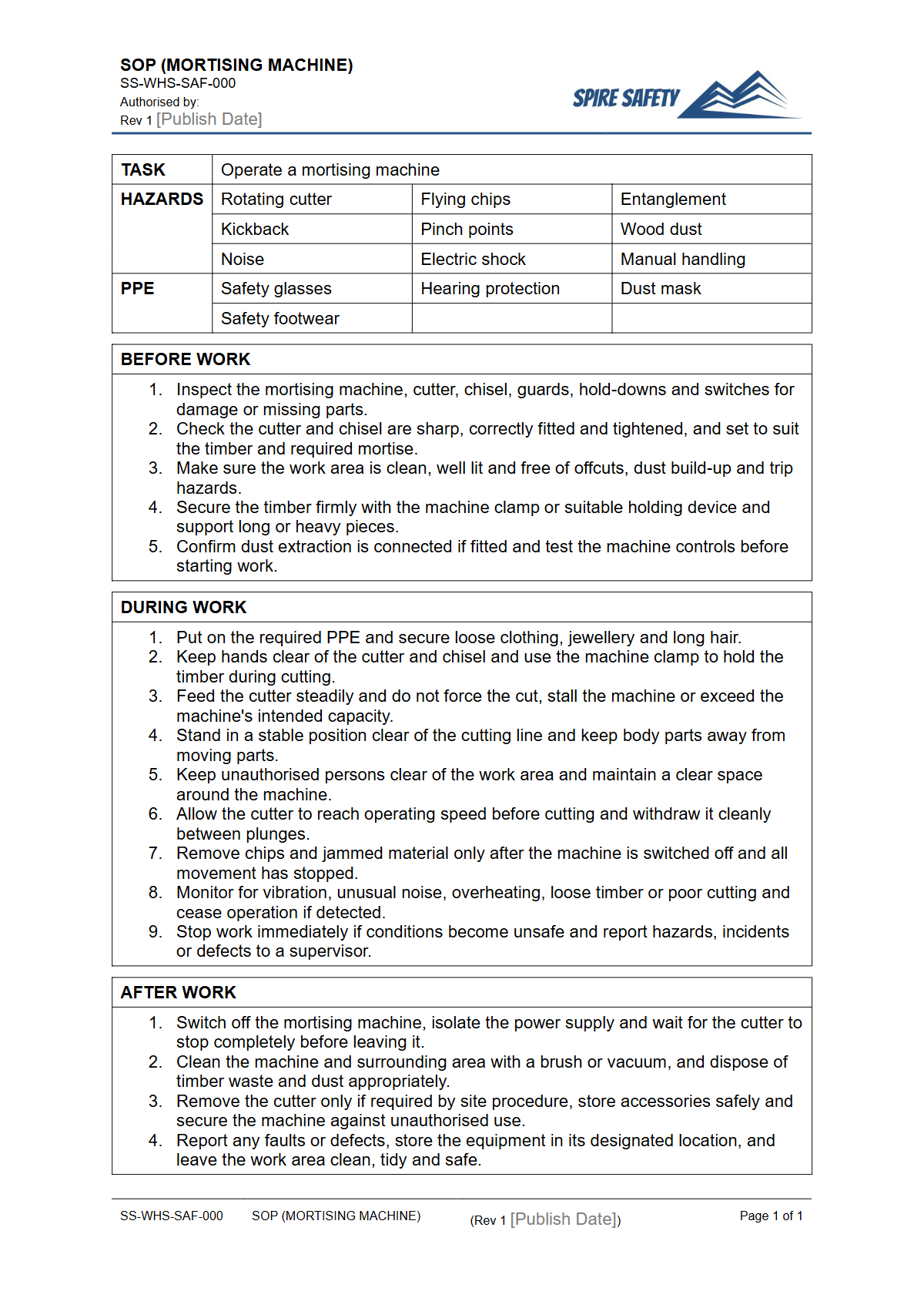
Formalise safe work methods for mortising machines with our free Safe Operating Procedure template.
Free Safe Operating Procedure (Mortising Machine) Template
DOCX • 126 KB + PDF
Updated Oct 2026
No signup required
Purpose of the Free Safe Operating Procedure (Mortising Machine) Template
This free Safe Operating Procedure (Mortising Machine) template provides a structured starting point for documenting the risks and controls associated with operating mortisers in your workplace. Mortising machines, whether chisel, chain, or hollow chisel models, present significant hazards including entanglement, lacerations from sharp components, and injuries from ejected woodchips or broken parts.
Implementing a formal SOP helps a Person Conducting a Business or Undertaking (PCBU) fulfil their duty of care by establishing a clear, repeatable, and safe method of work.
A well-developed SOP is a critical tool for worker training, competency assessment, and operational consistency. It standardises the expected safety behaviour and performance for all operators, reducing the likelihood of incidents caused by procedural errors or shortcuts.
Integrating this document into your broader WHS management systems demonstrates a proactive approach to risk management. For other common woodworking equipment, our FREE Circular Saw SOP provides a similar framework.
What is a Safe Operating Procedure?
A Safe Operating Procedure (SOP) is a written document that provides step-by-step instructions on how to perform a task safely. It identifies the hazards associated with the task and outlines the control measures required to eliminate or minimise those risks.
An SOP for a mortising machine should cover everything from pre-operational checks and personal protective equipment (PPE) to correct operating techniques, emergency shutdown, and routine cleaning and maintenance.
Video walkthrough
How to use the Free Safe Operating Procedure (Mortising Machine) Template
Our template is designed for ease of use. Simply download the DOCX file and open it in your preferred word processor.
The document is logically structured with sections for you to complete, including required PPE, pre-start safety checks, operational steps, and post-operational procedures. Review each section carefully and replace the placeholder text with information specific to your equipment and operational environment.
Important: This template is a guide only. It is not a complete, ready-to-use document.
We provide it as a starting point, but you are responsible for ensuring the final SOP is customised to reflect the specific model of mortising machine, the tasks performed, the materials used, and the unique hazards present in your workplace. If you require assistance with complex risk assessments or SOP development, engaging professional WHS consulting services can provide expert guidance.
When to use a Mortising Machine SOP
A Safe Operating Procedure for a mortising machine is not a 'set and forget' document. It should be actively used in day-to-day operations and integrated into your safety management lifecycle. Key times to use the SOP include:
- Induction and Training: When inducting new employees or training them on how to use the mortising machine for the first time.
- Pre-Operational Checks: As a reference guide for operators to ensure all safety checks are completed before starting work.
- Competency Assessments: To assess an operator's ability to use the machine safely and in accordance with established procedures.
- Incident Investigations: As a benchmark for expected procedure following a near miss or incident, helping to identify any procedural gaps or non-conformance.
- Audits and Reviews: During internal or external safety audits to demonstrate that safe systems of work are documented and in place. Regular reviews are essential for maintaining safety standards, often verified through WHS compliance auditing.
Who should use this Safe Operating Procedure
This SOP is intended for several key roles within an organisation to ensure a consistent and safe approach to operating mortising machines:
- Operators: The primary users of the SOP. They must read, understand, and follow the documented procedures every time they use the equipment.
- Supervisors and Managers: Responsible for ensuring operators are trained on the SOP, that procedures are being followed correctly, and for conducting regular reviews and updates.
- WHS/OHS Personnel: Use the SOP as a tool for risk management, training development, and compliance monitoring. They are often responsible for drafting, reviewing, and authorising the document.
- Maintenance Staff: Refer to the SOP for lockout/tagout procedures and other safety requirements before performing maintenance, adjustments, or repairs.
In any workshop environment, multiple pieces of equipment contribute to the overall risk profile. Alongside your mortiser SOP, consider documenting procedures for other plant, such as by using our Free Air Compressor SOP. To see our full range of customisable templates, browse our free WHS resources library.
Common mistakes
Common mistakes to avoid
- Failing to securely clamp the workpiece, leading to it moving or being ejected during operation.
- Using dull or damaged chisels, bits, or chains, which increases force requirements and the risk of kickback.
- Neglecting to adjust depth stops and fences correctly for the specific task.
- Attempting to clear jams or make adjustments without fully isolating the machine from its power source.
Legal references
Legal considerations
The following legal requirements may be relevant to this type of work.
- Work Health and Safety Act (Harmonised) — Provides the primary duties for protecting workers and other people from work health and safety risks.
- Work Health and Safety Regulations (Harmonised) — Sets out requirements supporting the management of workplace hazards and risks.
The following codes may be relevant to this type of work.
- Managing WHS Risks Code of Practice — Provides practical guidance on identifying hazards, assessing risks and applying effective controls.
- Work Health and Safety Consultation, Cooperation and Coordination Code of Practice — Provides practical guidance on consulting workers and coordinating with other duty holders.
- Managing the Work Environment and Facilities Code of Practice — Provides practical guidance on safe work environments, workplace facilities and related controls.
Did you know
Ancient Joinery
The mortise and tenon joint, which mortising machines are designed to create, is an ancient woodworking technique. Examples have been found in Egyptian furniture dating back over 4,000 years.
Chisel vs. Chain
Hollow chisel mortisers are known for creating clean, square-cornered mortises, while chain mortisers excel at quickly removing large amounts of material for bigger joints, often seen in timber framing.
FAQ
Frequently asked questions
01What key information should be in a mortising machine SOP?
02How often should a Safe Operating Procedure for a mortiser be reviewed?
03Is a Safe Operating Procedure a legal requirement in Australia?
04Can this template be used for all types of mortising machines?
Share this resource
Free Safe Operating Procedure (Mortising Machine) Template
Browse Categories
How To Use It
- 1Download and open in Word or PDF.
- 2Replace the placeholders with your business details.
- 3Get it reviewed by a WHS specialist before rollout.
Need it customised?
Our WHS consultants can adapt this template to your site, run a gap analysis, or audit what you already have in place.
Book a Free Consultation WHS consulting servicesor call 1300 156 382
Related templates
- Free Safe Operating Procedure (Motel Room Turnaround) Template
- Free Safe Operating Procedure (Mould Surface Treatment) Template
- Free Safe Operating Procedure (Moving Walkway) Template
- Free Safe Operating Procedure (Mud Mixing System) Template
- Free Safe Operating Procedure (Mud Pump) Template
- Free Safe Operating Procedure (Mulch Bed Maintenance) Template