
Free Safe Operating Procedure (Mooring Line Handling) Template
Document safe work steps for mooring operations with our free Safe Operating Procedure template.
Free Safe Operating Procedure (Mooring Line Handling) Template
DOCX • 126 KB + PDF
Updated Oct 2026
No signup required
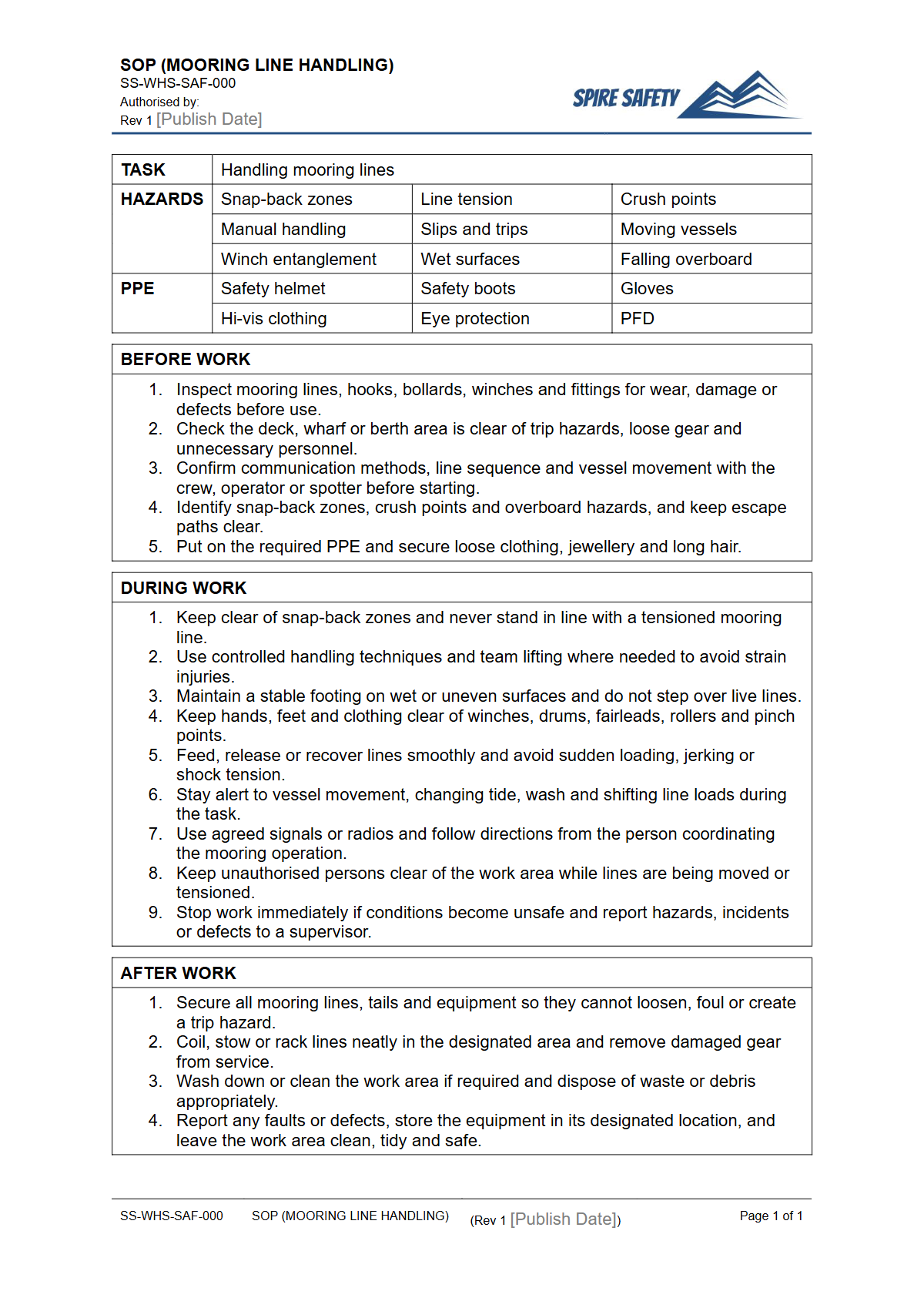
Purpose of the Free Safe Operating Procedure (Mooring Line Handling) Template
Mooring and unmooring operations are high-risk activities inherent to the maritime industry, responsible for numerous serious injuries and fatalities. This free Safe Operating Procedure (Mooring Line Handling) Template provides a structured framework for documenting the required safety controls for these tasks.
Formalising your process helps to manage critical hazards such as snap-back zones, trips, falls, and crush injuries from lines and machinery. A well-defined SOP is an essential tool for training personnel, standardising safe work practices across crews, and demonstrating due diligence in managing workplace risks.
Video walkthrough
How to use the Free Safe Operating Procedure (Mooring Line Handling) Template
Download the template in your preferred format (DOCX for easy editing or PDF) and begin customising it for your specific operational context. This document serves as a comprehensive starting point, aligned with Australian WHS principles, but it is not a complete, out-of-the-box solution.
To be effective, the SOP must reflect the reality of your workplace.
Important: It is crucial to adapt this template to the specific vessels, mooring equipment (winches, capstans, lines), environmental conditions, and personnel at your workplace. We have provided a framework, but you must complete a thorough risk assessment and detail the precise procedures relevant to your operations in consultation with your workers.
Key Elements of a Mooring Line SOP
A robust SOP for mooring line handling should be clear, concise, and actionable. When customising the template, ensure you address these critical areas:
- Roles and Responsibilities: Clearly define who is responsible for each part of the operation, from the master or pilot to the mooring party supervisor and deckhands.
- Communication: Detail the communication protocols and terminology to be used between the bridge, deck, and shore-side personnel. Specify hand signals or radio channels.
- Hazard Identification: List all potential hazards, with a strong focus on snap-back zones. Your procedure should include a diagram showing the specific snap-back danger zones for your vessel's mooring configuration.
- Step-by-Step Procedures: Provide sequential instructions for each phase of the operation: pre-mooring checks, sending lines ashore, heaving on lines, securing to bitts, and casting off.
- Personal Protective Equipment (PPE): Specify the mandatory PPE for all personnel involved, which typically includes a hard hat, high-visibility clothing, safety-toed boots, and gloves.
- Emergency Procedures: Outline the immediate actions to take in case a line parts, a person falls overboard, or another emergency occurs during the operation.
For operations involving heavy plant, such as those in a busy port environment, it may be beneficial to integrate procedures for other equipment. As an example, a comprehensive safety system could also include a Telehandler SOP for related materials handling tasks.
Integrating the SOP into Your Safety System
A Safe Operating Procedure is most effective when it is a living document within a broader safety framework. It should not be written once and filed away.
Integrate this SOP into your comprehensive WHS management systems by making it a central part of worker training, inductions for new crew members, and pre-task risk assessments like toolbox talks. Regularly review and update the SOP, especially after any incident or near miss, when new equipment is introduced, or when mooring configurations change.
In many industrial settings, other procedures like an Air Compressor SOP are also critical components of the overall safety system.
Review and Verification
Under Australian WHS law, a Person Conducting a Business or Undertaking (PCBU) has a primary duty of care to ensure the health and safety of workers. Having a documented, implemented, and regularly reviewed SOP is a practical way to demonstrate how risks are being managed.
Periodic verification ensures the procedure is still relevant and being followed correctly by workers. This can be done through direct observation, team discussions, or as part of a formal WHS compliance auditing program, which provides an independent assessment of your safety practices.
The same principles apply to other complex machinery, where a Conveyer System SOP would be similarly integrated and reviewed.
By implementing and maintaining a specific SOP for mooring line handling, you create a safer, more predictable, and more organised work environment. Explore our free WHS resources library for more templates to support your safety management system.
Common mistakes
Common mistakes to avoid
- Standing in the bight of a rope or within marked snap-back zones.
- Poor or unclear communication between the vessel, linesmen, and assisting tugs.
- Using damaged or poorly maintained mooring lines, wires, and deck equipment.
- Handling lines without appropriate personal protective equipment (PPE), especially gloves and hard hats.
Legal references
Legal considerations
The following legal requirements may be relevant to this type of work.
- Work Health and Safety Act (Harmonised) — Provides the primary duties for protecting workers and other people from work health and safety risks.
- Work Health and Safety Regulations (Harmonised) — Sets out requirements supporting the management of workplace hazards and risks.
The following codes may be relevant to this type of work.
- Managing WHS Risks Code of Practice — Provides practical guidance on identifying hazards, assessing risks and applying effective controls.
- Work Health and Safety Consultation, Cooperation and Coordination Code of Practice — Provides practical guidance on consulting workers and coordinating with other duty holders.
- Managing the Work Environment and Facilities Code of Practice — Provides practical guidance on safe work environments, workplace facilities and related controls.
Did you know
Snap-Back Dangers
A synthetic mooring line under heavy tension can store immense energy. If it parts, it can snap back at speeds exceeding 700 km/h, far too fast for a person to react.
Rope Material Matters
The material of a mooring line (e.g., nylon, polyester, polypropylene, or steel wire) significantly affects its strength, elasticity, and snap-back behaviour, requiring different handling procedures and safety zones.
FAQ
Frequently asked questions
01What is a snap-back zone in mooring operations?
02How often should a Mooring Line Handling SOP be reviewed?
03Who is responsible for developing a Safe Operating Procedure for mooring?
04Can this SOP template be used for all types of vessels?
Share this resource
Free Safe Operating Procedure (Mooring Line Handling) Template
Browse Categories
How To Use It
- 1Download and open in Word or PDF.
- 2Replace the placeholders with your business details.
- 3Get it reviewed by a WHS specialist before rollout.
Need it customised?
Our WHS consultants can adapt this template to your site, run a gap analysis, or audit what you already have in place.
Book a Free Consultation WHS consulting servicesor call 1300 156 382
Related templates
- Free Safe Operating Procedure (Mooring Winch) Template
- Free Safe Operating Procedure (Mortar Mixer) Template
- Free Safe Operating Procedure (Mortar Pump) Template
- Free Safe Operating Procedure (Mortising Machine) Template
- Free Safe Operating Procedure (Motel Room Turnaround) Template
- Free Safe Operating Procedure (Mould Surface Treatment) Template