
Free Safe Operating Procedure (Moisture Meter) Template
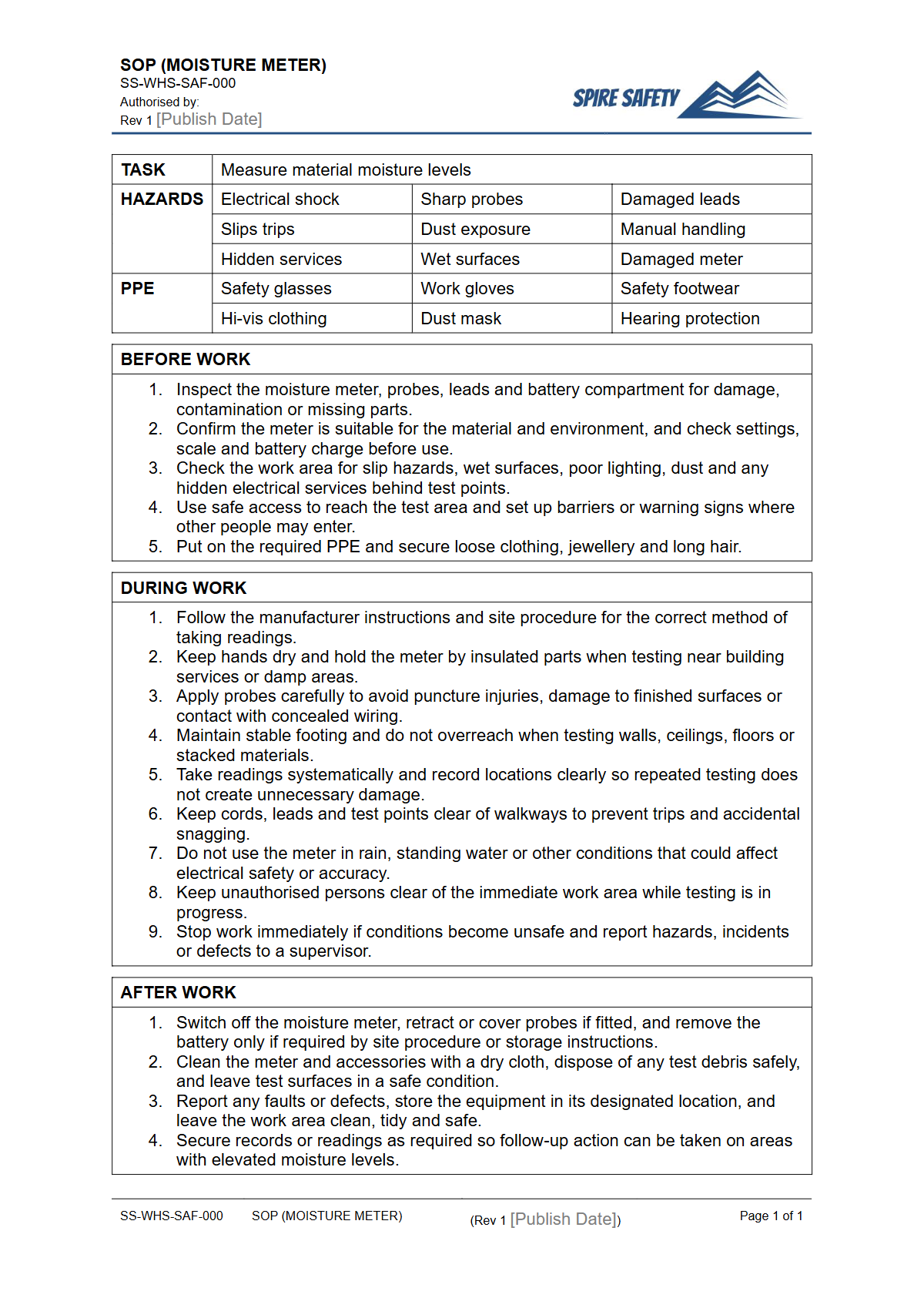
Download our free Safe Operating Procedure template for moisture meters. This customisable document helps outline safety steps for your workplace.
Free Safe Operating Procedure (Moisture Meter) Template
DOCX • 126 KB + PDF
Updated Oct 2026
No signup required
Purpose of the Free Safe Operating Procedure (Moisture Meter) Template
A moisture meter is a common tool in construction, restoration, and agriculture, used to detect water content in materials. While it may seem simple, its use involves potential hazards that require a formalised process to manage.
This Free Safe Operating Procedure (Moisture Meter) Template provides a structured starting point for organisations to document safe work methods, manage risks, and ensure consistent training for all operators. Using an SOP helps fulfil the duty of care required under Australian WHS laws by demonstrating a commitment to safe systems of work.
This template guides you in outlining the necessary pre-operational checks, step-by-step instructions for safe operation, and post-use maintenance. It helps standardise the task, reducing the likelihood of accidents, equipment damage, or inaccurate readings that could lead to flawed decisions in building remediation or material assessment.
Formalising this process is a key part of any robust safety framework.
Video walkthrough
How to use the Free Safe Operating Procedure (Moisture Meter) Template
This template is available for download in both DOCX and PDF formats. The DOCX version is fully editable, allowing you to tailor the content to your specific operational needs.
To use it effectively, you should add details about the exact models of moisture meters used on your site, list relevant personnel, and incorporate your company branding and emergency procedures.
Important: This document is a template and must be customised for your workplace. We have provided a framework based on common WHS practices, but you must adapt it to reflect your specific equipment, tasks, environment, and the unique hazards your workers face.
An SOP is a critical document within broader WHS management systems, and its effectiveness depends on its relevance to your actual operations.
When to use a Moisture Meter SOP
A Safe Operating Procedure for a moisture meter should be used in several key situations. It serves as a primary training document for new workers and a basis for refresher training for experienced staff.
It should also be readily available at the worksite as a reference document for pre-start meetings or whenever there is uncertainty about the task.
It is particularly vital when work involves assessing water damage, inspecting buildings for dampness, installing flooring, or checking moisture levels in agricultural products like grain or hay. For complex projects involving multiple tools, workers may need to consult various procedures.
For example, in restoration work, they might also require a Safe Operating Procedure for circular saws when removing damaged structures.
Who should use it
This SOP should be used by anyone involved in the task. This includes:
- Operators: Workers who physically use the moisture meter during their day-to-day tasks.
- Supervisors and Team Leaders: Managers responsible for overseeing the work, providing instruction, and ensuring procedures are followed correctly.
- WHS Managers and Officers: Personnel who develop, implement, and review safety documentation as part of the overall safety management system.
Supervisors should use the SOP as a tool for workplace inspections and observations, verifying that the documented steps are being followed in practice. This procedural adherence can be a key point of verification during formal WHS compliance auditing.
Key Hazards and Control Measures
While moisture meters are generally low-risk, several hazards exist:
- Electrical Hazards: If using a corded model, there is a risk of electric shock, particularly in damp environments. Controls include using battery-powered models where possible, ensuring cords are in good condition, and using a residual-current device (RCD).
- Ergonomic Hazards: Repetitive movements, awkward postures, or prolonged use can lead to musculoskeletal strain. Controls include taking regular breaks, rotating tasks, and selecting lightweight, ergonomically designed meters.
- Incorrect Readings: Using the wrong setting or an uncalibrated meter can lead to inaccurate data, resulting in poor decisions that may create new hazards (e.g., covering a damp subfloor). Controls include regular calibration and proper training on meter settings for different materials.
In many settings, moisture meters are part of a larger workflow. For example, in flood restoration, they are often used alongside drying equipment, which may require its own procedure like our free Air Compressor SOP to manage associated risks.
Training and Competency
All personnel required to use a moisture meter must receive adequate training on the contents of the finalised SOP. This training should cover how to select the right meter and settings for the job, how to interpret readings correctly, and the specific hazards involved.
Competency should be verified before a worker is permitted to use the equipment unsupervised.
In agricultural contexts, understanding moisture is critical for crop storage and handling. Using this SOP can complement other farm-specific procedures, such as an SOP for grain drills, to ensure a comprehensive approach to safety. For more templates and safety documents, you can browse our complete free WHS resources library.
Common mistakes
Common mistakes to avoid
- Forgetting to calibrate the meter regularly as per manufacturer specifications.
- Using the wrong material setting (e.g., wood vs. concrete), leading to highly inaccurate readings.
- Pressing pin-type meters with excessive force, causing damage to the pins or the surface being tested.
- Failing to account for surface temperature or ambient humidity, which can affect the meter's accuracy.
Legal references
Legal considerations
The following legal requirements may be relevant to this type of work.
- Work Health and Safety Act (Harmonised) — Provides the primary duties for protecting workers and other people from work health and safety risks.
- Work Health and Safety Regulations (Harmonised) — Sets out requirements supporting the management of workplace hazards and risks.
The following codes may be relevant to this type of work.
- Managing WHS Risks Code of Practice — Provides practical guidance on identifying hazards, assessing risks and applying effective controls.
- Work Health and Safety Consultation, Cooperation and Coordination Code of Practice — Provides practical guidance on consulting workers and coordinating with other duty holders.
- Managing the Work Environment and Facilities Code of Practice — Provides practical guidance on safe work environments, workplace facilities and related controls.
Did you know
Indirect Measurement
Pinless moisture meters don't measure water directly. They emit an electromagnetic signal and measure the dielectric constant of the material, which is affected by moisture, to calculate an estimated moisture content.
A Critical Farming Tool
In agriculture, moisture meters are essential for testing hay and grain. If moisture content is too high during storage, it can lead to mould, spoilage, and even spontaneous combustion in haystacks due to biological heat generation.
FAQ
Frequently asked questions
01Is a Safe Operating Procedure legally required for a moisture meter in Australia?
02What should be included in a moisture meter SOP?
03How often should an SOP for a moisture meter be reviewed?
04Can this template be used for all types of moisture meters (pin vs. pinless)?
Share this resource
Free Safe Operating Procedure (Moisture Meter) Template
Browse Categories
How To Use It
- 1Download and open in Word or PDF.
- 2Replace the placeholders with your business details.
- 3Get it reviewed by a WHS specialist before rollout.
Need it customised?
Our WHS consultants can adapt this template to your site, run a gap analysis, or audit what you already have in place.
Book a Free Consultation WHS consulting servicesor call 1300 156 382
Related templates
- Free Safe Operating Procedure (Monorail Hoist) Template
- Free Safe Operating Procedure (Mooring Area Inspection) Template
- Free Safe Operating Procedure (Mooring Line Handling) Template
- Free Safe Operating Procedure (Mooring Winch) Template
- Free Safe Operating Procedure (Mortar Mixer) Template
- Free Safe Operating Procedure (Mortar Pump) Template