
Free Safe Operating Procedure (Monorail Hoist) Template
Document the safe use of monorail hoists in your workplace with our customisable Safe Operating Procedure template. Download your free DOCX and PDF now.
Free Safe Operating Procedure (Monorail Hoist) Template
DOCX • 126 KB + PDF
Updated Oct 2026
No signup required
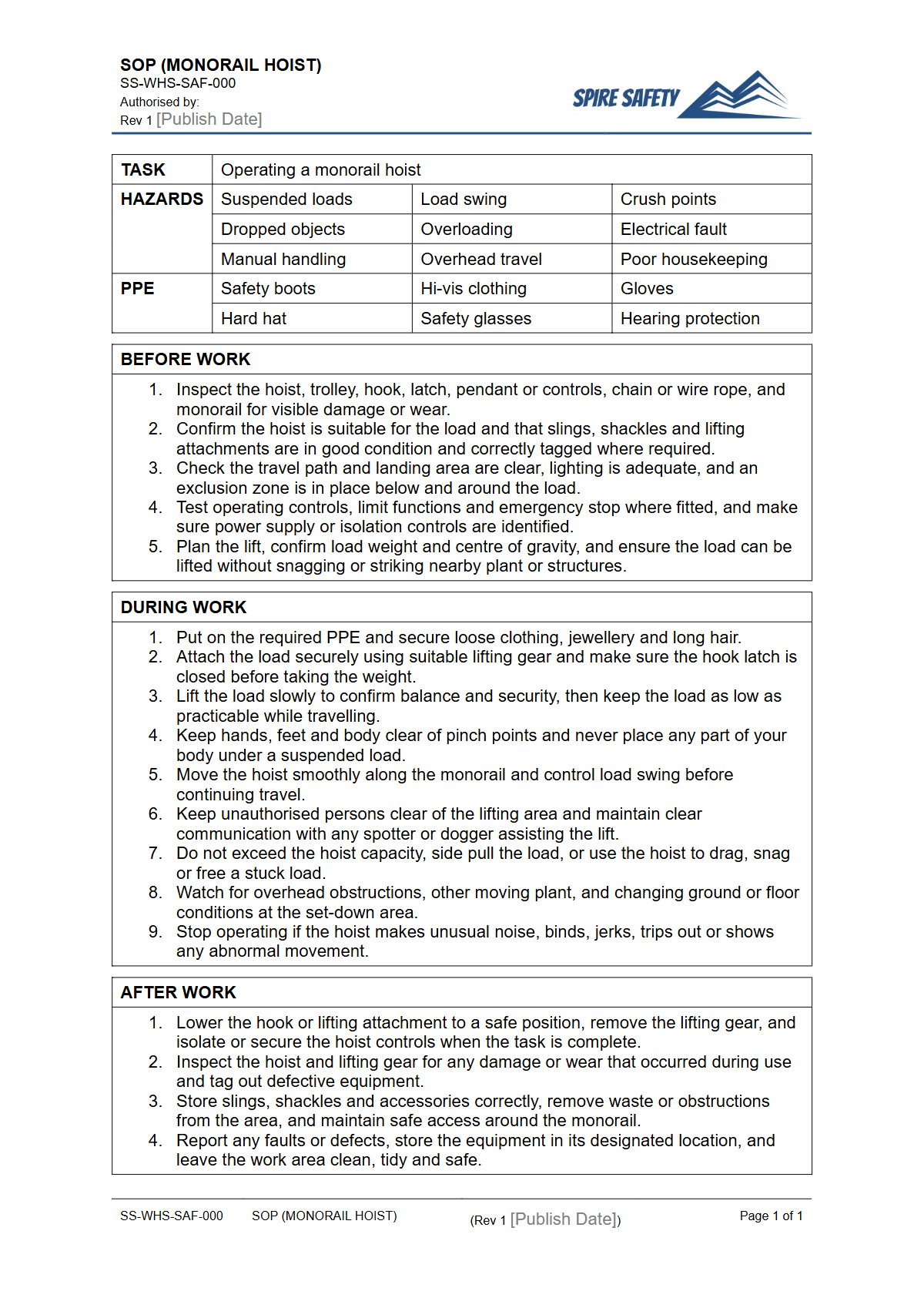
Purpose of the Free Safe Operating Procedure (Monorail Hoist) Template
This Free Safe Operating Procedure (Monorail Hoist) Template provides a structured framework for documenting the required steps to safely operate a stationary overhead monorail hoist. Using a detailed SOP is a critical control measure for managing the significant risks associated with lifting and moving suspended loads.
Key hazards include falling objects, equipment failure, crushing, and entanglement.
A well-defined SOP outlines pre-start checks, step-by-step operating instructions, and shutdown procedures to guide workers. It serves as a vital tool for operator training and competency verification, helping to ensure consistent and safe work practices are followed.
Implementing robust procedures like this is a fundamental component of effective WHS management systems, demonstrating a commitment to proactive risk management.
Video walkthrough
How to use the Free Safe Operating Procedure (Monorail Hoist) Template
This template is provided in both DOCX and PDF formats. The DOCX file is fully editable, allowing you to adapt the content to your specific operational needs.
The PDF version can be used as a quick-print reference for display in the work area.
Important: This document provides a structured starting point aligned with Australian WHS principles, but it must be customised to be effective. You are responsible for adapting this SOP to reflect the specific make and model of your monorail hoist, the types of loads being lifted, the physical layout of your workplace, and any unique environmental or operational hazards present on-site.
We have included prompts and section headings to guide this customisation.
To complete the procedure, consult the manufacturer's operating manual, conduct a site-specific risk assessment, and involve competent operators and supervisors in the drafting process. Ensure all details such as required Personal Protective Equipment (PPE), emergency procedures, and site contacts are accurately filled in before issuing the SOP for use.
Just as you would for other plant, such as with our free Telehandler SOP template, specificity is key to safety.
When to use a Monorail Hoist Safe Operating Procedure
An SOP for a monorail hoist should be a living document that is integrated into daily operations. It is not a set-and-forget form. The procedure should be used for:
- Worker Training and Induction: Forming the basis of training for new operators on the correct and safe use of the equipment.
- Competency Verification: Assessing and confirming an operator's ability to use the hoist safely.
- Pre-Operational Checks: Guiding operators through the essential daily or pre-shift inspections required to identify potential faults.
- Refresher Training: Periodically reviewing safe practices with experienced operators to prevent complacency.
- Incident Investigation: Serving as a benchmark for correct procedure when investigating an accident or near-miss.
The SOP should be kept in a location where it is easily accessible to all operators, supervisors, and maintenance personnel. Its implementation and effectiveness can be verified during a formal WHS compliance audit, providing evidence of your risk management processes.
Who should use this Safe Operating Procedure
Multiple roles within an organisation have a responsibility related to the development and use of a Monorail Hoist SOP:
- Operators: Must understand and follow the documented steps for pre-start checks, operation, and shutdown every time they use the hoist.
- Supervisors and Team Leaders: Are responsible for ensuring operators are trained on the SOP and adhere to it during work. They also conduct periodic checks and enforce the procedures.
- WHS Managers and Advisors: Typically lead the development, review, and updating of the SOP, ensuring it aligns with legislative requirements and integrates into the overall safety management system.
- Maintenance Personnel: Use the SOP to understand operational context and may be responsible for lockout/tagout procedures referenced within it before commencing maintenance or repair work.
Supervisors must also ensure that procedures for interdependent equipment are followed. For example, if a hoist is pneumatic, workers may need to consult the Safe Operating Procedure for an air compressor. Similarly, safe interaction with other machinery should be documented, such as when a hoist is used to load materials onto a production line, which may be covered by a Conveyer System SOP.
This template is one of many available in our comprehensive free WHS resources library, designed to help Australian businesses improve their safety documentation.
Common mistakes
Common mistakes to avoid
- Using a generic template without customising it for site-specific hoist models, tasks, and hazards.
- Failing to conduct and document daily pre-start checks before operation.
- Using the hoist for tasks it was not designed for, such as side-pulling loads or lifting people.
- Allowing untrained or unverified personnel to operate the equipment without adequate supervision.
Legal references
Legal considerations
The following legal requirements may be relevant to this type of work.
- Work Health and Safety Act (Harmonised) — Provides the primary duties for protecting workers and other people from work health and safety risks.
- Work Health and Safety Regulations (Harmonised) — Sets out requirements supporting the management of workplace hazards and risks.
The following codes may be relevant to this type of work.
- Managing WHS Risks Code of Practice — Provides practical guidance on identifying hazards, assessing risks and applying effective controls.
- Work Health and Safety Consultation, Cooperation and Coordination Code of Practice — Provides practical guidance on consulting workers and coordinating with other duty holders.
- Managing the Work Environment and Facilities Code of Practice — Provides practical guidance on safe work environments, workplace facilities and related controls.
Did you know
Load Limits Are Not Suggestions
The Safe Working Load (SWL) or Rated Capacity displayed on a hoist is a critical safety limit. Exceeding this limit, even briefly, can cause catastrophic failure of mechanical components or the support structure, leading to serious incidents.
Chain and Hook Inspections
According to Australian Standards, hoist chains and hooks require frequent inspection for wear, stretching, nicks, and gouges. Many organisations mandate a quick visual inspection by the operator before every shift to catch potential issues early.
FAQ
Frequently asked questions
01What should be included in a Monorail Hoist SOP?
02Is a Safe Operating Procedure a legal requirement for monorail hoists in Australia?
03How often should a Monorail Hoist SOP be reviewed?
04Who is responsible for writing a Safe Operating Procedure for a monorail hoist?
Share this resource
Free Safe Operating Procedure (Monorail Hoist) Template
Browse Categories
How To Use It
- 1Download and open in Word or PDF.
- 2Replace the placeholders with your business details.
- 3Get it reviewed by a WHS specialist before rollout.
Need it customised?
Our WHS consultants can adapt this template to your site, run a gap analysis, or audit what you already have in place.
Book a Free Consultation WHS consulting servicesor call 1300 156 382
Related templates
- Free Safe Operating Procedure (Mooring Area Inspection) Template
- Free Safe Operating Procedure (Mooring Line Handling) Template
- Free Safe Operating Procedure (Mooring Winch) Template
- Free Safe Operating Procedure (Mortar Mixer) Template
- Free Safe Operating Procedure (Mortar Pump) Template
- Free Safe Operating Procedure (Mortising Machine) Template