
Free Safe Operating Procedure (Mobility Aid Storage) Template
Manage hazards associated with storing wheelchairs, walkers, and scooters. Download our free Safe Operating Procedure for Mobility Aid Storage template.
Free Safe Operating Procedure (Mobility Aid Storage) Template
DOCX • 126 KB + PDF
Updated Oct 2026
No signup required
Purpose of the Free Safe Operating Procedure (Mobility Aid Storage) Template
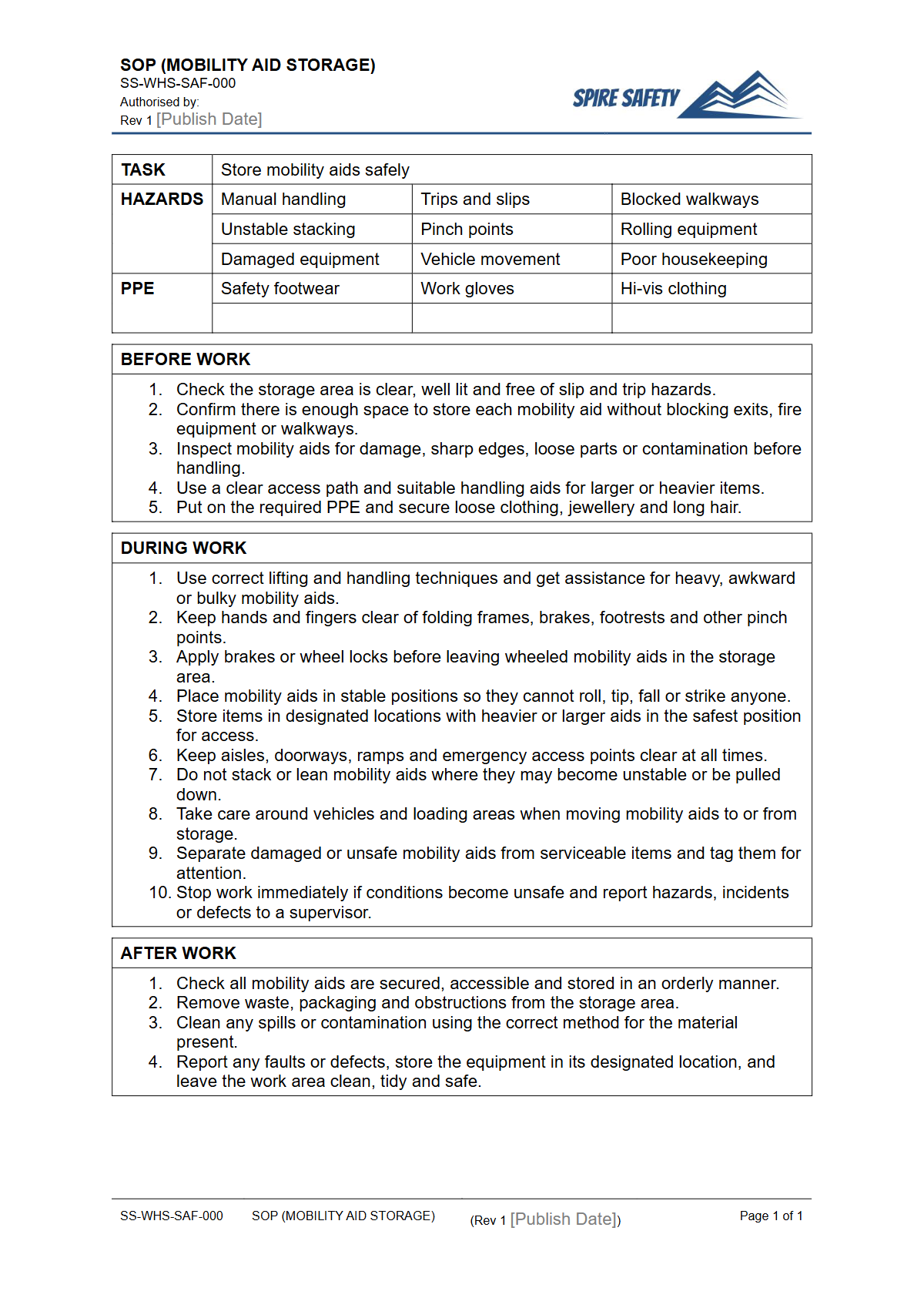
This Free Safe Operating Procedure (Mobility Aid Storage) Template provides a structured framework for businesses to manage the risks associated with the storage of mobility aids like wheelchairs, walkers, and mobility scooters. The primary purpose of this Safe Operating Procedure is to establish a clear, consistent, and safe method for handling and storing this equipment, minimising hazards such as trips and falls, manual handling injuries, and damage to the aids themselves.
By documenting the process, organisations can ensure all personnel, from healthcare staff to facility maintenance crews, understand their responsibilities and follow a standardised protocol. This helps in meeting duty of care obligations under Australian WHS legislation.
Implementing formalised procedures is a critical component of a functional safety framework. This SOP serves as a practical tool to control identified risks at an administrative level, forming an essential part of your broader WHS management systems. It helps create a safer environment for staff, residents, and visitors in settings like aged care facilities, hospitals, and community centres by preventing obstruction of walkways and ensuring equipment is stored securely and is ready for safe use.
Video walkthrough
How to use the Free Safe Operating Procedure (Mobility Aid Storage) Template
Our Safe Operating Procedure for Mobility Aid Storage is available for download as a DOCX file for easy editing or as a PDF for straightforward printing and distribution. To use the template, simply download your preferred format and begin populating the sections with information specific to your operational environment.
The document is logically structured to guide you through detailing responsibilities, outlining pre-operational checks, defining the step-by-step storage procedure, and listing emergency protocols.
It is crucial to remember that this template is a starting point. We have developed it to be adapted to your specific workplace, equipment types (e.g., manual wheelchairs vs.
electric scooters), storage areas, and personnel. You must conduct your own risk assessment and customise the document to reflect your unique operational context and control measures.
This customisation is a key step in demonstrating due diligence. A thorough WHS compliance audit would verify that your procedures are not only documented but also tailored and effectively implemented within your facility's specific context.
What is included in this Safe Operating Procedure?
This template is designed to be comprehensive and includes dedicated sections for:
- Defining the scope and purpose of the procedure.
- Assigning responsibilities to relevant roles.
- Listing required Personal Protective Equipment (PPE).
- Outlining potential hazards and associated risk control measures.
- A step-by-step guide for the storage task, from preparation to completion.
- Requirements for cleaning and maintenance of the aids.
- Training and competency requirements for staff.
When to use a Safe Operating Procedure for Mobility Aid Storage
A formal SOP for storing mobility aids should be used as a core operational document in any facility where such equipment is present. It is particularly important to implement or review this procedure when establishing a new storage area, introducing new types of mobility aids, or changing facility layouts.
It serves as an essential training tool for new employee inductions and for periodic refresher training to ensure ongoing competency and awareness. Furthermore, this SOP should be referenced and reviewed following any incident or near-miss related to equipment storage to identify and implement corrective actions.
Regular procedural reviews help ensure your safety practices remain effective and relevant.
Developing task-specific procedures should be a standard practice across your organisation. Just as you would formalise processes for potentially hazardous tools with a free Circular Saw SOP Template, administrative tasks with inherent risks like equipment storage warrant the same level of documented control.
Who should use this template?
This template is designed for use by a range of personnel responsible for workplace health and safety. This includes WHS Managers and Safety Officers tasked with developing and implementing safety systems.
Facility Managers in aged care, healthcare, and public venues will find it invaluable for standardising operations and managing risks in common areas. Supervisors and Team Leaders can use it to train their teams and monitor day-to-day compliance.
Essentially, anyone accountable for drafting, reviewing, or enforcing safety procedures in a workplace where mobility aids are handled will benefit from this structured starting point.
A well-managed facility often requires numerous SOPs covering a wide array of tasks and equipment. A manager might need to oversee procedures for everything from client-facing equipment to back-of-house machinery, such as that covered in our free Air Compressor SOP template. If you need assistance developing a full suite of documents or require expert advice, our WHS consulting team can provide tailored support.
By systematically addressing each task, you build a more resilient safety culture. This document is one of many tools available to help you achieve that goal.
We encourage you to explore our complete free WHS resources library for other templates and guides to support your safety management efforts.
Common mistakes
Common mistakes to avoid
- Failing to designate a specific, clearly marked, and unobstructed storage area.
- Neglecting to include procedures for cleaning, inspection, and charging (for electric aids).
- Writing a procedure but failing to adequately train all relevant staff and monitor compliance.
- Using a generic template without customising it to the facility's specific layout, equipment, and risks.
Legal references
Legal considerations
The following legal requirements may be relevant to this type of work.
- Work Health and Safety Act (Harmonised) — Provides the primary duties for protecting workers and other people from work health and safety risks.
- Work Health and Safety Regulations (Harmonised) — Sets out requirements supporting the management of workplace hazards and risks.
The following codes may be relevant to this type of work.
- Managing WHS Risks Code of Practice — Provides practical guidance on identifying hazards, assessing risks and applying effective controls.
- Work Health and Safety Consultation, Cooperation and Coordination Code of Practice — Provides practical guidance on consulting workers and coordinating with other duty holders.
- Managing the Work Environment and Facilities Code of Practice — Provides practical guidance on safe work environments, workplace facilities and related controls.
Did you know
A Common Hazard
Slips, trips, and falls are a leading cause of serious injury in Australian workplaces. Poorly stored equipment, including mobility aids left in corridors, is a significant and preventable contributor to these incidents, particularly in healthcare and social assistance settings.
FAQ
Frequently asked questions
01What hazards are associated with storing mobility aids?
02Is an SOP legally required for storing wheelchairs and walkers?
03Where is the best place to store mobility aids in a facility?
04How often should a mobility aid storage SOP be reviewed?
Share this resource
Free Safe Operating Procedure (Mobility Aid Storage) Template
Browse Categories
How To Use It
- 1Download and open in Word or PDF.
- 2Replace the placeholders with your business details.
- 3Get it reviewed by a WHS specialist before rollout.
Need it customised?
Our WHS consultants can adapt this template to your site, run a gap analysis, or audit what you already have in place.
Book a Free Consultation WHS consulting servicesor call 1300 156 382
Related templates
- Free Safe Operating Procedure (Mobility Scooter Charge) Template
- Free Safe Operating Procedure (Mobility Scooter Clean) Template
- Free Safe Operating Procedure (Moisture Meter) Template
- Free Safe Operating Procedure (Monorail Hoist) Template
- Free Safe Operating Procedure (Mooring Area Inspection) Template
- Free Safe Operating Procedure (Mooring Line Handling) Template