
Free Safe Operating Procedure (Mixed Recycling Sort) Template
Manage risks in waste management with our free Safe Operating Procedure for mixed recycling sorting. Download the customisable template to get started.
Free Safe Operating Procedure (Mixed Recycling Sort) Template
DOCX • 126 KB + PDF
Updated Oct 2026
No signup required
Purpose of the Free Safe Operating Procedure (Mixed Recycling Sort) Template
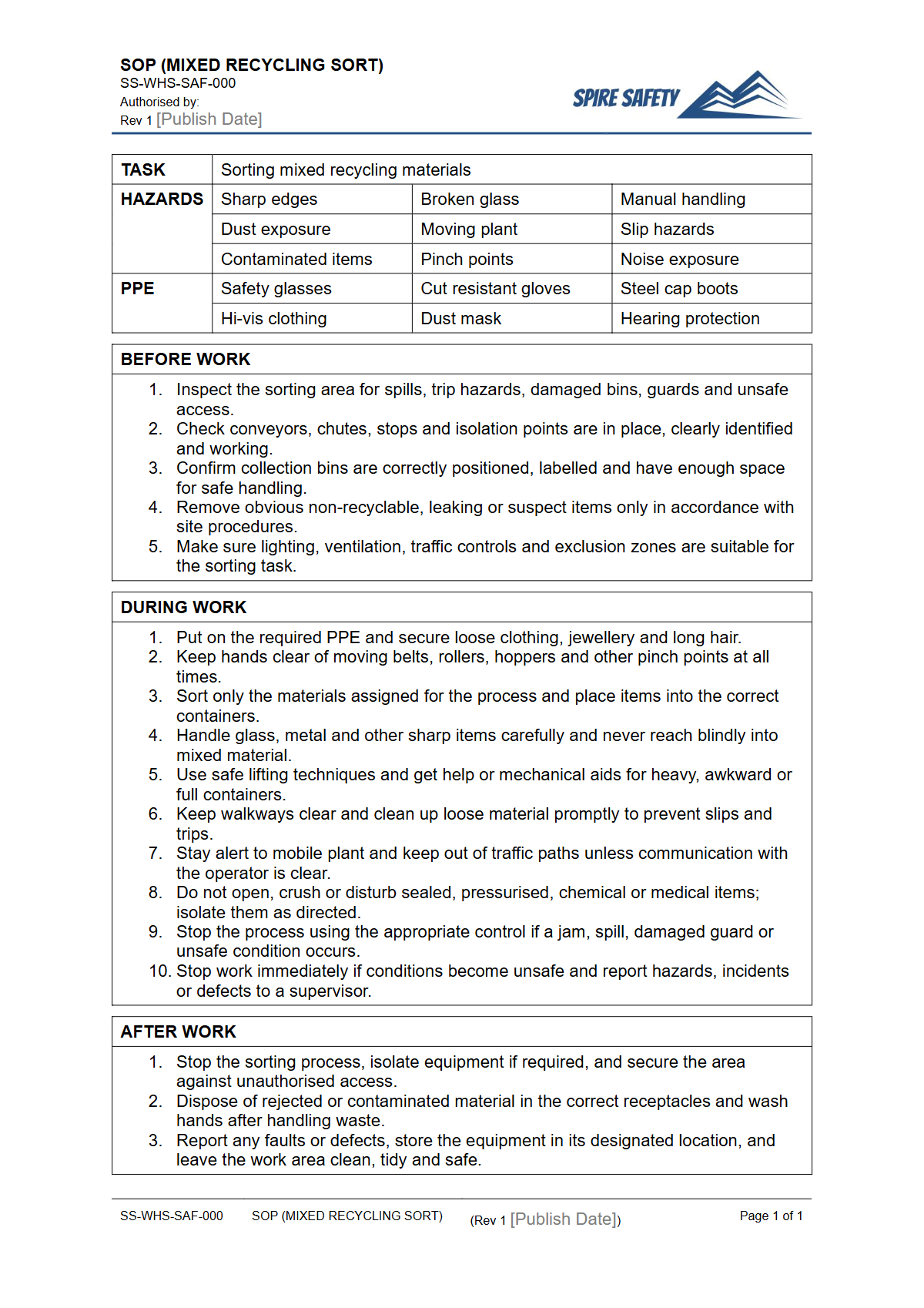
Sorting mixed recyclables is a critical process in waste management facilities, but it carries significant health and safety risks. This Free Safe Operating Procedure (Mixed Recycling Sort) Template provides a structured framework for documenting safe work methods to control these hazards.
The primary purpose is to guide workers through the required steps to perform sorting tasks safely, minimising the risk of injury from machinery, hazardous materials, and strenuous manual tasks. It serves as a vital tool for meeting your duty of care as a Person Conducting a Business or Undertaking (PCBU).
Key hazards addressed in a mixed recycling sort SOP include entanglement in moving parts, particularly on sorting lines and conveyors, and musculoskeletal disorders from repetitive manual handling. Workers also face exposure to biological hazards, chemicals, and physical risks from sharp objects like broken glass and metal.
A well-defined procedure helps standardise safe behaviour, ensures equipment is used correctly, and outlines the personal protective equipment (PPE) required. For plant with conveyors, you should also develop a specific FREE Conveyer System SOP.
Video walkthrough
How to use the Free Safe Operating Procedure (Mixed Recycling Sort) Template
This template is provided in both DOCX and PDF formats for your convenience. The DOCX file is fully editable, allowing you to adapt it to the unique circumstances of your workplace.
It's designed as a comprehensive starting point, aligned with Australian WHS best practices, but it is not a finished document.
Important: You must customise this Safe Operating Procedure to reflect your specific site, machinery, materials processed, and consultation with your workers. We cannot guarantee its suitability for your operations "as is". To use it effectively:
- Download the DOCX file.
- Conduct a risk assessment of your mixed recycling sorting process in consultation with your team.
- Modify the document to include your specific machinery (e.g., make and model of sorters, balers), workplace layout, and the types of recyclable materials handled.
- Clearly detail the step-by-step process, pre-start checks, shutdown procedures, and emergency responses relevant to your operation.
- Incorporate the SOP into your broader WHS management systems to ensure it is effectively implemented and reviewed.
- Train all relevant workers on the finalised SOP and document this training.
When to use a Mixed Recycling Sort Safe Operating Procedure
A Safe Operating Procedure for mixed recycling sorting should be used as a daily operational document. It is not something to be filed away and forgotten.
It forms a critical part of the safe system of work and should be readily accessible to all workers involved in sorting activities. It is also essential for moving and handling sorted materials, which often involves heavy machinery; for this, a FREE Telehandler SOP Template may also be necessary for your facility.
Specific times to use the SOP include:
- During the induction and training of new employees.
- As a basis for refresher training and competency assessments.
- For pre-start meetings or toolbox talks to reinforce key safety points.
- As a reference guide for workers during their shifts.
- When investigating an incident or near miss to review and improve procedures.
- During routine safety audits and inspections.
Who should use this Safe Operating Procedure
This SOP is intended for use by multiple roles within a waste management or recycling organisation. Primarily, it is for the workers who directly perform the sorting tasks, providing them with clear, unambiguous instructions to keep them safe.
It is also a key document for supervisors and team leaders, who are responsible for ensuring work is performed according to the established procedure and for monitoring compliance.
WHS managers and coordinators will use this template as a foundational document to build upon, ensuring it aligns with legislative requirements and the organisation's overall safety objectives. Senior management should also be aware of and endorse the SOP, demonstrating leadership and commitment to workplace health and safety.
The SOP may also specify procedures for cleaning equipment, which can involve specific tools; our Free Air Compressor SOP can help detail safe use of this common maintenance equipment.
If you require expert assistance in adapting this template or conducting the necessary risk assessments, engaging professional WHS consulting can provide tailored support. For those looking for more templates, our free WHS resources library offers a wide range of documents for various industries and tasks.
Common mistakes
Common mistakes to avoid
- Failing to customise the template for site-specific machinery and waste streams.
- Not consulting with workers who perform the task when drafting or reviewing the SOP.
- Neglecting to include procedures for handling unexpected or non-conforming items.
- Treating the SOP as a one-time document instead of a living guide for daily work and training.
Legal references
Legal considerations
The following legal requirements may be relevant to this type of work.
- Work Health and Safety Act (Harmonised) — Provides the primary duties for protecting workers and other people from work health and safety risks.
- Work Health and Safety Regulations (Harmonised) — Sets out requirements supporting the management of workplace hazards and risks.
The following codes may be relevant to this type of work.
- Managing WHS Risks Code of Practice — Provides practical guidance on identifying hazards, assessing risks and applying effective controls.
- Work Health and Safety Consultation, Cooperation and Coordination Code of Practice — Provides practical guidance on consulting workers and coordinating with other duty holders.
- Managing the Work Environment and Facilities Code of Practice — Provides practical guidance on safe work environments, workplace facilities and related controls.
Did you know
Hidden Hazards
Items like lithium-ion batteries and aerosol cans are frequently and incorrectly placed in mixed recycling, posing significant fire and explosion risks in sorting facilities.
Manual Handling Impact
The waste and recycling industry has one of the highest rates of serious workers' compensation claims, with manual handling injuries being a major contributor.
FAQ
Frequently asked questions
01What are the main hazards in mixed recycling sorting?
02Is this Safe Operating Procedure template ready to use after download?
03Who is responsible for developing an SOP for mixed recycling sorting?
04How often should a mixed recycling sort SOP be reviewed?
Share this resource
Free Safe Operating Procedure (Mixed Recycling Sort) Template
Browse Categories
How To Use It
- 1Download and open in Word or PDF.
- 2Replace the placeholders with your business details.
- 3Get it reviewed by a WHS specialist before rollout.
Need it customised?
Our WHS consultants can adapt this template to your site, run a gap analysis, or audit what you already have in place.
Book a Free Consultation WHS consulting servicesor call 1300 156 382
Related templates
- Free Safe Operating Procedure (Mobile Crane Setup) Template
- Free Safe Operating Procedure (Mobility Aid Storage) Template
- Free Safe Operating Procedure (Mobility Scooter Charge) Template
- Free Safe Operating Procedure (Mobility Scooter Clean) Template
- Free Safe Operating Procedure (Moisture Meter) Template
- Free Safe Operating Procedure (Monorail Hoist) Template