
Free Safe Operating Procedure (Mobile Crane Setup) Template
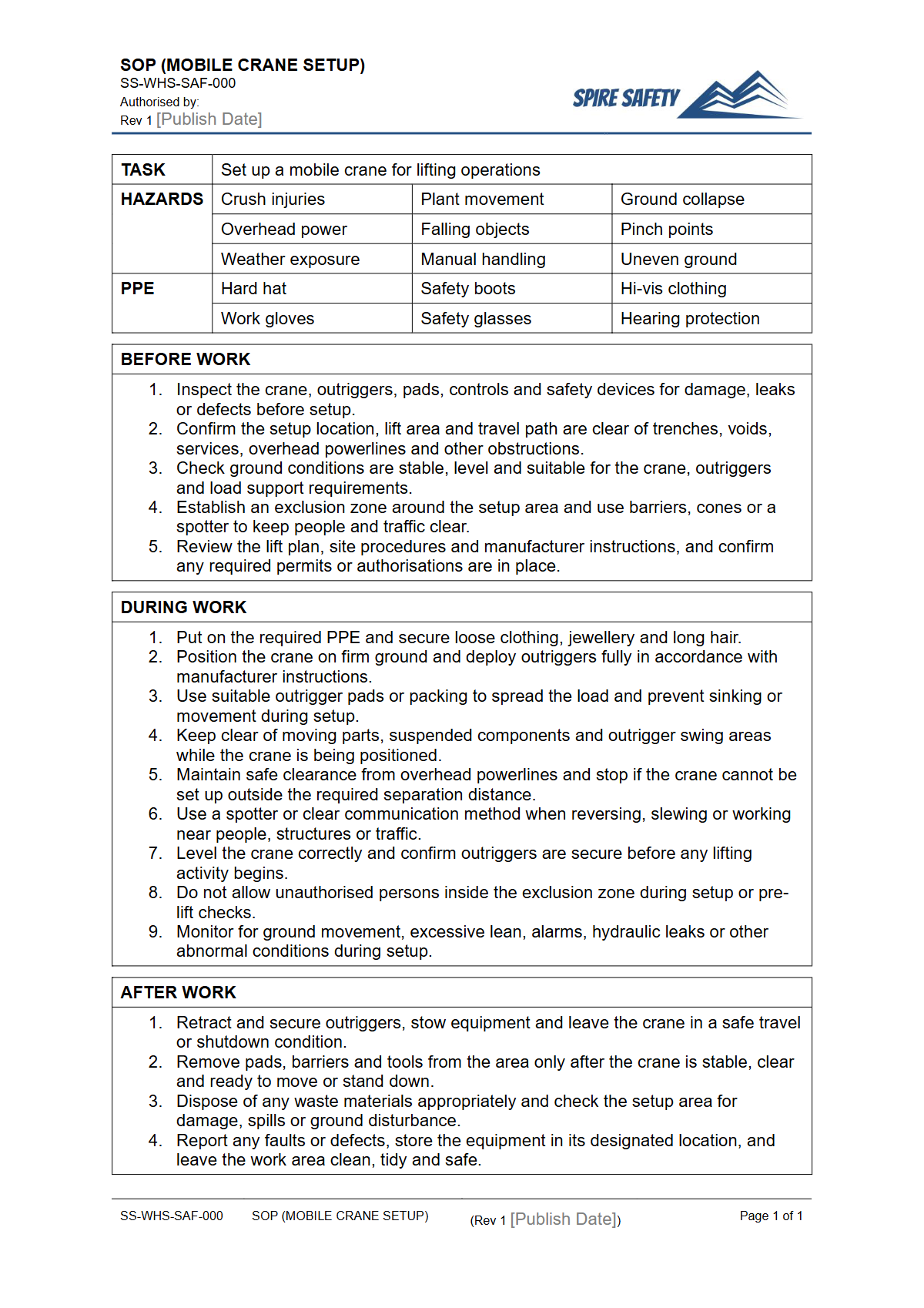
Establish a safe, repeatable process for mobile crane setup with our customisable template. Download your free Safe Operating Procedure in DOCX and PDF.
Free Safe Operating Procedure (Mobile Crane Setup) Template
DOCX • 126 KB + PDF
Updated Oct 2026
No signup required
Purpose of the Free Safe Operating Procedure (Mobile Crane Setup) Template
The successful and safe operation of a mobile crane begins long before the lift itself. This free Safe Operating Procedure (Mobile Crane Setup) Template provides a structured framework for a critical, high-risk phase of crane operations.
Setting up a mobile crane involves significant hazards, including unstable ground, proximity to overhead power lines, incorrect outrigger placement, and changing weather conditions. Using a documented SOP helps your organisation to systematically control these risks, ensuring every setup follows a proven, safe method.
It establishes consistency across different teams and sites, provides a vital training tool for operators and riggers, and forms a key part of your overall safety management system.
A standardised procedure demonstrates due diligence in managing workplace risks and helps prevent catastrophic incidents like crane rollovers, which are often traced back to errors during the setup phase. It formalises the steps for site assessment, equipment stabilisation, and pre-operational checks, creating a safer environment for everyone. Integrating this procedure into your broader operational framework is a cornerstone of effective risk management, which is essential for comprehensive WHS management systems.
Video walkthrough
How to use the Free Safe Operating Procedure (Mobile Crane Setup) Template
This Safe Operating Procedure for Mobile Crane Setup is provided as a starting point in both DOCX and PDF formats. It is designed to be adapted to the unique context of your business and worksites.
A generic procedure cannot account for all variables, so customisation is mandatory for it to be effective.
Important: This template is based on established Australian WHS practice and the model WHS framework. To use it correctly, you must conduct your own risk assessment and update the document to reflect your specific crane models, ground conditions, personnel competencies, and operational environment.
We are not liable for any incidents that occur from using this template without proper, site-specific customisation and implementation.
To implement it, download the DOCX file and consult with your crane operators, riggers, and supervisors. Modify the sections to align with your equipment manufacturer's instructions and site-specific risk assessments.
Once finalised, ensure all relevant personnel are trained on the procedure before it is put into practice. The principles outlined are also relevant for other lifting equipment, as detailed in our FREE Telehandler SOP Template.
When to use it
A mobile crane setup SOP should be used before every single lift operation commences. It is not a document to be filed away; it is an active tool for daily work planning and execution.
It should be referenced during pre-start meetings, toolbox talks, and when formulating lift plans. Furthermore, it serves as a critical training document for inducting new operators or riggers and for periodic refresher training for experienced personnel.
Following an incident or near-miss involving a crane, this SOP should be a primary document for review during the investigation to identify any procedural gaps or failures.
Who should use it
This Safe Operating Procedure is intended for use by several key roles within an organisation to ensure a coordinated approach to safety. Crane Operators must follow the step-by-step instructions to ensure the crane is set up correctly and safely.
Doggers and Riggers use it to understand their responsibilities in assisting with setup, such as positioning outrigger pads and managing exclusion zones. Site Supervisors and Managers are responsible for verifying that the procedure is followed correctly and for ensuring the site conditions are suitable as assessed.
WHS and HSE personnel will integrate this document into the company's safety system, using it for training, audits, and continuous improvement activities. Documenting procedures for all high-risk mobile plant is essential, a principle that also applies to earthmoving equipment like that covered in our FREE Grader SOP.
Key Elements of an Effective Mobile Crane SOP
A comprehensive SOP for crane setup should always include several core sections to be effective in controlling risk.
- Pre-Operational Checks: A detailed checklist for inspecting the crane before setup, including fluid levels, tyre condition, structural integrity, and the functionality of safety devices like the Load Moment Indicator (LMI).
- Site Assessment: Clear criteria for evaluating the setup area. This includes assessing ground bearing capacity, identifying slopes, locating underground services (pipes, drains, cables), and maintaining a safe distance from excavations or embankments.
- Crane Stabilisation: Step-by-step instructions for extending and setting outriggers, the correct use of pads or dunnage to distribute pressure, and the process for levelling the crane to within the manufacturer's specified tolerance.
- Hazard Management: Specific controls for identified hazards, such as defined clearance distances from power lines ('tiger tails' or de-energisation), establishment of exclusion zones, and protocols for operating in adverse weather like high winds or lightning. On a busy site, managing multiple pieces of equipment is common, and having procedures for each, like a Free Air Compressor SOP, is crucial.
- Communication: Standardised communication protocols, including recognised hand signals and radio etiquette between the operator and the rigging crew, to ensure clear and concise direction during the setup process.
- Review and Verification: A final sign-off step where the supervisor or a competent person verifies that all steps in the SOP have been completed correctly before any lift is authorised. This verification step can be a key focus during a WHS compliance auditing process.
Common mistakes
Common mistakes to avoid
- Failing to properly assess ground conditions for stability, voids, or underground services.
- Not using appropriately sized outrigger pads or dunnage suitable for the ground type and total load.
- Setting up too close to trenches, slopes, or building foundations without engineering advice.
- Neglecting to check for overhead hazards like power lines or tree branches before extending the boom.
Legal references
Legal considerations
The following legal requirements may be relevant to this type of work.
- Work Health and Safety Act (Harmonised) — Provides the primary duties for protecting workers and other people from work health and safety risks.
- Work Health and Safety Regulations (Harmonised) — Sets out requirements supporting the management of workplace hazards and risks.
The following codes may be relevant to this type of work.
- Managing WHS Risks Code of Practice — Provides practical guidance on identifying hazards, assessing risks and applying effective controls.
- Work Health and Safety Consultation, Cooperation and Coordination Code of Practice — Provides practical guidance on consulting workers and coordinating with other duty holders.
- Managing the Work Environment and Facilities Code of Practice — Provides practical guidance on safe work environments, workplace facilities and related controls.
Did you know
Ground Pressure
The pressure exerted by a crane's outrigger can be immense, often exceeding that of a battle tank's track. Inadequate ground support is a leading cause of catastrophic mobile crane rollovers worldwide.
The 3-Degree Rule
Most crane load charts are calculated on the assumption that the crane is perfectly level. Being just 3 degrees off-level can reduce a crane's lifting capacity by up to 50%, dramatically increasing the risk of failure.
FAQ
Frequently asked questions
01Is a Safe Operating Procedure for mobile crane setup legally required in Australia?
02How often should we review our mobile crane setup SOP?
03What's the difference between an SOP and a SWMS for a crane?
04Who is responsible for ensuring the crane is set up correctly?
Share this resource
Free Safe Operating Procedure (Mobile Crane Setup) Template
Browse Categories
How To Use It
- 1Download and open in Word or PDF.
- 2Replace the placeholders with your business details.
- 3Get it reviewed by a WHS specialist before rollout.
Need it customised?
Our WHS consultants can adapt this template to your site, run a gap analysis, or audit what you already have in place.
Book a Free Consultation WHS consulting servicesor call 1300 156 382
Related templates
- Free Safe Operating Procedure (Mobility Aid Storage) Template
- Free Safe Operating Procedure (Mobility Scooter Charge) Template
- Free Safe Operating Procedure (Mobility Scooter Clean) Template
- Free Safe Operating Procedure (Moisture Meter) Template
- Free Safe Operating Procedure (Monorail Hoist) Template
- Free Safe Operating Procedure (Mooring Area Inspection) Template