
Free Safe Operating Procedure (Mine Dewatering) Template
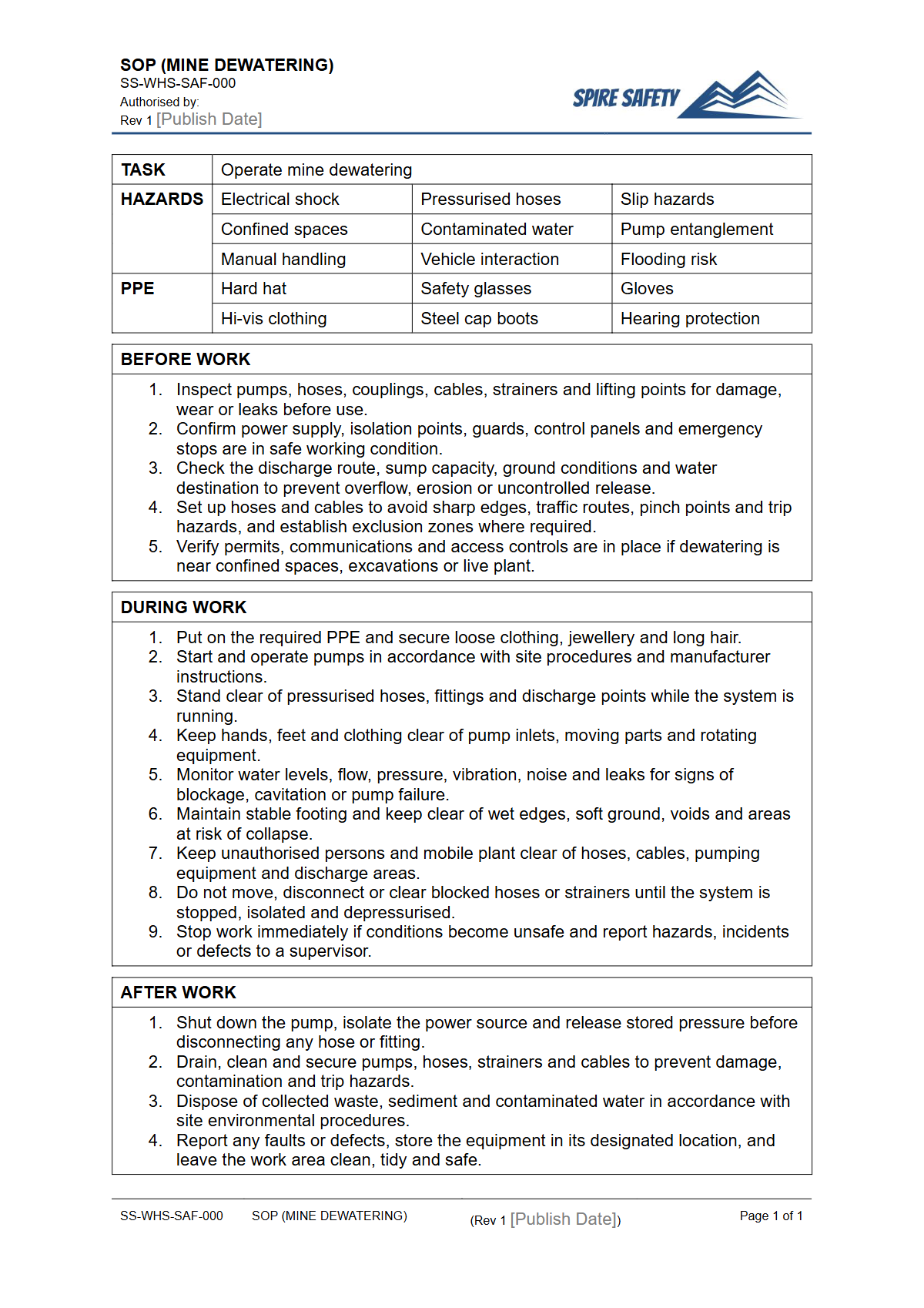
Download our free Safe Operating Procedure for mine dewatering. This customisable template provides a structured starting point for your WHS documentation.
Free Safe Operating Procedure (Mine Dewatering) Template
DOCX • 126 KB + PDF
Updated Oct 2026
No signup required
Purpose of the Free Safe Operating Procedure (Mine Dewatering) Template
Managing water is a critical and high-risk task in any mining operation. This Free Safe Operating Procedure (Mine Dewatering) Template provides a structured framework for documenting the required steps to safely remove groundwater or surface water from a mine site.
An effective SOP helps control major hazards associated with dewatering, such as ground instability, flooding, electrical shock from pumps and equipment, and environmental contamination from discharged water. By clearly outlining the process, required equipment, and safety precautions, this document serves as a vital tool for risk management and worker training, forming a key part of your site's overall safety management system.
A documented procedure ensures that all personnel involved in dewatering activities follow a consistent, pre-approved method that has been assessed for risk. It formalises pre-start checks, operational steps, monitoring requirements, and emergency responses.
This helps your organisation meet its primary duty of care under WHS law by taking reasonably practicable steps to ensure a safe working environment. Integrating this SOP with other operational documents, such as a FREE Conveyer System SOP (Safe Operating Procedure), helps build a comprehensive safety framework for your site.
What this Safe Operating Procedure covers
This template is designed as a comprehensive starting point. It includes sections for you to detail:
- Required Personal Protective Equipment (PPE)
- Hazard identification and risk control measures
- Step-by-step instructions for pre-start, operation, and shutdown of dewatering pumps and associated equipment
- Water quality testing and discharge management protocols
- Emergency shutdown and response procedures
- Maintenance and inspection schedules
Video walkthrough
How to use the Free Safe Operating Procedure (Mine Dewatering) Template
To effectively use this Safe Operating Procedure for Mine Dewatering, you must adapt it to the unique conditions of your operation. Download the DOCX file and begin by conducting a thorough risk assessment of your specific dewatering tasks.
This involves identifying all potential hazards related to the equipment used (e.g., specific pump models, power sources), the location (open-cut pit, underground decline), and the environment (water chemistry, ground conditions). Populate the template with this site-specific information, including equipment serial numbers, emergency contact details, and the names or roles of responsible persons.
It's crucial to remember that this document is a template, not a finished product. We have provided a solid framework, but you must customise it to reflect the specific hazards, equipment, and operating context of your mine site.
Involve workers who perform the task in the customisation process to ensure the SOP is practical and reflects how the work is actually done. Once finalised, the SOP should be used as a central part of worker training and competency assessments. This process of customisation and implementation is a core component of effective WHS management systems.
When to use it
A Safe Operating Procedure for mine dewatering should be consulted and applied consistently. It is not a document to be filed away and forgotten. It should be used:
- Before any dewatering activity begins: As a guide for pre-start inspections and task planning.
- During worker training and induction: To ensure new and existing employees understand the approved, safe method for the task.
- For competency assessments: To verify that operators can perform the dewatering task safely and in accordance with the procedure.
- During safety audits and inspections: As a benchmark to measure against actual work practices. You can learn more about this process through our WHS compliance auditing services.
- After an incident or near miss: As a key document to review and update to prevent recurrence.
Regularly reviewing the SOP, especially when new equipment is introduced or environmental conditions change, ensures it remains a relevant and effective safety tool. This proactive approach is essential for maintaining a safe workplace, particularly for ancillary tasks that support major earthmoving operations detailed in documents like a FREE Scraper SOP (Safe Operating Procedure) Template.
Who should use it
This SOP is intended for a range of personnel within a mining organisation. Primary users include:
- Equipment Operators and Technicians: The individuals directly responsible for setting up, operating, and monitoring dewatering equipment. They use the SOP as a direct guide for their work.
- Supervisors and Foremen: To oversee dewatering operations, conduct pre-start meetings (toolbox talks), and ensure their teams are adhering to the documented procedures.
- WHS/HSE Advisors and Managers: To develop, review, and implement the procedure as part of the site's overall safety system, and to use it during incident investigations and risk assessments.
- Mine Planners and Engineers: To understand the operational and safety constraints of dewatering when planning mine development and extraction sequences.
- Training Coordinators: To develop training materials and competency assessment criteria based on the approved procedure.
Effectively managing documentation for tasks across a site, from pumping water to digging trenches, is crucial. For related activities, you might find our FREE Trencher SOP (Safe Operating Procedure) Template useful.
You can also explore our complete free WHS resources library for more templates to support your operations.
Common mistakes
Common mistakes to avoid
- Failing to adequately customise the template with site-specific equipment and hazards.
- Neglecting pre-start checks on pumps, power cords, and hoses, leading to equipment failure.
- Not monitoring discharge points, causing environmental contamination or downstream flooding.
- Inadequate training on emergency shutdown procedures for pumps and power sources.
Legal references
Legal considerations
The following legal requirements may be relevant to this type of work.
- Work Health and Safety Act (Harmonised) — Provides the primary duties for protecting workers and other people from work health and safety risks.
- Work Health and Safety Regulations (Harmonised) — Sets out requirements supporting the management of workplace hazards and risks.
The following codes may be relevant to this type of work.
- Managing WHS Risks Code of Practice — Provides practical guidance on identifying hazards, assessing risks and applying effective controls.
- Work Health and Safety Consultation, Cooperation and Coordination Code of Practice — Provides practical guidance on consulting workers and coordinating with other duty holders.
- Managing the Work Environment and Facilities Code of Practice — Provides practical guidance on safe work environments, workplace facilities and related controls.
Did you know
Water Weight
One cubic metre of water weighs approximately one tonne. Rapidly dewatering an area can suddenly change the load on surrounding rock or soil, potentially triggering ground failure if not managed correctly.
Acid Mine Drainage
Mine water is often acidic and can contain heavy metals. This 'Acid Mine Drainage' (AMD) is a significant environmental hazard, making water quality testing and controlled discharge a critical part of any dewatering SOP.
FAQ
Frequently asked questions
01What are the primary hazards involved in mine dewatering?
02How often should a Safe Operating Procedure for mine dewatering be reviewed?
03Is this SOP template suitable for both open-cut and underground mines?
04What training is required to perform mine dewatering?
Share this resource
Free Safe Operating Procedure (Mine Dewatering) Template
Browse Categories
How To Use It
- 1Download and open in Word or PDF.
- 2Replace the placeholders with your business details.
- 3Get it reviewed by a WHS specialist before rollout.
Need it customised?
Our WHS consultants can adapt this template to your site, run a gap analysis, or audit what you already have in place.
Book a Free Consultation WHS consulting servicesor call 1300 156 382
Related templates
- Free Safe Operating Procedure (Mine Ventilation Fan) Template
- Free Safe Operating Procedure (Mixed Recycling Sort) Template
- Free Safe Operating Procedure (Mobile Crane Setup) Template
- Free Safe Operating Procedure (Mobility Aid Storage) Template
- Free Safe Operating Procedure (Mobility Scooter Charge) Template
- Free Safe Operating Procedure (Mobility Scooter Clean) Template