
Free Safe Operating Procedure (Mincer Bowl Cutter Operation) Template
Download our free Safe Operating Procedure (Mincer Bowl Cutter Operation) Template.
Free Safe Operating Procedure (Mincer Bowl Cutter Operation) Template
DOCX • 166 KB + PDF
Updated Oct 2026
No signup required
Purpose of the Free Safe Operating Procedure (Mincer Bowl Cutter Operation) Template
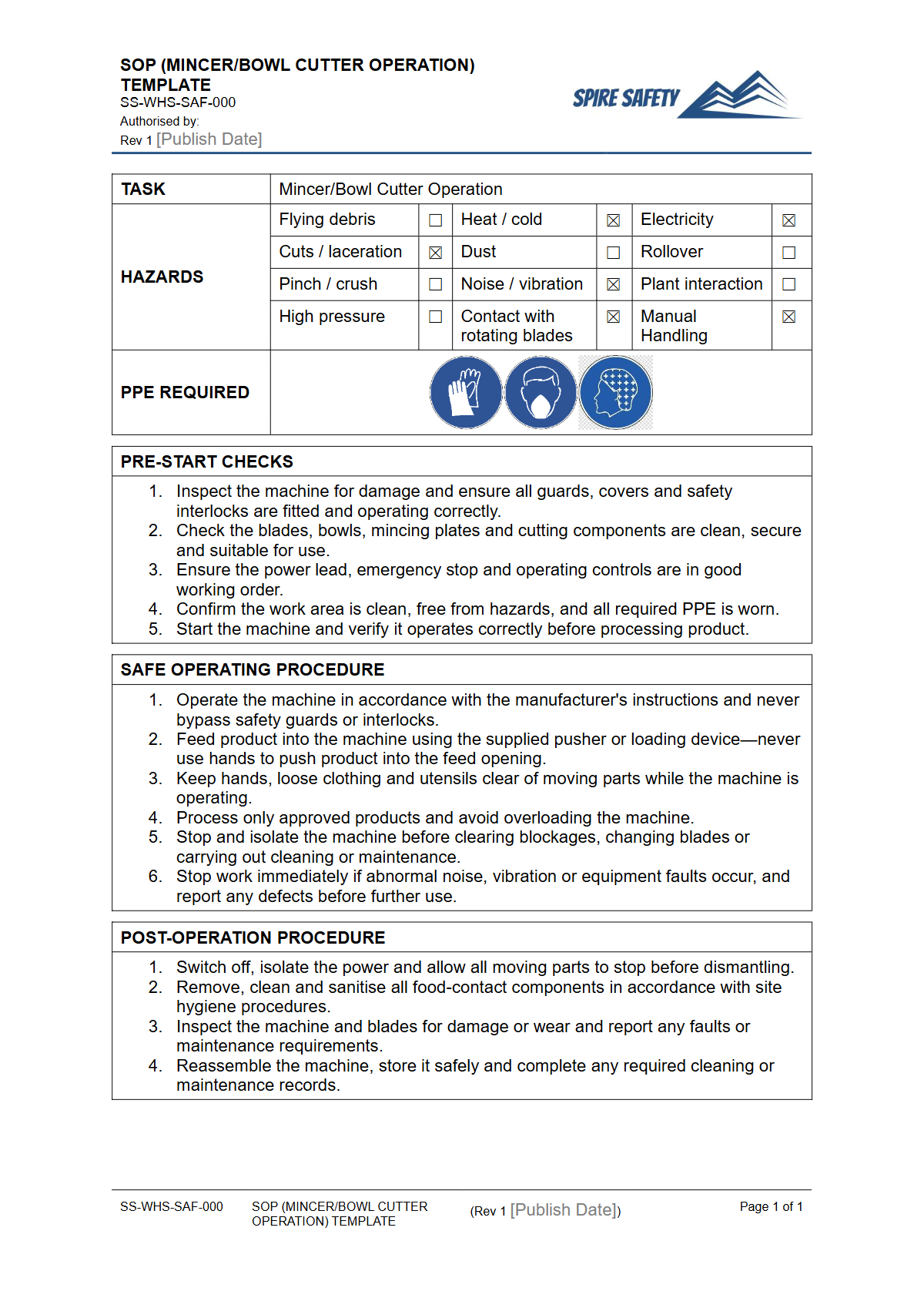
Operating a mincer bowl cutter involves significant risks, including entanglement, lacerations from sharp blades, and electrical hazards. This Free Safe Operating Procedure (Mincer Bowl Cutter Operation) Template provides a structured framework for documenting the step-by-step process required to use this equipment safely.
A well-developed Safe Operating Procedure (SOP) is a critical tool for any business using high-risk plant, helping to standardise tasks, train workers, and meet WHS obligations. By formalising safety protocols, you can minimise the risk of injury and demonstrate a commitment to a safe work environment.
This template is designed as a starting point, aligned with Australian WHS principles for managing workplace hazards. It guides you through identifying the necessary personal protective equipment (PPE), pre-operational checks, safe shutdown procedures, and emergency responses.
Integrating this SOP into your broader safety framework is a key step in controlling risks associated with food processing machinery. A comprehensive approach often involves building out complete WHS management systems to ensure all aspects of workplace safety are covered.
Video walkthrough
How to use the Free Safe Operating Procedure (Mincer Bowl Cutter Operation) Template
To effectively use this Safe Operating Procedure (Mincer Bowl Cutter Operation) Template, download the DOCX file and adapt it to the specific context of your workplace. A generic procedure is not sufficient for compliance or safety; it must reflect your unique equipment, environment, and processes.
Involve workers who operate the machinery, supervisors, and health and safety representatives in the customisation process to ensure the SOP is practical and comprehensive.
Pay close attention to sections requiring site-specific information, such as the exact make and model of the mincer bowl cutter, specific guarding mechanisms, isolation points, and your workplace's emergency contacts. Detail the required maintenance schedule and cleaning protocols, as these are critical for safe operation.
For other specialised equipment, you might also require procedures like our FREE Circular Saw SOP Template, which follows a similar customisable structure.
Important Customisation Note
This document is a template and does not constitute a complete or compliant safety procedure on its own. It is essential that you customise this template to accurately reflect the specific machinery, hazards, risks, and control measures present in your workplace.
We accept no liability for any incident, loss, or damage arising from the use of this template without thorough, site-specific customisation and implementation.
When to use it
A Safe Operating Procedure for a mincer bowl cutter should be a living document, used consistently in daily operations. It is essential for inducting and training new employees, ensuring they understand the hazards and safe work methods before they operate the machine.
It also serves as a valuable refresher for experienced workers and a benchmark for supervisors conducting routine observations or performance reviews. In the event of an incident or near miss, the SOP is a critical reference for investigation, helping to identify any procedural gaps or non-conformance.
Furthermore, these documents are fundamental during safety reviews and audits. Having documented procedures for high-risk tasks is often a key area of focus for internal and external auditors.
Regularly reviewing and updating SOPs as part of a WHS compliance auditing program ensures they remain current with any changes in equipment, processes, or regulations.
Who should use it
This SOP should be used by several key groups within an organisation. Workers who operate, clean, or perform minor maintenance on the mincer bowl cutter are the primary users and must be trained on its contents.
Supervisors and managers are responsible for ensuring the SOP is followed, providing adequate training, and enforcing the documented safety rules. Persons Conducting a Business or Undertaking (PCBUs) have the ultimate responsibility to provide safe systems of work, and a well-implemented SOP is a primary way to fulfil this duty for specific tasks.
Health and Safety Representatives (HSRs) and WHS committee members should also be familiar with the SOP to assist in workplace safety consultations and inspections. For organisations needing broader support, engaging external expertise can be beneficial.
Professional WHS consulting services can assist in developing and implementing comprehensive safety systems that go beyond individual procedures.
Key Elements of an Effective Mincer Bowl Cutter SOP
A robust SOP for a mincer bowl cutter contains several critical sections, all of which are included in this template for you to customise. These include:
- Required PPE: Specifies mandatory personal protective equipment, such as cut-resistant gloves, safety glasses, and non-slip footwear.
- Hazard Identification: Lists potential hazards associated with the task, including mechanical (entanglement, cutting), electrical, and manual handling risks.
- Pre-Operational Checks: A checklist of actions to perform before starting the machine, such as verifying that guards are in place and functional, checking for damage, and ensuring the work area is clear. A similar systematic approach is vital for other equipment, as outlined in resources like our Free Air Compressor SOP Template.
- Step-by-Step Operating Instructions: A clear, sequential guide on how to perform the task safely from start to finish. This should include how to load ingredients, operate controls, and monitor the process.
- Post-Operational Procedures: Instructions for safely shutting down, isolating, and cleaning the equipment. This is a critical phase where many injuries occur if not performed correctly.
- Emergency Procedures: Outlines the steps to take in an emergency, including hitting the emergency stop, isolation procedures, and contacting first aid or emergency services.
By ensuring each of these sections is thoroughly completed with site-specific details, you create a powerful tool for risk management. For a wider selection of procedural documents, explore our complete free WHS resources library.
Common mistakes
Common mistakes to avoid
- Failing to customise the template with specifics of the machine model and workplace.
- Not involving experienced workers in the drafting and review process, leading to an impractical SOP.
- Bypassing or disabling safety guards and interlocks to speed up production or cleaning.
- Treating the SOP as a one-time document instead of providing ongoing training and supervision.
Legal references
Legal considerations
The following legal requirements may be relevant to this type of work.
- Work Health and Safety Act (Harmonised) — Provides the primary duties for protecting workers and other people from work health and safety risks.
- Work Health and Safety Regulations (Harmonised) — Sets out requirements supporting the management of workplace hazards and risks.
The following codes may be relevant to this type of work.
- Managing WHS Risks Code of Practice — Provides practical guidance on identifying hazards, assessing risks and applying effective controls.
- Work Health and Safety Consultation, Cooperation and Coordination Code of Practice — Provides practical guidance on consulting workers and coordinating with other duty holders.
- Managing the Work Environment and Facilities Code of Practice — Provides practical guidance on safe work environments, workplace facilities and related controls.
Did you know
Guarding is Critical
The guarding on machinery like mincer bowl cutters is a critical control measure. Interlocked guards, which stop the machine when opened, are a key safety feature designed to prevent entanglement, a leading cause of serious injury in Australian workplaces.
FAQ
Frequently asked questions
01What PPE is required for operating a mincer bowl cutter?
02How often should a Safe Operating Procedure for a mincer bowl cutter be reviewed?
03Can this template be used for other food processing equipment?
04What are the most common hazards with mincer bowl cutters?
Share this resource
Free Safe Operating Procedure (Mincer Bowl Cutter Operation) Template
Browse Categories
How To Use It
- 1Download and open in Word or PDF.
- 2Replace the placeholders with your business details.
- 3Get it reviewed by a WHS specialist before rollout.
Need it customised?
Our WHS consultants can adapt this template to your site, run a gap analysis, or audit what you already have in place.
Book a Free Consultation WHS consulting servicesor call 1300 156 382
Related templates
- Free Safe Operating Procedure (Mine Dewatering) Template
- Free Safe Operating Procedure (Mine Ventilation Fan) Template
- Free Safe Operating Procedure (Mixed Recycling Sort) Template
- Free Safe Operating Procedure (Mobile Crane Setup) Template
- Free Safe Operating Procedure (Mobility Aid Storage) Template
- Free Safe Operating Procedure (Mobility Scooter Charge) Template