
Free Safe Operating Procedure (Milking Machine) Template
Standardise your dairy safety with our free Safe Operating Procedure (Milking Machine) template. Download the customisable DOCX and PDF to get started.
Free Safe Operating Procedure (Milking Machine) Template
DOCX • 126 KB + PDF
Updated Oct 2026
No signup required
Purpose of the Free Safe Operating Procedure (Milking Machine) Template
Operating dairy equipment requires clear, consistent instructions to ensure the safety of workers and the welfare of animals. This Free Safe Operating Procedure (Milking Machine) Template provides a structured starting point for agricultural businesses to document safe work methods.
It helps organisations meet their work health and safety (WHS) obligations by formalising procedures for pre-operational checks, operation, cleaning, and maintenance.
A documented SOP helps systematically address hazards associated with milking operations. These can include musculoskeletal injuries from repetitive tasks, slips and trips on wet floors, electric shock from faulty equipment, zoonotic diseases, and exposure to cleaning chemicals.
By outlining step-by-step instructions, the SOP serves as a critical tool in your risk management process, aiming to minimise the likelihood of incidents and injuries.
Implementing robust SOPs is a fundamental component of an effective safety framework. These documents provide the detail needed to support broader safety policies and are essential for demonstrating due diligence.
Integrating specific procedures like this one is a practical step in building comprehensive WHS management systems that protect your people and your business.
Video walkthrough
How to use the Free Safe Operating Procedure (Milking Machine) Template
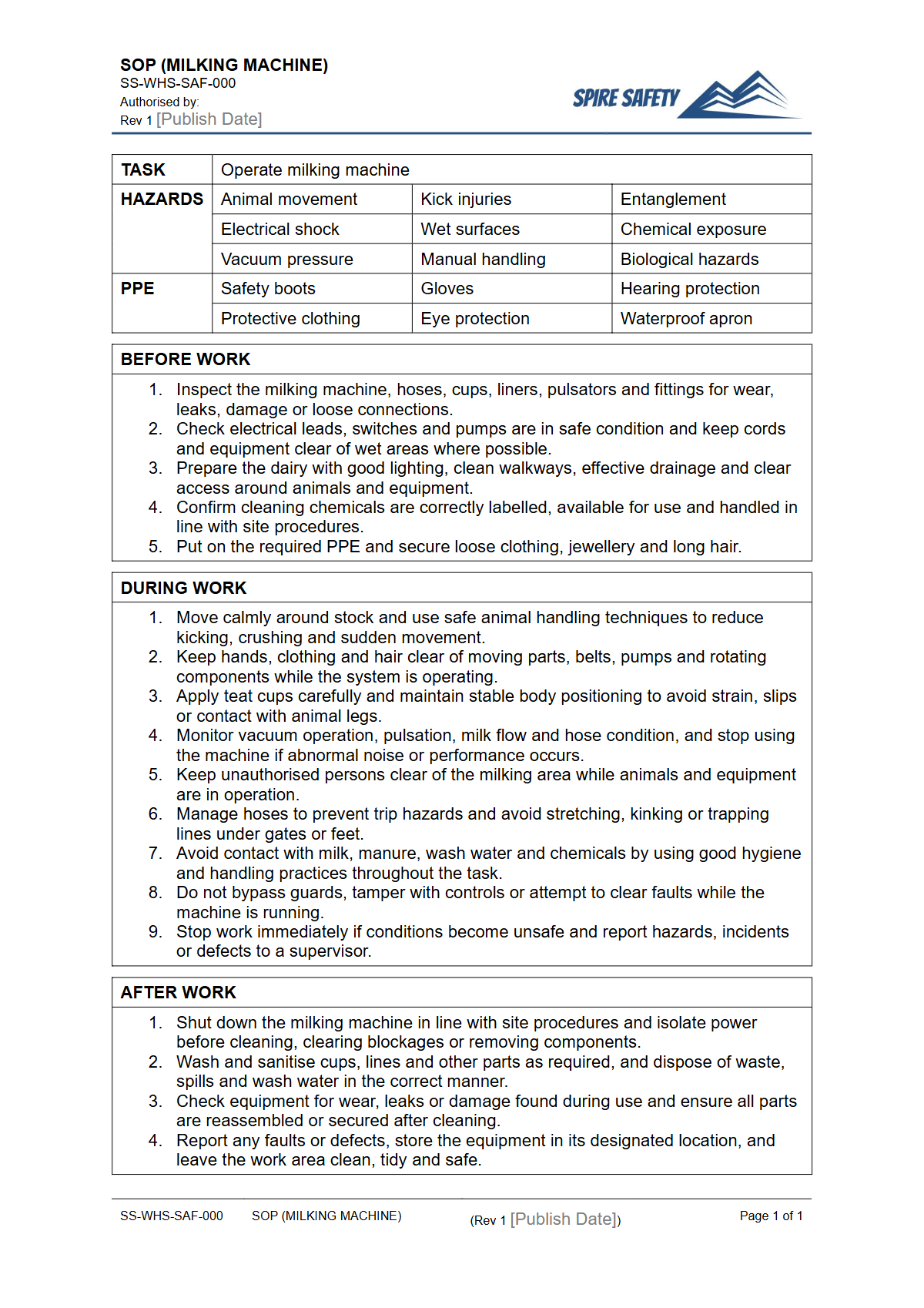
Download the template in your preferred format—a fully editable DOCX file or a ready-to-print PDF. The document is organised into logical sections, including required personal protective equipment (PPE), pre-start safety checks, step-by-step operating instructions, shutdown procedures, and cleaning and maintenance guidelines.
This structure is designed to be intuitive for workers and straightforward for managers to implement.
Important: This template provides a foundation aligned with Australian WHS practice, but it is not a complete, out-of-the-box solution. You must customise this document to reflect the specific make and model of your milking machines, the layout of your dairy, the chemicals used, and any unique site hazards.
We recommend a competent person reviews and tailors the content to ensure it is specific and relevant to your workplace.
Engaging your team in the customisation process is highly beneficial. Workers who operate the equipment daily have valuable insights into the practical realities and risks of the task.
Their involvement ensures the final SOP is practical and readily adopted. This principle applies to all agricultural machinery, whether it's creating a procedure for a milking parlour or finalising a FREE Grain Drill SOP Template for cropping operations.
When to use it
A Safe Operating Procedure for milking machines should be a core document used in multiple contexts. It is essential for inducting new farm workers and for providing refresher training to existing staff, ensuring everyone follows the same safe and efficient process.
The SOP should be readily accessible in the work area for quick reference during daily operations.
The document is also a critical tool during formal reviews of your safety practices. It provides a benchmark for conducting periodic safety observations and is an essential piece of evidence during internal or external audits.
Having well-maintained SOPs can streamline the process of a WHS compliance auditing engagement.
Furthermore, the SOP should be reviewed and updated after any incident or near-miss, or whenever a change is made to the equipment, chemicals, or work environment. This continuous improvement cycle is vital for maintaining a safe workplace and applies to all farm equipment, including when refining procedures outlined in a FREE Spreader SOP (Safe Operating Procedure) Template.
Who should use it
This template is designed for anyone responsible for workplace safety in a dairy farming context. This includes Farm Owners, Dairy Managers, and WHS Officers who need to develop, implement, and maintain safety documentation.
It provides them with a professional, structured document that can be adapted to their specific operational needs.
The primary end-users of the completed SOP are the farm workers, milkers, and dairy hands who operate the equipment each day. The procedure provides them with clear, unambiguous instructions that promote safe work habits and reduce the risk of error or injury.
It serves as both a training guide and an on-the-job reminder of correct procedure.
Maintenance personnel and technicians will also find the SOP useful, particularly the sections on shutdown, isolation, and cleaning. It ensures that maintenance work is conducted safely without exposing staff to electrical, mechanical, or chemical hazards. Many farms use equipment beyond the dairy itself; for those tasks, you can find more guidance in our free WHS resources library.
Common mistakes
Common mistakes to avoid
- Failing to customise the template with site-specific information, such as emergency contacts and equipment models.
- Not involving experienced workers in the drafting and review process, leading to an impractical document.
- Neglecting to provide adequate training on the finalised SOP, making it a 'tick and flick' exercise.
- Forgetting to schedule regular reviews, causing the SOP to become outdated and irrelevant.
Legal references
Legal considerations
The following legal requirements may be relevant to this type of work.
- Work Health and Safety Act (Harmonised) — Provides the primary duties for protecting workers and other people from work health and safety risks.
- Work Health and Safety Regulations (Harmonised) — Sets out requirements supporting the management of workplace hazards and risks.
The following codes may be relevant to this type of work.
- Managing WHS Risks Code of Practice — Provides practical guidance on identifying hazards, assessing risks and applying effective controls.
- Work Health and Safety Consultation, Cooperation and Coordination Code of Practice — Provides practical guidance on consulting workers and coordinating with other duty holders.
- Managing the Work Environment and Facilities Code of Practice — Provides practical guidance on safe work environments, workplace facilities and related controls.
Did you know
A Pain in the Back
According to Safe Work Australia, the agriculture industry has one of the highest rates of serious workers' compensation claims, with body stressing (musculoskeletal injuries) being a leading cause of injury.
FAQ
Frequently asked questions
01What hazards are associated with milking machines?
02How often should a milking machine SOP be reviewed?
03Is a Safe Operating Procedure a legal requirement in Australia?
04Can this template be used for different types of milking machines?
Share this resource
Free Safe Operating Procedure (Milking Machine) Template
Browse Categories
How To Use It
- 1Download and open in Word or PDF.
- 2Replace the placeholders with your business details.
- 3Get it reviewed by a WHS specialist before rollout.
Need it customised?
Our WHS consultants can adapt this template to your site, run a gap analysis, or audit what you already have in place.
Book a Free Consultation WHS consulting servicesor call 1300 156 382
Related templates
- Free Safe Operating Procedure (Milkshake Mixer) Template
- Free Safe Operating Procedure (Mincer Bowl Cutter Operation) Template
- Free Safe Operating Procedure (Mine Dewatering) Template
- Free Safe Operating Procedure (Mine Ventilation Fan) Template
- Free Safe Operating Procedure (Mixed Recycling Sort) Template
- Free Safe Operating Procedure (Mobile Crane Setup) Template