
Free Safe Operating Procedure (Milkshake Mixer) Template
Formalise safety protocols for your commercial milkshake mixer with our structured template. Download your free Safe Operating Procedure to get started.
Free Safe Operating Procedure (Milkshake Mixer) Template
DOCX • 126 KB + PDF
Updated Oct 2026
No signup required
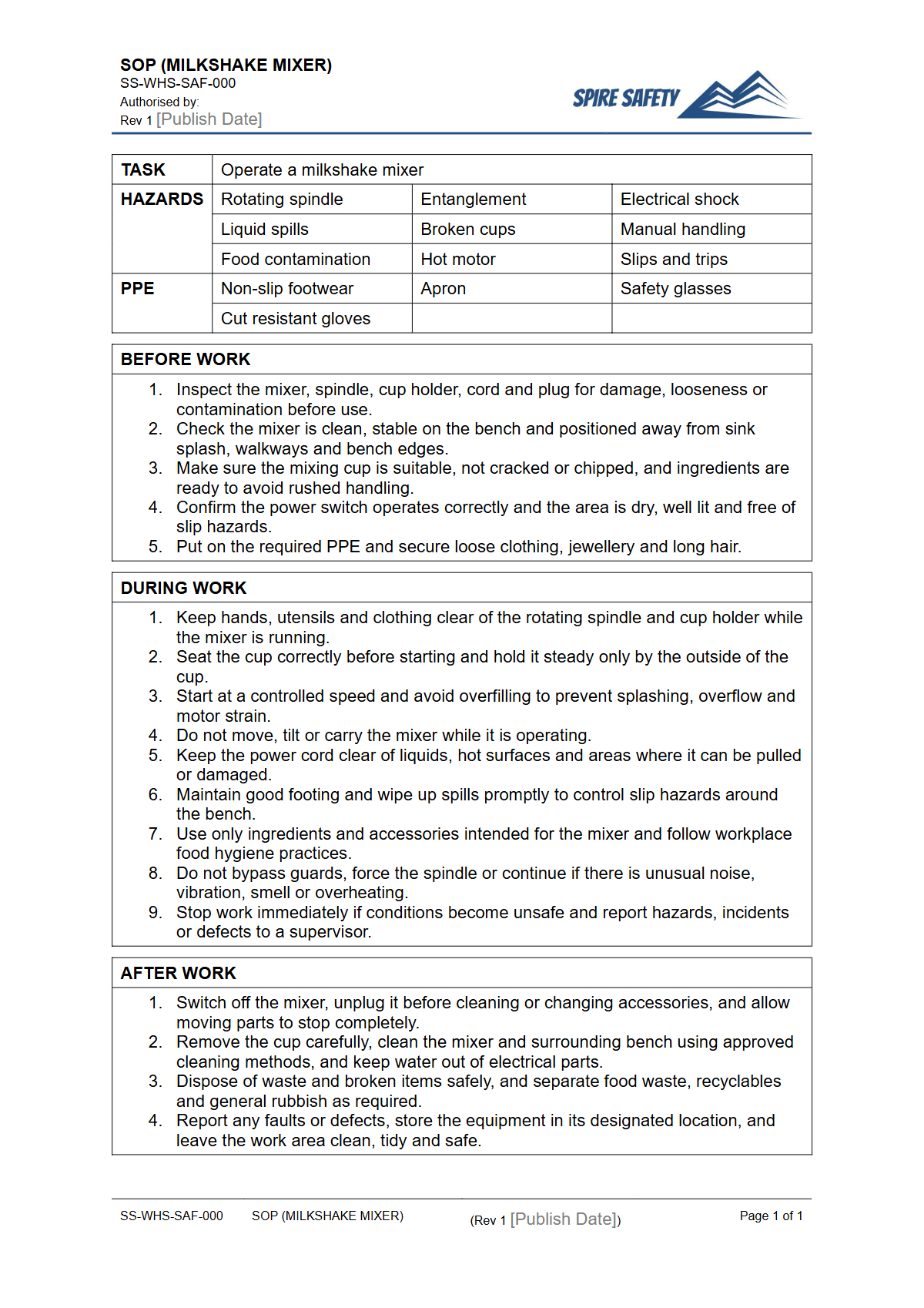
Purpose of the Free Safe Operating Procedure (Milkshake Mixer) Template
A Safe Operating Procedure (SOP) is a fundamental document in any workplace health and safety system, providing clear, step-by-step instructions on how to perform a specific task safely. This free Safe Operating Procedure (Milkshake Mixer) template is designed for businesses in the hospitality and food service industries to establish and document safe work methods for using commercial milkshake mixers.
It helps your organisation control risks associated with the equipment, reducing the likelihood of injuries from electrical, mechanical, or hygiene-related hazards. Using a structured SOP ensures consistency in training and operation, forming a key part of your duty of care to employees.
By outlining pre-operational checks, safe operational steps, and procedures for cleaning and maintenance, this template helps you systematically manage risks. It serves as a practical tool for workers to reference and for supervisors to use during training and competency assessments.
Similar to a Safe Operating Procedure for a deep fryer, it focuses on the specific hazards of a single piece of kitchen equipment, which is a best-practice approach to risk management.
Video walkthrough
How to use the Free Safe Operating Procedure (Milkshake Mixer) Template
This resource is provided as a fully editable DOCX file, with a PDF version also available for easy printing and distribution. To make this document effective for your workplace, you must customise it to reflect your specific environment and equipment.
Generic procedures are a starting point, but true safety comes from detail.
We strongly advise you to do the following:
- Consult with the workers who actually use the milkshake mixers. Their experience is invaluable for identifying practical challenges and effective safety measures.
- Insert the specific make and model of the equipment used in your workplace.
- Add site-specific details, such as the location of emergency stop buttons and relevant first aid facilities.
- Incorporate your organisation's specific emergency procedures, reporting processes, and required Personal Protective Equipment (PPE).
- Review and approve the final document by a competent person before implementation.
When to use this Safe Operating Procedure
An SOP for a milkshake mixer should be a living document integrated into your daily operations, not just a file saved on a hard drive. It is most effective when used in several key situations.
It should be a core component of the induction process for any new employee who will be required to operate the equipment. The SOP also serves as the basis for refresher training, ensuring that all workers remain aware of safe practices over time.
Furthermore, it should be made readily available in the work area—either as a laminated copy near the mixer or accessible via a digital device—so workers can reference it before starting a task, especially if they use the machine infrequently.
Integrating this document into your broader safety framework demonstrates a proactive approach to hazard management. For a more holistic view, consider how individual SOPs contribute to your overall WHS management systems, ensuring a consistent and systematic approach to safety across your entire organisation.
Who should use it
This Safe Operating Procedure is intended for all personnel involved with the milkshake mixer. This primarily includes food and beverage attendants, kitchen hands, and baristas who operate and clean the machine daily.
Supervisors and managers should also use the document to guide their training, supervision, and performance monitoring activities. It provides them with a clear benchmark for what safe operation looks like.
WHS representatives and committee members can use the SOP as a reference during workplace inspections and risk assessments. Ultimately, anyone with a responsibility for health and safety in the workplace can benefit from this structured guide.
Key Hazards of Milkshake Mixer Operation
While seemingly simple, milkshake mixers present several hazards that must be managed. This SOP template prompts you to consider controls for:
- Electrical Hazards: Risk of electric shock from faulty cords, plugs, or internal wiring, especially when liquids are present. The procedure should include checks for damaged electrical components.
- Mechanical Hazards: The primary hazard is entanglement of hair, clothing, jewellery, or cleaning cloths in the rotating spindle. Procedures must enforce that the machine is de-energised during cleaning.
- Slips, Trips, and Falls: Spilled milk, syrup, or ice cream on the floor can create a significant slip hazard. Good housekeeping practices are essential.
- Hygiene Hazards: Improper cleaning can lead to bacterial growth, posing a risk to both workers and customers. The SOP details a specific cleaning and sanitising process.
- Ergonomic Hazards: Repetitive movements during busy periods can lead to strain injuries. While not a primary focus of this SOP, it's a related hazard to consider in your overall risk assessment. Similar principles of equipment safety apply across various plant, as outlined in documents like our Free Air Compressor SOP.
Reviewing and Maintaining Your SOP
A Safe Operating Procedure is not a 'set and forget' document. To remain effective, it must be reviewed and, if necessary, updated on a regular basis.
A review should be triggered whenever there is a change to the equipment, the process, or the work environment. It should also be reviewed after any incident or near miss involving the milkshake mixer.
Scheduling a periodic review, such as annually, is a good practice to ensure the procedure remains current and relevant. These reviews help maintain a high standard of safety and are a key activity in regular WHS compliance auditing.
This template is one of many tools available to help you build a safer workplace. For more templates, checklists, and guides, browse our complete free WHS resources library.
Common mistakes
Common mistakes to avoid
- Using the downloaded template without customising it for the specific mixer model and work environment.
- Failing to adequately train all relevant workers on the finalised SOP, assuming they will just read it.
- Not making the SOP easily accessible to workers at the point of use.
- Neglecting to include specific cleaning steps that require the machine to be unplugged and de-energised.
Legal references
Legal considerations
The following legal requirements may be relevant to this type of work.
- Work Health and Safety Act (Harmonised) — Provides the primary duties for protecting workers and other people from work health and safety risks.
- Work Health and Safety Regulations (Harmonised) — Sets out requirements supporting the management of workplace hazards and risks.
The following codes may be relevant to this type of work.
- Managing WHS Risks Code of Practice — Provides practical guidance on identifying hazards, assessing risks and applying effective controls.
- Work Health and Safety Consultation, Cooperation and Coordination Code of Practice — Provides practical guidance on consulting workers and coordinating with other duty holders.
- Managing the Work Environment and Facilities Code of Practice — Provides practical guidance on safe work environments, workplace facilities and related controls.
Did you know
Invention of the Mixer
The modern electric blender, which evolved into the milkshake mixer, was invented in 1922 by Stephen Poplawski. His primary innovation was placing a spinning blade at the bottom of a container, a design that revolutionised the preparation of drinks like milkshakes and smoothies.
Kitchen Electrical Safety
In commercial kitchens, water and electricity are in constant proximity, increasing the risk of electric shock. A faulty appliance, like a mixer with a damaged cord, can easily become energised, making regular equipment inspection a critical safety task.
FAQ
Frequently asked questions
01What should be included in a milkshake mixer SOP?
02How often should a Safe Operating Procedure for a milkshake mixer be reviewed?
03Is a Safe Operating Procedure a legal requirement in Australia?
04Can this template be used for any brand of commercial milkshake mixer?
Share this resource
Free Safe Operating Procedure (Milkshake Mixer) Template
Browse Categories
How To Use It
- 1Download and open in Word or PDF.
- 2Replace the placeholders with your business details.
- 3Get it reviewed by a WHS specialist before rollout.
Need it customised?
Our WHS consultants can adapt this template to your site, run a gap analysis, or audit what you already have in place.
Book a Free Consultation WHS consulting servicesor call 1300 156 382
Related templates
- Free Safe Operating Procedure (Mincer Bowl Cutter Operation) Template
- Free Safe Operating Procedure (Mine Dewatering) Template
- Free Safe Operating Procedure (Mine Ventilation Fan) Template
- Free Safe Operating Procedure (Mixed Recycling Sort) Template
- Free Safe Operating Procedure (Mobile Crane Setup) Template
- Free Safe Operating Procedure (Mobility Aid Storage) Template