
Free Safe Operating Procedure (Milk Frother) Template
Download our free Safe Operating Procedure (Milk Frother) template. A structured starting point for cafes and hospitality venues in Australia.
Free Safe Operating Procedure (Milk Frother) Template
DOCX • 126 KB + PDF
Updated Oct 2026
No signup required
Purpose of the Free Safe Operating Procedure (Milk Frother) Template
Get started with our free Safe Operating Procedure (Milk Frother) Template, a practical resource for Australian cafes, restaurants, and hospitality businesses. While a milk frother or espresso machine steam wand may seem like simple equipment, they introduce significant workplace hazards, primarily from pressurised steam, hot surfaces, and hot liquids.
This template provides a structured format to document the safest way to perform this common task, helping you meet your duty of care as a Person Conducting a Business or Undertaking (PCBU).
Using a documented procedure helps standardise training, reduces the risk of burn injuries, and ensures consistent cleaning and maintenance. It forms a key part of your safety management system by formally identifying risks and outlining clear control measures.
This SOP is not just about compliance; it's about creating a reliably safe environment for your baristas and kitchen staff. Implementing clear, task-specific procedures is a fundamental component of effective WHS management systems.
Video walkthrough
How to use the Free Safe Operating Procedure (Milk Frother) Template
This Safe Operating Procedure for a milk frother is provided in an editable DOCX format so you can adapt it to your specific workplace. It is crucial that you customise the document to reflect the exact make and model of your coffee machine or standalone frother, your workplace layout, and your existing safety protocols.
A generic procedure that doesn't match your reality offers little practical protection.
Customisation is Essential
You must consult with your workers—the baristas and staff who use the equipment daily—during the customisation process. Their hands-on experience is invaluable for identifying practical steps and unforeseen risks.
We have provided this template as a guide based on common WHS practice, but we are not WHS consultants and cannot know the specific hazards of your workplace. You are responsible for ensuring the final document is accurate and suitable for your business needs.
Key Sections of the Template
The template guides you through several critical areas:
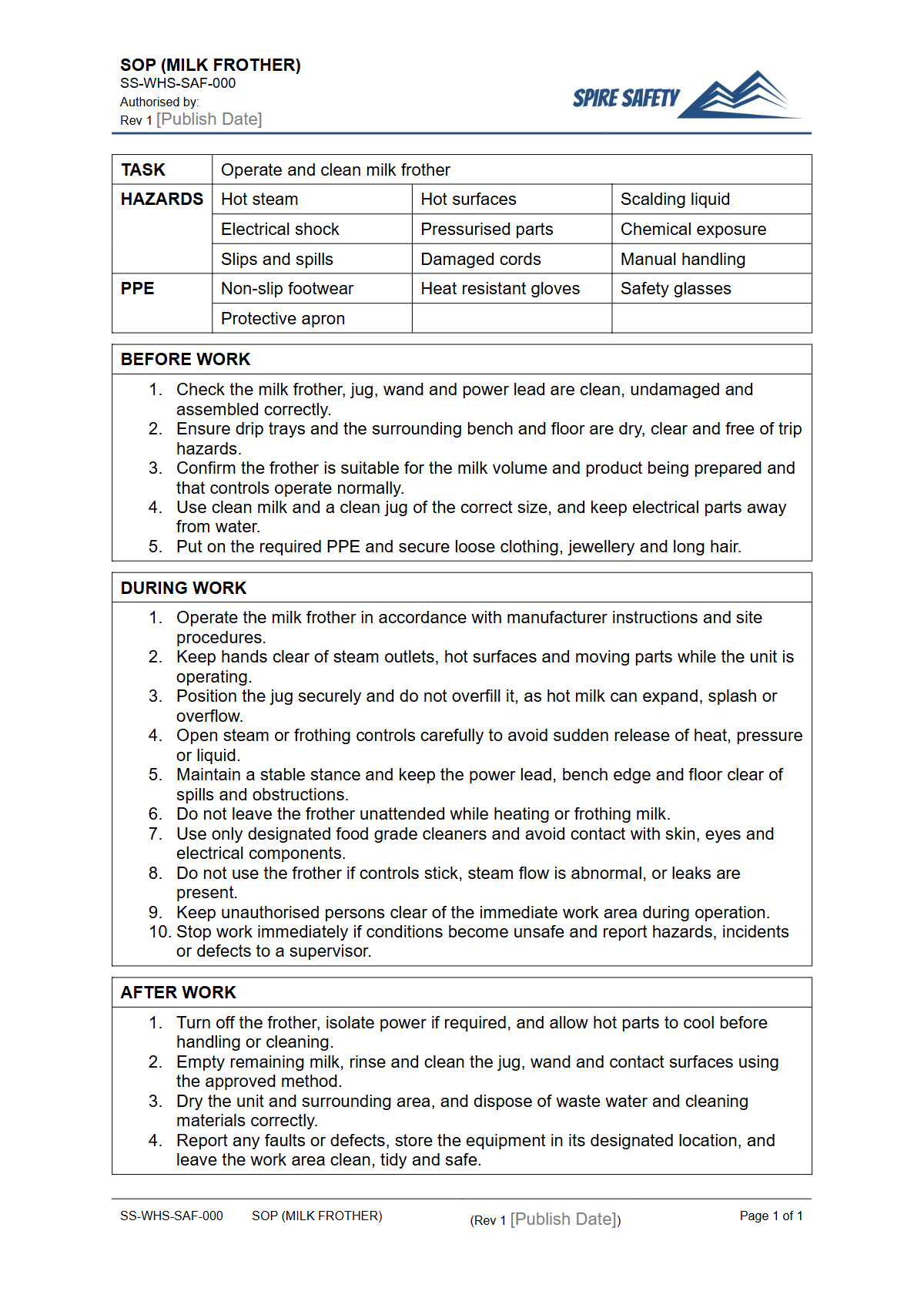
- Hazards & Risks: Pre-filled with common hazards like steam burns, contact with hot surfaces, electrical risks, and slip hazards from spills. Add any others specific to your setup.
- Personal Protective Equipment (PPE): Specifies required PPE, although for milk frothing this is often minimal and focuses on safe work practices instead.
- Pre-Operational Checks: A checklist for workers to run through before their shift, such as checking for damaged cords, ensuring the steam wand is clear, and checking pressure gauges. Just as a worker should check their tools before use, whether it's a coffee machine or a simple ladder, these checks are vital. Our FREE Step Ladder SOP Template reinforces this same principle of pre-use inspection for all equipment.
- Step-by-Step Instructions: A section for you to detail the sequential process of frothing milk safely, from purging the wand to the correct techniques for heating and texturing.
- Cleaning and Maintenance: Outlines procedures for daily cleaning (purging and wiping the wand) and any periodic maintenance like descaling, which is crucial for preventing blockages and pressure issues.
When to use the Milk Frother SOP
A Safe Operating Procedure is a dynamic document that should be used and reviewed regularly. It is most effective when integrated into your daily operations.
Use it during new staff induction and training to ensure they learn the correct, safe method from day one. It should also be a reference point for refresher training.
The SOP must be reviewed after any incident, accident, or near miss involving the equipment. It's also wise to schedule a review when a new coffee machine is installed or if procedures change.
Regular reviews of your SOPs should be a standard part of any internal or external WHS compliance auditing program.
Who should use this SOP
This SOP is intended for use by any business where milk frothing is performed. This includes cafes, restaurants, hotels, and even office kitchens with commercial-grade coffee machines.
The primary responsibility for implementing the SOP lies with the PCBU, but its daily use is for supervisors, managers, and the workers themselves, such as baristas and all-rounders. For workers, it is a clear guide to performing their tasks safely.
For supervisors, it is a tool for training, monitoring, and enforcing safe work practices. An SOP for a milk frother, much like one for other common hospitality equipment like a small air compressor for cleaning, demonstrates a commitment to managing all workplace risks, not just the most obvious ones.
For organisations wanting to take a more structured approach, embedding these procedures within a certified framework like ISO 45001 can be highly beneficial, and our ISO 45001 consulting services can guide you through that process.
Common mistakes
Common mistakes to avoid
- Using a generic template without customising it for the specific make and model of the coffee machine.
- Failing to adequately train staff on the SOP, assuming they will simply read and follow it.
- Neglecting to include detailed cleaning and descaling procedures, which are vital for safe operation.
- Not consulting experienced baristas during the drafting process, thereby missing crucial real-world risks and techniques.
Legal references
Legal considerations
The following legal requirements may be relevant to this type of work.
- Work Health and Safety Act (Harmonised) — Provides the primary duties for protecting workers and other people from work health and safety risks.
- Work Health and Safety Regulations (Harmonised) — Sets out requirements supporting the management of workplace hazards and risks.
The following codes may be relevant to this type of work.
- Managing WHS Risks Code of Practice — Provides practical guidance on identifying hazards, assessing risks and applying effective controls.
- Work Health and Safety Consultation, Cooperation and Coordination Code of Practice — Provides practical guidance on consulting workers and coordinating with other duty holders.
- Managing the Work Environment and Facilities Code of Practice — Provides practical guidance on safe work environments, workplace facilities and related controls.
Did you know
Steam Power
Commercial espresso machine steam wands operate at 1–1.5 bar of pressure, producing superheated steam over 100°C that can cause severe scalds in less than a second.
Not Just Burns
Besides burns, a common injury associated with high-volume milk frothing is musculoskeletal strain, such as 'barista wrist', from repetitive and awkward wrist and shoulder movements.
FAQ
Frequently asked questions
01Is an SOP legally required for a milk frother in Australia?
02What are the main hazards of using a commercial milk frother?
03Who is responsible for writing a Safe Operating Procedure?
04How often should we review our milk frother SOP?
Share this resource
Free Safe Operating Procedure (Milk Frother) Template
Browse Categories
How To Use It
- 1Download and open in Word or PDF.
- 2Replace the placeholders with your business details.
- 3Get it reviewed by a WHS specialist before rollout.
Need it customised?
Our WHS consultants can adapt this template to your site, run a gap analysis, or audit what you already have in place.
Book a Free Consultation WHS consulting servicesor call 1300 156 382
Related templates
- Free Safe Operating Procedure (Milk Vat Cleaning) Template
- Free Safe Operating Procedure (Milking Machine) Template
- Free Safe Operating Procedure (Milkshake Mixer) Template
- Free Safe Operating Procedure (Mincer Bowl Cutter Operation) Template
- Free Safe Operating Procedure (Mine Dewatering) Template
- Free Safe Operating Procedure (Mine Ventilation Fan) Template