
Free Safe Operating Procedure (MIG Spot Welding) Template
Download our Free Safe Operating Procedure for MIG Spot Welding to establish clear safety guidelines. This template helps you outline risks and controls.
Free Safe Operating Procedure (MIG Spot Welding) Template
DOCX • 126 KB + PDF
Updated Oct 2026
No signup required
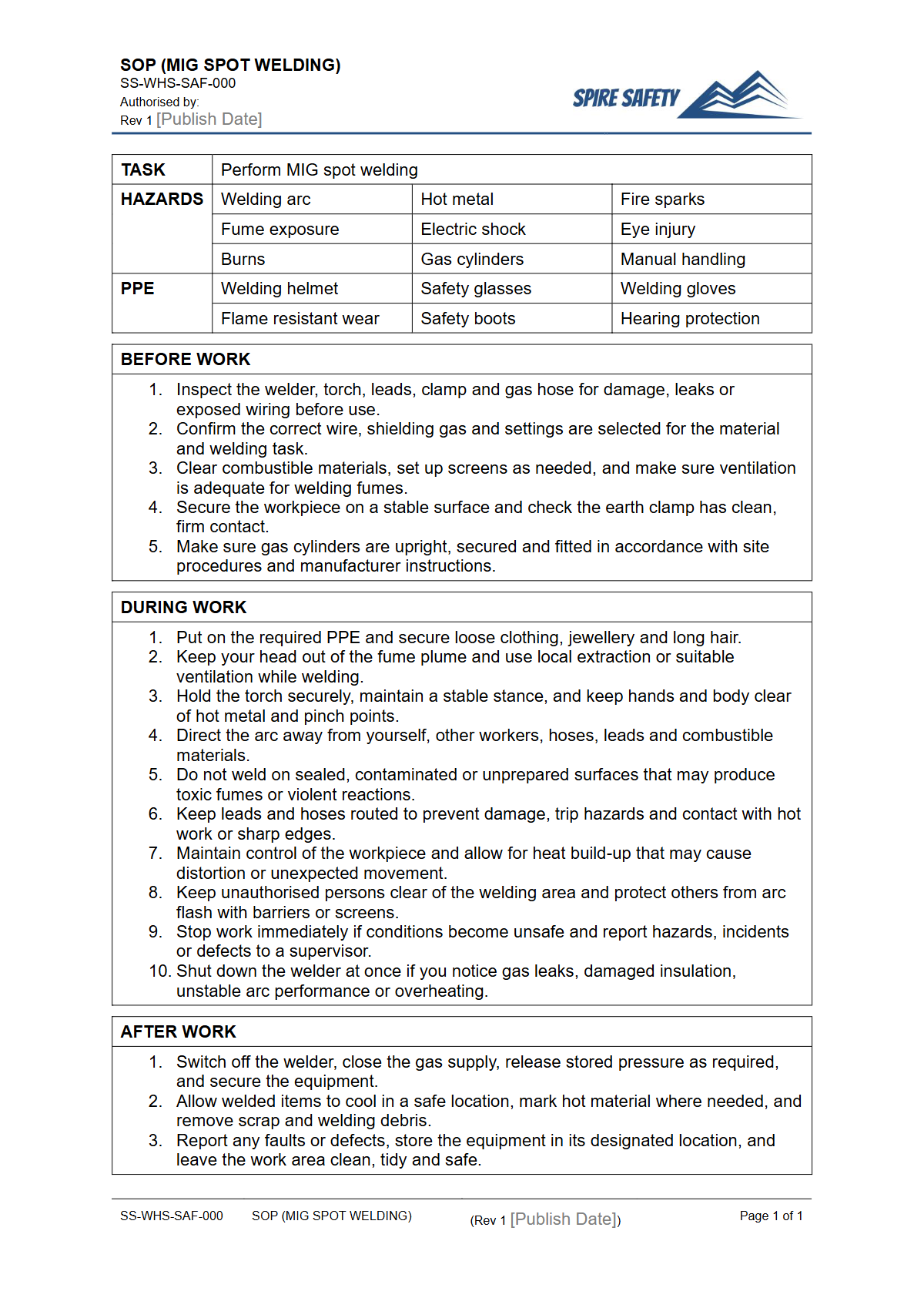
Purpose of the Free Safe Operating Procedure (MIG Spot Welding) Template
This Free Safe Operating Procedure (MIG Spot Welding) Template provides a structured framework for documenting the safe use of MIG spot welders in your workplace. Developing a formal SOP is a critical step in managing the significant risks associated with welding, including electric shock, thermal burns from spatter, exposure to ultraviolet (UV) radiation, and the inhalation of hazardous fumes.
By outlining a clear, step-by-step process, this document helps ensure tasks are performed safely and consistently by all operators, reducing the likelihood of incidents and injuries.
A well-defined SOP is a fundamental component of any effective safety framework. It serves as a key operational document within broader WHS management systems, demonstrating your organisation's commitment to providing a safe working environment.
This template helps you formalise pre-operational checks, operational steps, and post-operational procedures, ensuring all safety controls are clearly communicated to workers.
Video walkthrough
How to use the Free Safe Operating Procedure (MIG Spot Welding) Template
Simply download the template in your preferred format (DOCX for easy editing or PDF for straightforward printing) and begin populating it with information specific to your business. It is crucial to adapt the content to match the exact make and model of your welding equipment, the materials being worked on, and the unique conditions of your work area.
Important: This document is a template and must be customised to your specific workplace requirements. We strongly recommend that a competent person, with direct knowledge of MIG spot welding and your operational context, leads this customisation process.
This involves consulting directly with the workers who operate the equipment to ensure the SOP is practical, accurate, and reflects how the task is actually performed.
This process of tailoring documentation is standard for all high-risk equipment. For instance, creating a procedure for a workshop compressor would follow a similar customisation path, just like the process for our Free Air Compressor SOP Template.
When to use it
A Safe Operating Procedure for MIG spot welding should be an active document, not one that is filed away and forgotten. It should be used consistently for:
- Operator Training: As a core training document for new or inexperienced workers.
- Pre-start Reference: As a quick reference guide for operators to review before commencing work.
- Refresher Training: During toolbox talks or scheduled refresher sessions to reinforce safe work practices.
- Risk Management: As a reference point when conducting risk assessments or investigating incidents.
The existence and proper use of SOPs are often a key focus during safety inspections. They serve as tangible evidence of your risk control measures during internal or external WHS compliance auditing.
Who should use it
This SOP is designed for several key roles within a workplace:
- Operators: The primary users, who must understand and follow the procedure to ensure their own safety and the safety of others.
- Supervisors and Managers: To train workers, monitor compliance, and ensure safety standards are being met on the workshop floor.
- WHS/HSE Personnel: To develop, review, and integrate the SOP into the broader safety management system.
- Maintenance Staff: To understand the safe shutdown, isolation, and cleaning procedures required before performing maintenance or repairs.
Documenting procedures for all workshop equipment is a vital part of a safe system of work. For example, similar principles apply when creating an SOP for other common tools, as shown in our FREE Circular Saw SOP Template. Explore our complete catalogue of document templates and safety guides in our free WHS resources library to further strengthen your workplace safety protocols.
Common mistakes
Common mistakes to avoid
- Using incorrect PPE, such as wearing flammable synthetic clothing or using a helmet with the wrong lens shade.
- Failing to ensure adequate ventilation, leading to the accumulation and inhalation of toxic fumes.
- Neglecting to clear the work area of flammable or combustible materials before starting to weld.
- Skipping pre-use equipment inspections, particularly checks of cables, gas lines, and safety features.
Legal references
Legal considerations
The following legal requirements may be relevant to this type of work.
- Work Health and Safety Act (Harmonised) — Provides the primary duties for protecting workers and other people from work health and safety risks.
- Work Health and Safety Regulations (Harmonised) — Sets out requirements supporting the management of workplace hazards and risks.
The following codes may be relevant to this type of work.
- Managing WHS Risks Code of Practice — Provides practical guidance on identifying hazards, assessing risks and applying effective controls.
- Work Health and Safety Consultation, Cooperation and Coordination Code of Practice — Provides practical guidance on consulting workers and coordinating with other duty holders.
- Managing the Work Environment and Facilities Code of Practice — Provides practical guidance on safe work environments, workplace facilities and related controls.
Did you know
Welding Fumes are Carcinogenic
In 2017, the International Agency for Research on Cancer (IARC) reclassified welding fumes as a Group 1 carcinogen, meaning there is sufficient evidence to link them to cancer in humans.
Invisible Danger
The intense UV radiation from a welding arc can cause severe sunburn on exposed skin and 'arc eye' in minutes, even from a distance. Always use appropriate auto-darkening helmets and protective clothing.
FAQ
Frequently asked questions
01What are the main hazards of MIG spot welding?
02Is a Safe Operating Procedure a legal requirement for welding in Australia?
03How often should a MIG welding SOP be reviewed?
04Who is a 'competent person' to write or approve a welding SOP?
Share this resource
Free Safe Operating Procedure (MIG Spot Welding) Template
Browse Categories
How To Use It
- 1Download and open in Word or PDF.
- 2Replace the placeholders with your business details.
- 3Get it reviewed by a WHS specialist before rollout.
Need it customised?
Our WHS consultants can adapt this template to your site, run a gap analysis, or audit what you already have in place.
Book a Free Consultation WHS consulting servicesor call 1300 156 382
Related templates
- Free Safe Operating Procedure (Milk Fridge Cleaning) Template
- Free Safe Operating Procedure (Milk Frother) Template
- Free Safe Operating Procedure (Milk Vat Cleaning) Template
- Free Safe Operating Procedure (Milking Machine) Template
- Free Safe Operating Procedure (Milkshake Mixer) Template
- Free Safe Operating Procedure (Mincer Bowl Cutter Operation) Template