
Free Safe Operating Procedure (Milk Fridge Cleaning) Template
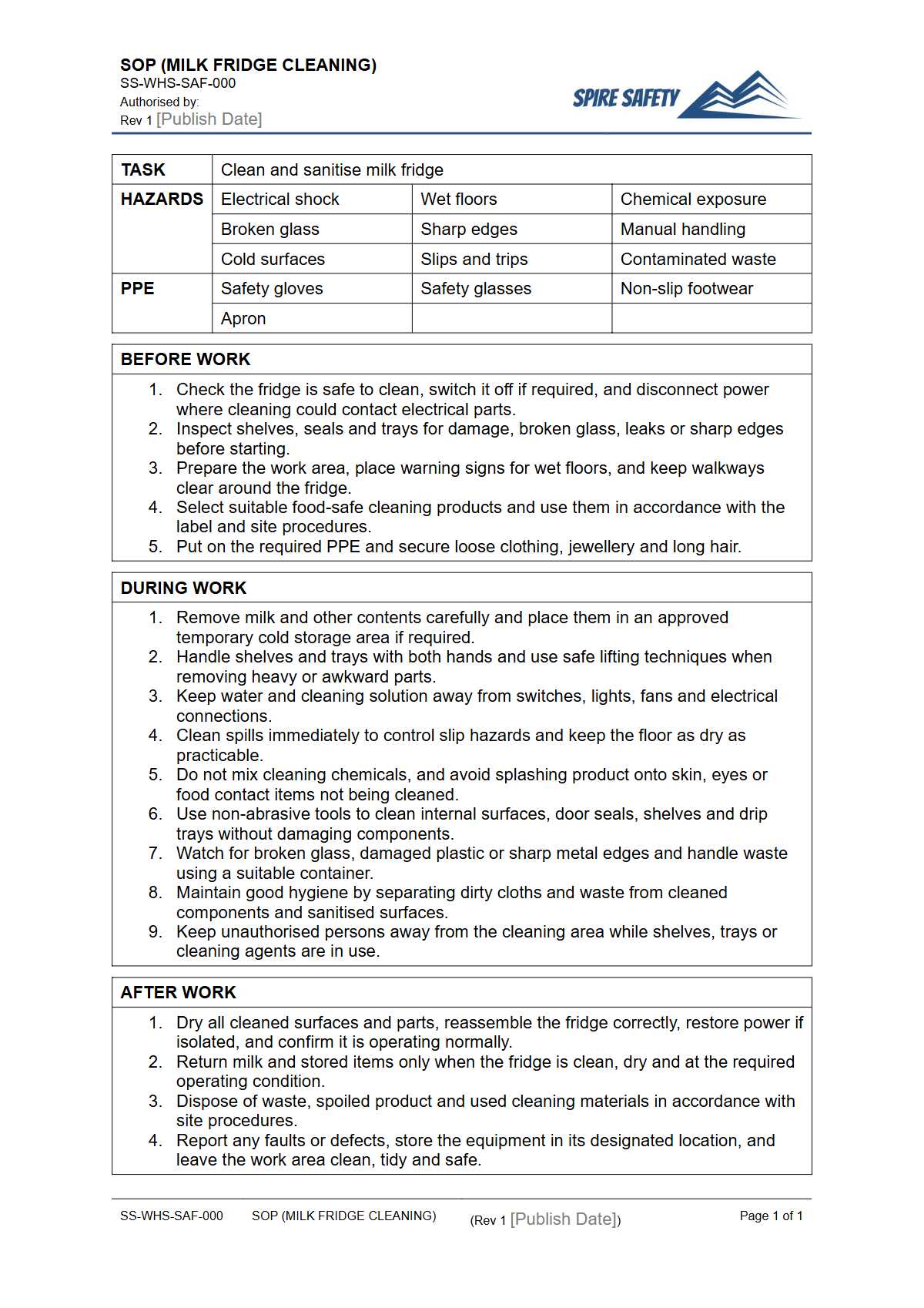
Download our free Safe Operating Procedure (Milk Fridge Cleaning) Template. This structured Word & PDF document helps outline safety steps for your workplace.
Free Safe Operating Procedure (Milk Fridge Cleaning) Template
DOCX • 126 KB + PDF
Updated Oct 2026
No signup required
Purpose of the Free Safe Operating Procedure (Milk Fridge Cleaning) Template
Maintaining hygiene in a workplace kitchen or hospitality environment is critical for both health and safety. Our Free Safe Operating Procedure (Milk Fridge Cleaning) Template provides a structured framework for documenting the steps required to clean commercial and office milk fridges safely and effectively.
This document helps you manage risks associated with electrical appliances, cleaning chemicals, manual handling, and food safety. By establishing a clear, repeatable process, you can ensure consistency, train staff effectively, and demonstrate a commitment to a safe system of work.
This Safe Operating Procedure is designed as a foundational document, aligned with Australian WHS best practices. It helps a Person Conducting a Business or Undertaking (PCBU) fulfil their primary duty of care by providing clear instruction on a routine workplace task.
Implementing standardised procedures is a core component of any effective safety framework, helping to minimise the risk of incidents and ensure hygiene standards are met. Integrating this SOP into your broader WHS management systems creates a more robust and organised approach to workplace safety.
Video walkthrough
How to use the Free Safe Operating Procedure (Milk Fridge Cleaning) Template
This template is provided in an editable DOCX format, allowing for complete customisation to your specific workplace. It is pre-filled with common steps, hazards, and control measures relevant to cleaning a milk fridge, but it must be adapted to reflect your unique environment, equipment, and cleaning products.
Once downloaded, review and edit each section to ensure it aligns perfectly with your operational requirements.
Important: We have drafted this document as a starting point. You must consult with your workers and customise the SOP to address the specific hazards in your workplace.
This includes listing the exact make and model of the fridge, specifying the approved cleaning chemicals and personal protective equipment (PPE), and adding any site-specific emergency procedures. Finalising this document is a key step in managing your workplace risks.
When to use a Milk Fridge Cleaning SOP
A Safe Operating Procedure for milk fridge cleaning should be used every time the task is performed. It serves as both a training tool for new employees and a reference guide for experienced staff to ensure no steps are missed.
It is particularly important in environments with high staff turnover, such as cafes and restaurants, where consistent training and performance are essential for food safety and WHS compliance.
This procedure should also be reviewed and referenced during internal safety checks or formal audits. Regular verification ensures the documented process is still relevant and being followed correctly.
If you conduct periodic internal reviews, this SOP serves as the benchmark against which worker behaviour can be assessed, often as part of a comprehensive WHS compliance auditing program.
Who should use this Safe Operating Procedure
This SOP is intended for any worker or team member responsible for cleaning workplace amenities or food service equipment. This includes kitchen staff, cleaners, office managers, and designated WHS officers.
Supervisors and managers should use the document to train their teams and verify that the cleaning process is completed correctly and safely. The SOP ensures that everyone, regardless of their experience level, follows the same approved method.
WHS managers and business owners can use this template as part of their broader safety documentation portfolio. It provides evidence that risks for a common task have been identified and controlled.
In some settings, a worker may need to use other equipment to complete the task, such as reaching high shelves. For these related tasks, specific procedures should also be available, such as our FREE Step Ladder SOP Template, to ensure end-to-end safety.
Further Customisation and Support
While this template provides a solid foundation, tailoring it to your exact needs is vital. If you require assistance in developing or customising SOPs, conducting risk assessments, or implementing your safety management system, expert guidance can be invaluable.
Our WHS consulting services provide practical support to help you meet your obligations and create a safer workplace. You can also explore our complete free WHS resources library for a wide range of other templates and guides.
Common mistakes
Common mistakes to avoid
- Forgetting to disconnect the fridge from the power source before cleaning.
- Using incorrect or improperly diluted cleaning chemicals, risking surface damage or chemical hazards.
- Not allowing the fridge to return to its safe operating temperature (<5°C) before restocking it with milk.
- Failing to document that the cleaning was completed, which can be a compliance issue for food businesses.
Legal references
Legal considerations
The following legal requirements may be relevant to this type of work.
- Work Health and Safety Act (Harmonised) — Provides the primary duties for protecting workers and other people from work health and safety risks.
- Work Health and Safety Regulations (Harmonised) — Sets out requirements supporting the management of workplace hazards and risks.
The following codes may be relevant to this type of work.
- Managing WHS Risks Code of Practice — Provides practical guidance on identifying hazards, assessing risks and applying effective controls.
- Work Health and Safety Consultation, Cooperation and Coordination Code of Practice — Provides practical guidance on consulting workers and coordinating with other duty holders.
- Managing the Work Environment and Facilities Code of Practice — Provides practical guidance on safe work environments, workplace facilities and related controls.
Did you know
Food Safety Link
Improperly cleaned milk fridges can be a breeding ground for harmful bacteria, including Listeria. Maintaining a strict cleaning schedule is a critical control for preventing foodborne illness in the workplace.
Temperature Danger Zone
The 'temperature danger zone' for food like milk, where bacteria multiply fastest, is between 5°C and 60°C. Australian food safety standards require that potentially hazardous food be stored at 5°C or colder.
FAQ
Frequently asked questions
01What are the main hazards when cleaning a milk fridge?
02Is an SOP for fridge cleaning legally required in Australia?
03How often should a milk fridge cleaning SOP be reviewed?
04What is the difference between an SOP and a SWMS?
Share this resource
Free Safe Operating Procedure (Milk Fridge Cleaning) Template
Browse Categories
How To Use It
- 1Download and open in Word or PDF.
- 2Replace the placeholders with your business details.
- 3Get it reviewed by a WHS specialist before rollout.
Need it customised?
Our WHS consultants can adapt this template to your site, run a gap analysis, or audit what you already have in place.
Book a Free Consultation WHS consulting servicesor call 1300 156 382
Related templates
- Free Safe Operating Procedure (Milk Frother) Template
- Free Safe Operating Procedure (Milk Vat Cleaning) Template
- Free Safe Operating Procedure (Milking Machine) Template
- Free Safe Operating Procedure (Milkshake Mixer) Template
- Free Safe Operating Procedure (Mincer Bowl Cutter Operation) Template
- Free Safe Operating Procedure (Mine Dewatering) Template