
Free Safe Operating Procedure (Meter Installation) Template
Streamline your safety processes for electrical or utility work with our free Safe Operating Procedure for meter installation. Download the DOCX or PDF.
Free Safe Operating Procedure (Meter Installation) Template
DOCX • 126 KB + PDF
Updated Oct 2026
No signup required
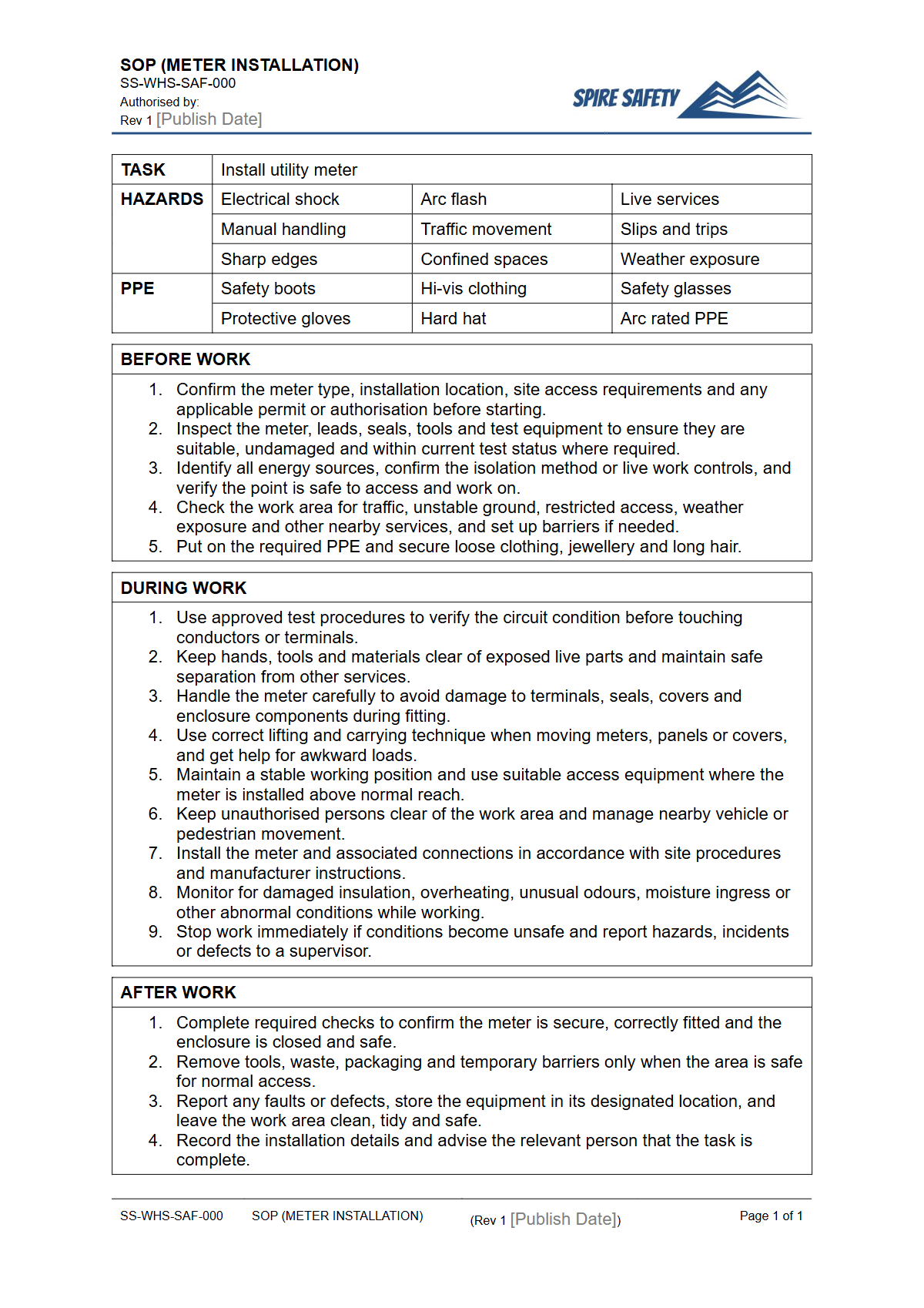
Purpose of the Free Safe Operating Procedure (Meter Installation) Template
Installing electrical, gas, or water meters involves significant risks that must be carefully managed. Our Free Safe Operating Procedure (Meter Installation) Template provides a structured framework for documenting the required safety steps, helping your organisation meet its duty of care.
This document helps formalise a systematic approach to the task, covering everything from pre-start checks to final testing and clean-up.
A well-defined SOP is a cornerstone of operational safety, ensuring tasks are performed consistently and safely every time. It identifies potential hazards such as electric shock, arc flash, gas leaks, falls from height, and manual handling.
By outlining clear control measures, this Safe Operating Procedure helps minimise the risk of injury and incidents. It also serves as a critical training tool for new workers and a reference for experienced technicians, promoting a strong safety culture within the team.
Video walkthrough
How to use the Free Safe Operating Procedure (Meter Installation) Template
This document is a template and must be customised to suit the specific requirements of your workplace, the equipment being used, and the personnel involved. After downloading the DOCX or PDF, consult with your team—including the electricians, gasfitters, or technicians who perform the work—to ensure the procedure reflects your practical on-site realities.
Key Customisation Steps:
- Site-Specific Hazards: Add details relevant to your work environments, such as risks from overhead power lines, confined spaces, or asbestos in older switchboards.
- Equipment Details: Specify the exact models of test equipment, tools, and personal protective equipment (PPE) required for the job.
- Emergency Procedures: Integrate your site's specific emergency contacts and procedures for incidents like electric shock or gas leaks.
- Consultation: We cannot stress this enough: you must consult with your workers and any other relevant stakeholders during the drafting and review process.
Once adapted, the SOP should be formally approved by a competent person within your organisation before being implemented. For complex groundwork that may accompany new installations, you might also require procedures like our free Trencher SOP template.
When to use a Meter Installation Safe Operating Procedure
An SOP for meter installation should be integrated into your daily workflow. It is not a document to be filed away and forgotten. Use it during:
- Work Planning: Before any installation job begins, the supervisor and workers should review the SOP to ensure all safety measures are in place.
- Worker Training and Induction: It is an essential resource for training new employees and verifying the competency of existing ones.
- Toolbox Talks: Use the SOP as a basis for pre-start meetings to discuss the specific hazards and controls for the day's tasks.
- Incident Investigations: If an incident or near-miss occurs, the SOP provides a baseline to assess whether procedures were followed and if they need improvement.
- Audits and Reviews: The SOP is a key piece of evidence during safety audits to demonstrate that a safe system of work is in place. Regular reviews are part of maintaining robust WHS management systems.
Who should use this SOP
This Safe Operating Procedure is intended for a range of personnel involved in the lifecycle of meter installation, including:
- Licensed Electricians, Gasfitters, and Plumbers: The primary users who perform the hands-on installation work.
- Apprentices and Trainees: To learn the established safe method of work under direct supervision.
- Supervisors and Team Leaders: To oversee the work, enforce safety standards, and conduct pre-start briefings.
- WHS Managers and Advisors: To develop, implement, and review safety procedures as part of the overall WHS framework. If you need assistance with customisation, consider seeking specialist WHS consulting.
It's crucial that everyone using the SOP is trained on its contents and understands their responsibilities. For other common construction tasks, you might also need documents like a circular saw SOP to ensure comprehensive site safety. All our documents are available to browse in our free WHS resources library.
Common mistakes
Common mistakes to avoid
- Failing to properly de-energise and lock-out/tag-out electrical circuits before starting work.
- Using a generic SOP without customising it for the specific site, meter type, and environmental conditions.
- Neglecting to conduct a pre-start risk assessment to identify unexpected hazards.
- Assuming all workers understand the procedure without providing adequate training and verification of competency.
Legal references
Legal considerations
The following legal requirements may be relevant to this type of work.
- Work Health and Safety Act (Harmonised) — Provides the primary duties for protecting workers and other people from work health and safety risks.
- Work Health and Safety Regulations (Harmonised) — Sets out requirements supporting the management of workplace hazards and risks.
The following codes may be relevant to this type of work.
- Managing WHS Risks Code of Practice — Provides practical guidance on identifying hazards, assessing risks and applying effective controls.
- Work Health and Safety Consultation, Cooperation and Coordination Code of Practice — Provides practical guidance on consulting workers and coordinating with other duty holders.
- Managing the Work Environment and Facilities Code of Practice — Provides practical guidance on safe work environments, workplace facilities and related controls.
Did you know
Electrical Risk
A significant number of serious electrical incidents in Australia involve contact with overhead or underground power lines, a key risk during external meter installation work.
Duty of Care
Under model WHS laws, a Person Conducting a Business or Undertaking (PCBU) must ensure, so far as is reasonably practicable, that workers are provided with safe systems of work.
FAQ
Frequently asked questions
01What are the primary hazards involved in meter installation?
02Is a Safe Operating Procedure a legal requirement for meter installation in Australia?
03How often should a meter installation SOP be reviewed?
04What is the difference between an SOP and a SWMS?
Share this resource
Free Safe Operating Procedure (Meter Installation) Template
Browse Categories
How To Use It
- 1Download and open in Word or PDF.
- 2Replace the placeholders with your business details.
- 3Get it reviewed by a WHS specialist before rollout.
Need it customised?
Our WHS consultants can adapt this template to your site, run a gap analysis, or audit what you already have in place.
Book a Free Consultation WHS consulting servicesor call 1300 156 382
Related templates
- Free Safe Operating Procedure (Meter Room Cleaning) Template
- Free Safe Operating Procedure (Metering Pump) Template
- Free Safe Operating Procedure (Microbial Sampling) Template
- Free Safe Operating Procedure (Microscope Cleaning) Template
- Free Safe Operating Procedure (MIG Spot Welding) Template
- Free Safe Operating Procedure (Milk Fridge Cleaning) Template