
Free Safe Operating Procedure (Microbial Sampling) Template
Download our free Safe Operating Procedure (Microbial Sampling) template to formalise your lab or field safety processes.
Free Safe Operating Procedure (Microbial Sampling) Template
DOCX • 126 KB + PDF
Updated Oct 2026
No signup required
Purpose of the Free Safe Operating Procedure (Microbial Sampling) Template
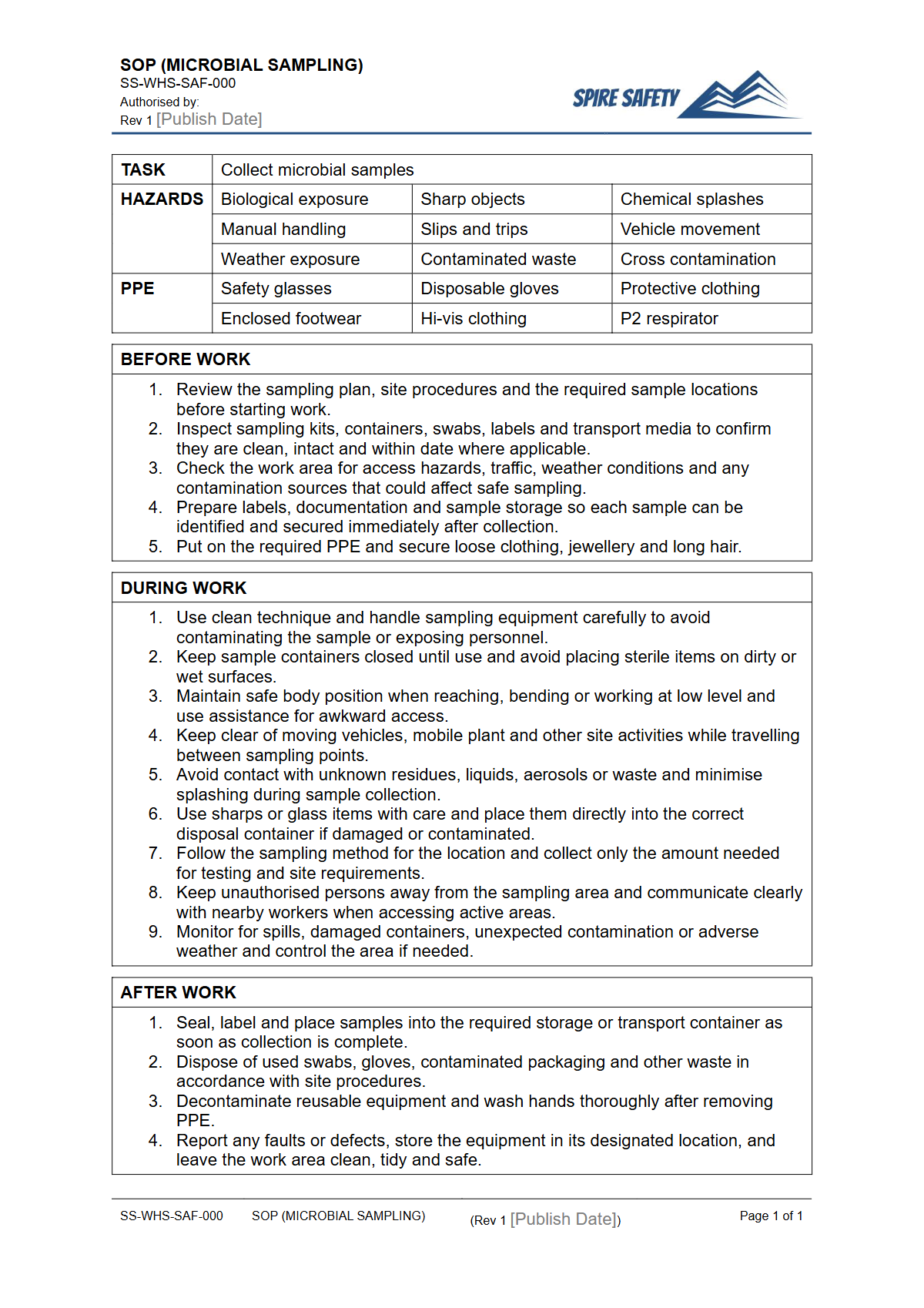
This Safe Operating Procedure (SOP) for Microbial Sampling provides a structured framework for conducting sampling tasks safely and effectively. It is designed to help your organisation document critical processes, manage biological hazards, and ensure consistency in sample collection.
Using this template helps standardise the steps for tasks like air quality testing, surface swabbing, and water analysis, reducing the risk of exposure to potentially harmful microorganisms and preventing cross-contamination.
A well-defined SOP is a fundamental component of effective risk management. By clearly outlining responsibilities, required Personal Protective Equipment (PPE), and emergency protocols, you create a safer work environment for technicians, scientists, and hygienists.
Integrating this procedure is a key step in developing comprehensive WHS management systems that protect both workers and the integrity of your scientific data.
Video walkthrough
How to use the Free Safe Operating Procedure (Microbial Sampling) Template
To implement this SOP effectively, you must adapt it to the specific context of your workplace. The provided DOCX and PDF files serve as a starting point.
Begin by downloading the document and thoroughly reviewing its sections. Identify the unique hazards, equipment, and environmental conditions at your site, and add them to the template.
This includes specifying the types of microorganisms being tested for, the exact sampling media used, and the specific decontamination agents required.
It is crucial to consult with the workers who will be performing the microbial sampling tasks. Their direct experience is invaluable for creating a practical and effective procedure.
Once customised, the SOP should be formally approved, and all relevant personnel must be trained on its contents. Remember, this document is a template; we have provided a solid foundation, but you must build upon it to ensure it reflects your workplace's actual operations and risk controls.
Key Customisation Steps:
- Hazard Identification: Detail the specific biological hazards (e.g., mould, bacteria, viruses) workers may encounter.
- Equipment and Media: List all sampling pumps, cassettes, swabs, agar plates, and other equipment used. You might find our free Air Compressor SOP useful if compressed air is used for cleaning or equipment operation.
- Step-by-Step Procedure: Write clear, sequential instructions for pre-sampling checks, sample collection, and post-sampling actions.
- Sample Handling: Specify requirements for labelling, storing, and transporting samples to maintain the cold chain and prevent degradation.
- Emergency Procedures: Outline actions for spills, personal exposure, or equipment failure.
When to use it
A microbial sampling SOP should be developed and used whenever workers are required to collect samples for the detection, identification, or quantification of microorganisms. This is common in a wide range of industries and scenarios, from healthcare and food production to environmental consulting and scientific research.
Formal procedures are particularly important for routine monitoring programs where data consistency is essential for trend analysis.
This SOP is also critical for post-remediation verification, such as confirming the successful removal of mould contamination after a flood or leak. In food processing environments, it supports food safety programs by testing surfaces, ingredients, and finished products, and a process for specific equipment like a Deep Fryer SOP would complement this.
The document is also a key piece of evidence during regulatory inspections or WHS compliance audits, demonstrating a systematic approach to managing biological hazards.
Who should use it
This template is intended for use by Persons Conducting a Business or Undertaking (PCBUs) to meet their duty of care. It should be implemented by WHS managers, laboratory supervisors, occupational hygienists, and team leaders responsible for overseeing sampling activities.
The final SOP is a direct instructional tool for the workers performing the sampling, including environmental technicians, food safety officers, research assistants, and quality assurance personnel.
It also serves as an essential training resource for new employees or workers being assigned to sampling tasks for the first time, ensuring they understand the risks and control measures from the outset. For a wider range of procedural documents, you can browse our complete free WHS resources library. In workplaces with complex manufacturing lines, this document should be used alongside equipment-specific procedures, such as a Conveyer System SOP, to provide a holistic view of safety.
Common mistakes
Common mistakes to avoid
- Using expired sampling media, agar plates, or swabs.
- Incorrectly or illegibly labelling samples, leading to data mix-ups.
- Failing to maintain the 'cold chain' by following correct sample storage and transport temperatures.
- Not decontaminating equipment or work areas between samples, causing cross-contamination.
Legal references
Legal considerations
The following legal requirements may be relevant to this type of work.
- Work Health and Safety Act (Harmonised) — Provides the primary duties for protecting workers and other people from work health and safety risks.
- Work Health and Safety Regulations (Harmonised) — Sets out requirements supporting the management of workplace hazards and risks.
The following codes may be relevant to this type of work.
- Managing WHS Risks Code of Practice — Provides practical guidance on identifying hazards, assessing risks and applying effective controls.
- Work Health and Safety Consultation, Cooperation and Coordination Code of Practice — Provides practical guidance on consulting workers and coordinating with other duty holders.
- Managing the Work Environment and Facilities Code of Practice — Provides practical guidance on safe work environments, workplace facilities and related controls.
Did you know
Cross-Contamination Risk
Even a minor breach in sterile technique, such as touching a non-sterile surface with a glove, can transfer microbes and invalidate sample results or create a new contamination site.
Bioaerosols
Microscopic biological particles like bacteria and mould spores can remain suspended in the air for extended periods, posing an inhalation risk long after the source has been disturbed.
FAQ
Frequently asked questions
01What should be included in a microbial sampling SOP?
02How often should we review our microbial sampling procedures?
03Is this template suitable for air, surface, and water sampling?
04What PPE is required for microbial sampling?
Share this resource
Free Safe Operating Procedure (Microbial Sampling) Template
Browse Categories
How To Use It
- 1Download and open in Word or PDF.
- 2Replace the placeholders with your business details.
- 3Get it reviewed by a WHS specialist before rollout.
Need it customised?
Our WHS consultants can adapt this template to your site, run a gap analysis, or audit what you already have in place.
Book a Free Consultation WHS consulting servicesor call 1300 156 382
Related templates
- Free Safe Operating Procedure (Microscope Cleaning) Template
- Free Safe Operating Procedure (MIG Spot Welding) Template
- Free Safe Operating Procedure (Milk Fridge Cleaning) Template
- Free Safe Operating Procedure (Milk Frother) Template
- Free Safe Operating Procedure (Milk Vat Cleaning) Template
- Free Safe Operating Procedure (Milking Machine) Template