
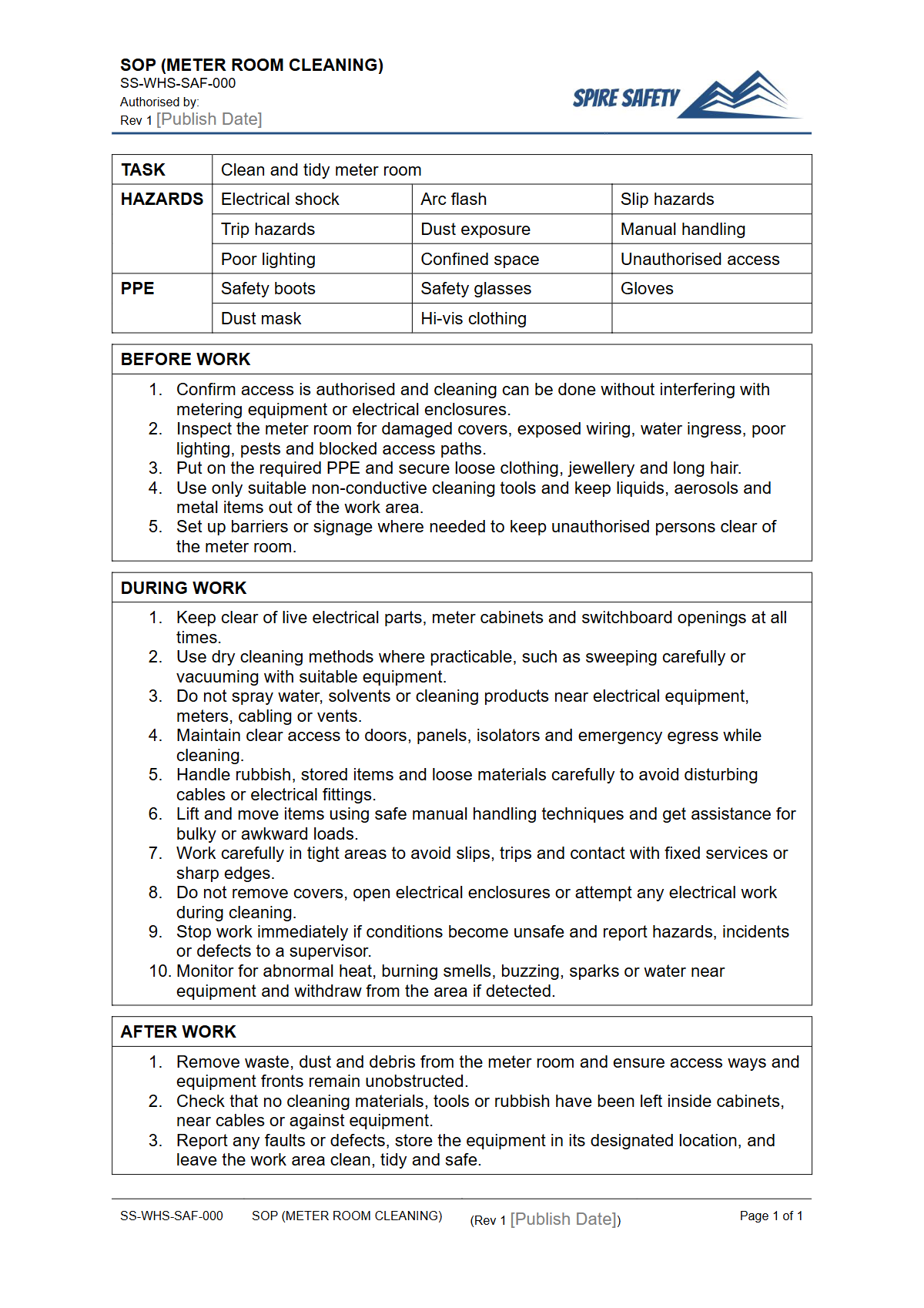
Free Safe Operating Procedure (Meter Room Cleaning) Template
Our Safe Operating Procedure for meter room cleaning provides a structured template for documenting task-specific hazards and controls.
Free Safe Operating Procedure (Meter Room Cleaning) Template
DOCX • 126 KB + PDF
Updated Oct 2026
No signup required
Purpose of the Free Safe Operating Procedure (Meter Room Cleaning) Template
This Free Safe Operating Procedure (Meter Room Cleaning) Template helps you formalise a safe system of work for a high-risk task. Cleaning in and around electrical meter rooms presents significant hazards, including electric shock, fire, and slips, trips, and falls.
Using a structured SOP ensures that workers are aware of the risks and follow specific control measures to stay safe. A documented procedure is a critical component of any effective WHS management system, demonstrating your organisation's commitment to mitigating risk.
A comprehensive SOP for this task should detail every step, from pre-start checks to the specific cleaning methods and waste disposal. It addresses critical questions: What personal protective equipment (PPE) is required?
Which cleaning agents are approved for use near electrical components? What are the emergency procedures in case of an incident?
This template provides the framework to answer these questions for your specific site.
Video walkthrough
How to Use the Free Safe Operating Procedure (Meter Room Cleaning) Template
To get started, download the template in your preferred format (DOCX for easy editing or PDF). It is essential to understand that this document is a starting point, not a finished product.
To be effective, we require you to customise this SOP to reflect the unique hazards, equipment, and environment of your workplace. This involves conducting a site-specific risk assessment for the meter room cleaning task.
Follow these steps to implement the SOP effectively:
- Consult: Discuss the cleaning task with the workers who will perform it. Their input is invaluable for identifying practical hazards and effective controls.
- Customise: Edit the template to include your company details, specific site information, relevant machinery, and the agreed-upon safety controls.
- Train: Ensure all relevant personnel are trained on the contents of the final SOP. This training must cover the identified hazards, control measures, and emergency responses.
- Review: Schedule regular reviews of the SOP to ensure it remains current. A periodic WHS compliance audit can help identify gaps in your procedures and practices.
When to Use This Safe Operating Procedure
The meter room cleaning SOP is not a document to be filed and forgotten. It is a live tool that should be actively used to ensure safety.
Refer to it during worker induction and training for new cleaning or maintenance staff. It should be readily accessible in the work area for reference before and during the task.
The SOP also serves as a key reference document during incident investigations or regular safety inspections. Having specific procedures for high-risk tasks is a common feature in many industries; for example, the food service industry relies on documents like our Free Safe Operating Procedure (Deep Fryer - Standard Operation) Template to manage risks like burns and slips.
Who Should Use It
This template is designed for use by a range of personnel within an organisation. Persons Conducting a Business or Undertaking (PCBUs), business owners, and directors can use it to fulfil their duty of care.
Safety managers and WHS professionals can integrate it into the company's overall safety framework. Supervisors and team leaders are responsible for implementing the SOP on the ground, ensuring workers follow it correctly.
Finally, the workers performing the cleaning task are the primary end-users, relying on it for step-by-step guidance on how to work safely. The structured format is applicable to many tasks, from cleaning to equipment operation, as seen in our Free Air Compressor SOP (Safe Operating Procedure) Template.
Developing robust SOPs is a cornerstone of workplace safety, regardless of the task. While the hazards in a meter room are primarily electrical and chemical, operating machinery requires its own set of detailed controls, as outlined in our FREE Circular Saw SOP (Safe Operating Procedure) Template. For businesses needing help to develop a suite of tailored procedures, engaging external WHS consulting services can provide expert guidance and ensure best practice is followed.
If you're looking for other templates, you can browse our complete free WHS resources library for more checklists, procedures, and forms.
Common mistakes
Common mistakes to avoid
- Using a generic cleaning SOP that doesn't address specific electrical hazards.
- Failing to de-energise and lock out/tag out circuits before cleaning, where practicable.
- Using water or conductive cleaning solutions and tools near live electrical equipment.
- Neglecting to train cleaners on the unique risks and emergency procedures for meter rooms.
Legal references
Legal considerations
The following legal requirements may be relevant to this type of work.
- Work Health and Safety Act (Harmonised) — Provides the primary duties for protecting workers and other people from work health and safety risks.
- Work Health and Safety Regulations (Harmonised) — Sets out requirements supporting the management of workplace hazards and risks.
The following codes may be relevant to this type of work.
- Managing WHS Risks Code of Practice — Provides practical guidance on identifying hazards, assessing risks and applying effective controls.
- Work Health and Safety Consultation, Cooperation and Coordination Code of Practice — Provides practical guidance on consulting workers and coordinating with other duty holders.
- Managing the Work Environment and Facilities Code of Practice — Provides practical guidance on safe work environments, workplace facilities and related controls.
Did you know
Electrical Risks
Between 2003 and 2015, an average of 11 workers were killed each year in Australia from contact with electricity, highlighting the critical need for safe procedures in areas like meter rooms.
Duty to Consult
The model WHS Act requires PCBUs to consult with workers on matters affecting their health and safety. Involving staff in writing an SOP makes it more practical and effective.
FAQ
Frequently asked questions
01What are the main hazards when cleaning a meter room?
02Is a Safe Operating Procedure legally required for meter room cleaning?
03Who is responsible for developing a SOP for meter room cleaning?
04How often should a Meter Room Cleaning SOP be reviewed?
Share this resource
Free Safe Operating Procedure (Meter Room Cleaning) Template
Browse Categories
How To Use It
- 1Download and open in Word or PDF.
- 2Replace the placeholders with your business details.
- 3Get it reviewed by a WHS specialist before rollout.
Need it customised?
Our WHS consultants can adapt this template to your site, run a gap analysis, or audit what you already have in place.
Book a Free Consultation WHS consulting servicesor call 1300 156 382
Related templates
- Free Safe Operating Procedure (Metering Pump) Template
- Free Safe Operating Procedure (Microbial Sampling) Template
- Free Safe Operating Procedure (Microscope Cleaning) Template
- Free Safe Operating Procedure (MIG Spot Welding) Template
- Free Safe Operating Procedure (Milk Fridge Cleaning) Template
- Free Safe Operating Procedure (Milk Frother) Template