
Free Safe Operating Procedure (Metal Detector) Template
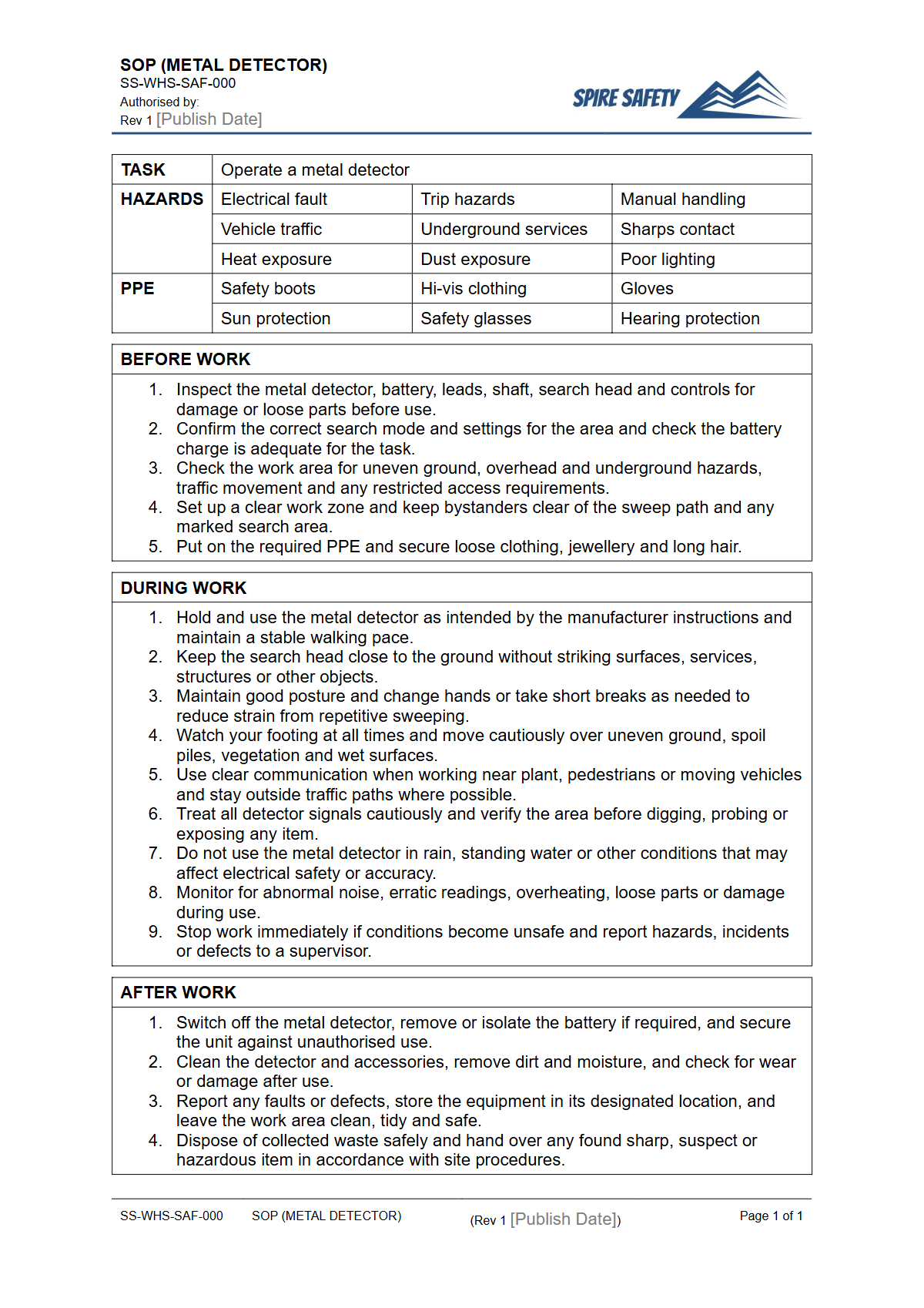
Download our free Safe Operating Procedure (Metal Detector) template. This customisable DOCX and PDF helps define safe work methods for your team.
Free Safe Operating Procedure (Metal Detector) Template
DOCX • 126 KB + PDF
Updated Oct 2026
No signup required
Purpose of the Free Safe Operating Procedure (Metal Detector) Template
This Free Safe Operating Procedure (Metal Detector) Template provides a structured framework for documenting the risks and control measures associated with using metal detection equipment in the workplace. Metal detectors are critical control points in many industries, including food manufacturing, pharmaceuticals, and recycling, used to prevent contamination and protect consumers and machinery.
A documented SOP ensures that all operators perform tasks consistently and safely, understand the hazards involved, and know the correct response to a detection event. Using a standardised procedure helps your organisation meet its primary duty of care under WHS legislation.
A well-defined SOP is a foundational element for demonstrating due diligence and forms a core part of your overall WHS management system. It provides clear, step-by-step instructions for pre-operational checks, operation, calibration, cleaning, and shutdown processes. This template is designed as a starting point, aligned with Australian WHS principles, to help you formalise your work health and safety processes efficiently.
Video walkthrough
How to use the Free Safe Operating Procedure (Metal Detector) Template
This template is provided in both DOCX and PDF formats for your convenience. To effectively implement it, you must conduct a site-specific risk assessment for your particular metal detector model and its operational context.
Consult with the equipment manufacturer’s guidelines, operators, and safety personnel to identify all relevant hazards and establish robust control measures. The document includes sections for you to detail personal protective equipment (PPE) requirements, outline emergency procedures, and specify training and competency standards.
Important: This is a template only. We have provided a comprehensive starting point, but it is your responsibility to customise this Safe Operating Procedure to reflect the specific equipment, processes, hazards, and controls present in your workplace.
Unmodified, it will not be sufficient for your specific operational needs. Ensure you fill in all company-specific details and remove any instructional text before finalising the document.
When to use a Safe Operating Procedure for Metal Detectors
An SOP for a metal detector should be developed before the equipment is first used and be readily available at all times. It is a critical document for inducting and training new employees or for workers who are new to the task.
The SOP should be a key part of your training records, ensuring a consistent message is delivered to all staff. It is also a vital reference tool during routine operations and for refresher training.
The procedure should be reviewed and updated regularly, especially when there is a change to the equipment, the process, or the work environment. It should also be reviewed after any incident, near miss, or detection event to identify opportunities for improvement. The process of developing and reviewing SOPs can be a key part of preparation for a WHS compliance audit.
Who should use this Safe Operating Procedure
This SOP should be used by all personnel involved with the metal detector, including:
- Operators: Workers who directly operate the metal detector as part of their daily tasks.
- Supervisors and Managers: Individuals responsible for overseeing operations, providing training, and ensuring procedures are followed correctly.
- Maintenance Staff: Personnel who perform maintenance, calibration, cleaning, and repairs on the equipment.
- Quality Assurance (QA) Personnel: Staff responsible for verifying the effectiveness of the metal detector as a critical control point.
- WHS Professionals: Safety managers and officers who use the SOP for risk assessments, training development, and incident investigations.
In many production facilities, this SOP will integrate with other key procedures. For example, in a food processing plant, it may link to SOPs for related equipment, such as our free conveyer system SOP template. This ensures a holistic approach to managing risk across an entire production line.
Developing clear, task-specific procedures demonstrates a commitment to a safe system of work. For other equipment in a food production or manufacturing environment, you may also require specific documents, such as our procedure for a standard deep fryer operation. The principles of identifying hazards, assessing risks, and implementing controls apply across all types of machinery.
This also extends to procedures for ancillary plant like our air compressor SOP template, which may be present in the same facility. To find more templates for your business, explore our complete free WHS resources library for a wide range of downloadable documents.
Common mistakes
Common mistakes to avoid
- Failing to customise the template to reflect specific workplace equipment and risks.
- Providing inadequate training on the SOP, treating it as a 'tick-and-flick' exercise.
- Neglecting to maintain detailed logs of calibration tests, detection events, and corrective actions.
- Not clearly defining the quarantine and investigation process for when metal is detected.
Legal references
Legal considerations
The following legal requirements may be relevant to this type of work.
- Work Health and Safety Act (Harmonised) — Provides the primary duties for protecting workers and other people from work health and safety risks.
- Work Health and Safety Regulations (Harmonised) — Sets out requirements supporting the management of workplace hazards and risks.
The following codes may be relevant to this type of work.
- Managing WHS Risks Code of Practice — Provides practical guidance on identifying hazards, assessing risks and applying effective controls.
- Work Health and Safety Consultation, Cooperation and Coordination Code of Practice — Provides practical guidance on consulting workers and coordinating with other duty holders.
- Managing the Work Environment and Facilities Code of Practice — Provides practical guidance on safe work environments, workplace facilities and related controls.
Did you know
Calibration is Key
Most food safety and quality assurance standards require metal detectors to be tested and calibrated at regular intervals, often at the start of a shift, after a product changeover, and hourly. These tests and their results must be meticulously documented.
Beyond Security
While often associated with security screening, industrial metal detectors are vital in the food, pharmaceutical, textile, and plastics industries to detect metal fragments that could contaminate products, damage machinery, or harm consumers.
FAQ
Frequently asked questions
01What is the purpose of a metal detector SOP?
02Who is responsible for writing a Safe Operating Procedure for a metal detector?
03How often should a metal detector SOP be reviewed?
04Does this template cover both handheld and industrial metal detectors?
Share this resource
Free Safe Operating Procedure (Metal Detector) Template
Browse Categories
How To Use It
- 1Download and open in Word or PDF.
- 2Replace the placeholders with your business details.
- 3Get it reviewed by a WHS specialist before rollout.
Need it customised?
Our WHS consultants can adapt this template to your site, run a gap analysis, or audit what you already have in place.
Book a Free Consultation WHS consulting servicesor call 1300 156 382
Related templates
- Free Safe Operating Procedure (Metal Locator) Template
- Free Safe Operating Procedure (Metal Pickling) Template
- Free Safe Operating Procedure (Meter Installation) Template
- Free Safe Operating Procedure (Meter Room Cleaning) Template
- Free Safe Operating Procedure (Metering Pump) Template
- Free Safe Operating Procedure (Microbial Sampling) Template