
Free Safe Operating Procedure (Metal Locator) Template
Download our free Safe Operating Procedure (Metal Locator) template. This structured document helps you outline key safety steps for your workplace.
Free Safe Operating Procedure (Metal Locator) Template
DOCX • 126 KB + PDF
Updated Oct 2026
No signup required
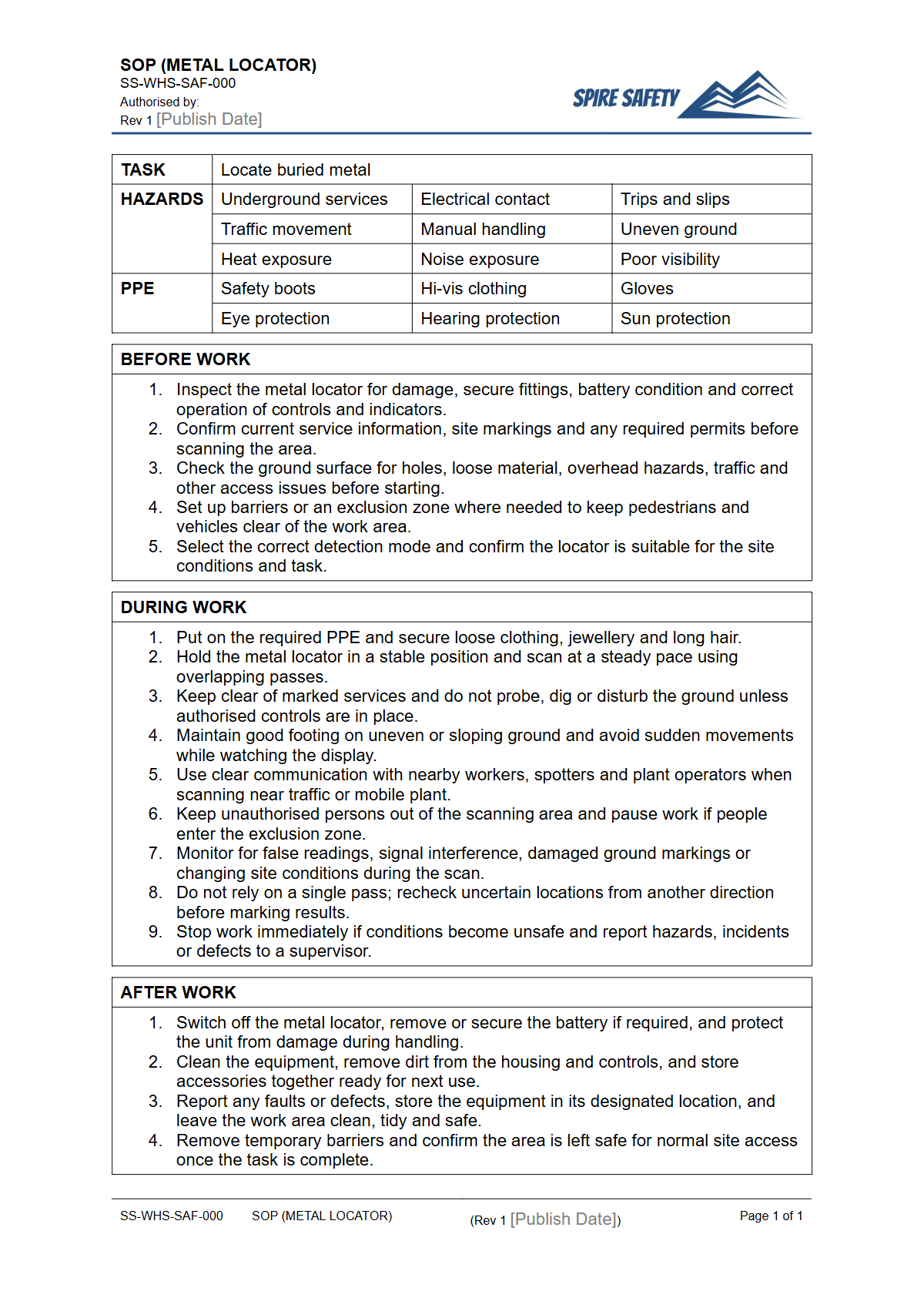
Purpose of the Free Safe Operating Procedure (Metal Locator) Template
The primary purpose of this SOP template is to provide a clear, step-by-step guide for operating a metal locator safely and effectively. Its use is fundamental in preventing catastrophic incidents such as striking underground electrical cables, gas lines, or water mains.
A well-documented procedure ensures that every operator follows a consistent, safe method, minimising the risk of human error. It formalises pre-start checks, operational steps, and shutdown protocols, creating a reliable safety process.
By implementing this procedure, you are taking a proactive step towards fulfilling your health and safety obligations. A documented SOP serves as a key piece of evidence in your safety management framework, demonstrating that risks have been identified and controlled.
It helps integrate a critical safety check into your broader WHS management systems, ensuring a consistent approach to this high-risk precursor activity.
Video walkthrough
How to use the Free Safe Operating Procedure (Metal Locator) Template
This template is provided in both DOCX and PDF formats for your convenience. The DOCX file is fully editable, allowing you to tailor the content to your specific needs.
We strongly advise that you treat this document as a foundation, not a finished product. A competent person within your organisation should adapt it to suit the specific models of metal locators you use, the unique conditions of your work sites, and your internal safety policies.
Important: This is a template and must be customised to your specific workplace. We recommend a competent person reviews and adapts the SOP to reflect your unique equipment, site conditions, personnel, and organisational procedures.
This customisation is essential for the procedure to be effective and relevant.
Once customised, the SOP should be used as a primary training document for all operators. It can also form the basis for conducting competency assessments.
For sequential tasks like digging, it's vital to have procedures for all stages. For example, the actions following a successful locate might be covered in our FREE Trencher SOP Template.
When to use a Metal Locator SOP
A Safe Operating Procedure for a metal locator should be referenced before and during any task that involves locating underground services. It is not a document to be filed away; it is an active tool for daily use. Key times to use the SOP include:
- Planning Work: During the planning phase of any excavation project to ensure the locating process is properly integrated.
- Pre-Start Checks: Operators must follow the pre-start inspection list in the SOP every time before using the equipment to ensure it is calibrated and functioning correctly.
- Operator Training: As the core document for inducting and training new operators on the safe and correct use of the device.
- During Operation: As a reference for the correct sweeping patterns, signal interpretation, and marking procedures.
- Post-Incident: As a reference point during incident investigations to determine if procedures were followed or if they need revision.
For more complex civil projects, a suite of SOPs may be required to manage sequential tasks. After locating services, you might proceed with work like grading, which should also be governed by a procedure such as our FREE Grader SOP (Safe Operating Procedure) Template.
Who Should Use This Procedure?
This SOP is intended for a range of personnel within an organisation to ensure a holistic approach to safety:
- Equipment Operators: The primary users who must follow the procedure step-by-step to perform their work safely.
- Supervisors and Foremen: Responsible for ensuring operators are trained on the SOP and are adhering to it during works. They use it to guide toolbox talks and monitor site activities.
- WHS/HSE Managers: Responsible for developing, reviewing, and implementing the SOP as part of the overall safety system. They ensure it aligns with legislative requirements and best practices.
- Project Managers and Planners: Use the SOP to understand the requirements and time involved in safely locating services, allowing for accurate project scheduling.
WHS managers can also use this SOP as a baseline document during site reviews and safety assessments. Verifying that documented procedures are followed on the ground is a core part of any WHS compliance auditing program.
What's Included in the Template?
Our template provides a comprehensive structure for you to build upon, covering the essential elements of a robust SOP. Key sections include:
- Hazards and Risks Assessment
- Required Personal Protective Equipment (PPE)
- Pre-Operational Safety Checks
- Step-by-Step Operating Instructions
- Post-Operation and Shutdown Procedures
- Emergency Procedures
By using this structured template, you can save time while ensuring all critical safety aspects are considered. Explore our full range of documents in our free WHS resources library to build a comprehensive safety system for your workplace.
Common mistakes
Common mistakes to avoid
- Relying solely on "as-built" drawings without physical verification using a locator.
- Failing to calibrate the equipment correctly before each use or as per manufacturer specifications.
- Not accounting for signal interference from nearby metallic objects, rebar, or overhead power lines.
- Assigning an untrained or inexperienced operator to a critical pre-excavation locating task.
Legal references
Legal considerations
The following legal requirements may be relevant to this type of work.
- Work Health and Safety Act (Harmonised) — Provides the primary duties for protecting workers and other people from work health and safety risks.
- Work Health and Safety Regulations (Harmonised) — Sets out requirements supporting the management of workplace hazards and risks.
The following codes may be relevant to this type of work.
- Managing WHS Risks Code of Practice — Provides practical guidance on identifying hazards, assessing risks and applying effective controls.
- Work Health and Safety Consultation, Cooperation and Coordination Code of Practice — Provides practical guidance on consulting workers and coordinating with other duty holders.
- Managing the Work Environment and Facilities Code of Practice — Provides practical guidance on safe work environments, workplace facilities and related controls.
Did you know
Before You Dig Australia
In Australia, the 'Before You Dig Australia' service is a mandatory first step before any excavation, providing plans for underground infrastructure. A metal locator is then used to physically verify these plans on-site.
Types of Locators
Metal locators for construction use electromagnetic fields to detect conductive pipes and cables. More advanced Ground Penetrating Radar (GPR) is often used alongside them to locate non-conductive services like PVC or fibre optic cables.
FAQ
Frequently asked questions
01What is a Safe Operating Procedure for a metal locator?
02Is using a metal locator a high-risk activity?
03Do I need to train workers even if we have a detailed SOP?
04How often should I review my metal locator SOP?
Share this resource
Free Safe Operating Procedure (Metal Locator) Template
Browse Categories
How To Use It
- 1Download and open in Word or PDF.
- 2Replace the placeholders with your business details.
- 3Get it reviewed by a WHS specialist before rollout.
Need it customised?
Our WHS consultants can adapt this template to your site, run a gap analysis, or audit what you already have in place.
Book a Free Consultation WHS consulting servicesor call 1300 156 382
Related templates
- Free Safe Operating Procedure (Metal Pickling) Template
- Free Safe Operating Procedure (Meter Installation) Template
- Free Safe Operating Procedure (Meter Room Cleaning) Template
- Free Safe Operating Procedure (Metering Pump) Template
- Free Safe Operating Procedure (Microbial Sampling) Template
- Free Safe Operating Procedure (Microscope Cleaning) Template