
Free Safe Operating Procedure (Mechanical Room Clean) Template
Download our free Safe Operating Procedure for mechanical room cleaning. This customisable template helps you outline risks and controls for your team.
Free Safe Operating Procedure (Mechanical Room Clean) Template
DOCX • 126 KB + PDF
Updated Oct 2026
No signup required
Purpose of the Free Safe Operating Procedure (Mechanical Room Clean) Template
Mechanical rooms house critical building infrastructure but also present significant hazards, from moving machinery and electrical systems to chemical storage and confined spaces. This Free Safe Operating Procedure (Mechanical Room Clean) Template provides a structured starting point for organisations to formally document a safe system of work for cleaning these areas.
It helps you systematically identify the tasks, potential hazards, and the specific control measures required to ensure worker safety.
Using a standardised procedure promotes consistent and safe work practices, reduces the risk of incidents, and demonstrates a commitment to workplace health and safety. The SOP serves as a vital tool for worker training and competency assessment, ensuring everyone understands the risks and the steps needed to mitigate them before work begins.
This is a foundational element within broader WHS management systems, helping to formalise risk management processes.
Video walkthrough
How to use the Free Safe Operating Procedure (Mechanical Room Clean) Template
This document is available as a fully editable DOCX file, allowing for comprehensive customisation. It is crucial to adapt the content to the unique conditions of your workplace.
A competent person should lead this process, involving consultation with the workers who will be performing the cleaning tasks.
Important: This document is a template only. We recommend you customise it to suit the specific plant, equipment, chemicals, and layout of your facility.
You must assess the specific hazards present in your mechanical room and implement appropriate risk controls. For example, if your room contains specific machinery, you may need to cross-reference other procedures, such as our free Air Compressor SOP, to ensure all energy sources are correctly isolated.
What's included in the template?
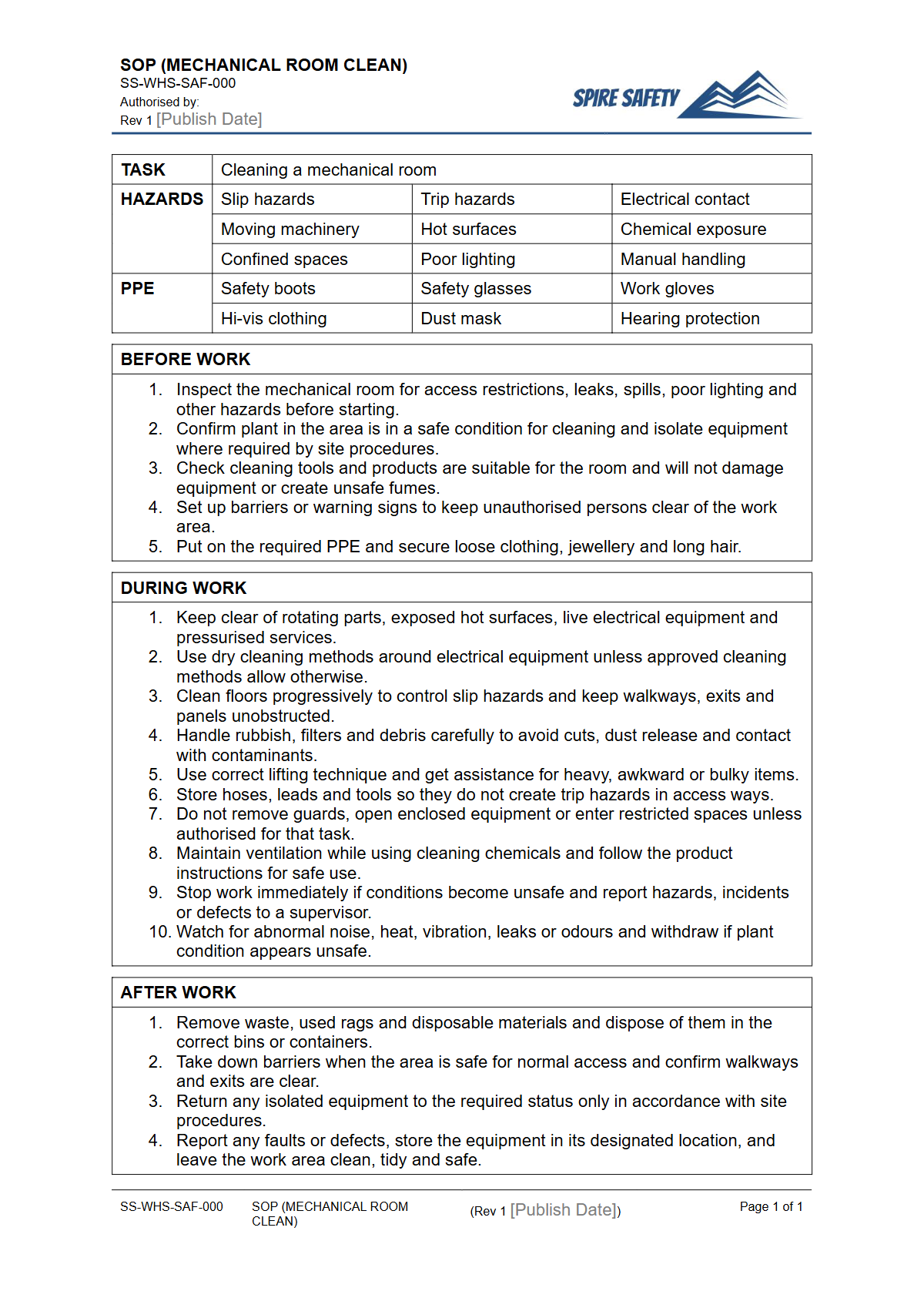
Our Safe Operating Procedure template guides you through documenting:
- Required Personal Protective Equipment (PPE)
- Pre-operational checks and environmental considerations
- A step-by-step guide to the cleaning procedure
- Potential hazards and their corresponding control measures
- Emergency procedures
- Waste disposal requirements
When to use a Safe Operating Procedure
An SOP for mechanical room cleaning should be used consistently before any cleaning task is undertaken. It is particularly important in several situations:
- Worker Induction: For new employees or contractors unfamiliar with the site.
- Refresher Training: As part of regular safety training cycles to reinforce safe practices.
- Procedural Changes: When new equipment is installed, different cleaning chemicals are introduced, or the cleaning process is modified.
- High-Risk Tasks: Cleaning in areas with energised equipment, trip hazards, or poor ventilation always requires a documented safe system of work.
Integrating this SOP into your regular operations is a key activity that would be reviewed during WHS compliance auditing to verify that safe work practices are being followed as documented.
Who should use it
This template is designed for use by a range of personnel within an organisation to ensure a collaborative approach to safety:
- Person Conducting a Business or Undertaking (PCBU): To meet their primary duty of care by providing a safe system of work.
- Managers and Supervisors: To train workers, supervise cleaning tasks, and ensure procedures are followed correctly.
- WHS Professionals: To develop and integrate the SOP into the organisation's overall safety management system.
- Workers and Cleaning Staff: As a practical guide to follow during their work, empowering them to work safely and identify when conditions deviate from the documented procedure.
If your mechanical room contains complex machinery like conveyor belts, you may also need to consult our free Conveyer System SOP to manage those specific hazards. If you need assistance developing comprehensive, site-specific procedures, our WHS consulting services can provide expert guidance. For more templates and checklists, explore our complete free WHS resources library.
Common mistakes
Common mistakes to avoid
- Using a generic SOP without customising it for site-specific hazards and equipment.
- Failing to adequately train workers on the procedure and verify their understanding.
- Neglecting to isolate all energy sources (electrical, mechanical, hydraulic) before starting work.
- Not updating the SOP after an incident or when a new hazard is identified.
Legal references
Legal considerations
The following legal requirements may be relevant to this type of work.
- Work Health and Safety Act (Harmonised) — Provides the primary duties for protecting workers and other people from work health and safety risks.
- Work Health and Safety Regulations (Harmonised) — Sets out requirements supporting the management of workplace hazards and risks.
The following codes may be relevant to this type of work.
- Managing WHS Risks Code of Practice — Provides practical guidance on identifying hazards, assessing risks and applying effective controls.
- Work Health and Safety Consultation, Cooperation and Coordination Code of Practice — Provides practical guidance on consulting workers and coordinating with other duty holders.
- Managing the Work Environment and Facilities Code of Practice — Provides practical guidance on safe work environments, workplace facilities and related controls.
Did you know
Slips, Trips, and Falls
According to Safe Work Australia, slips, trips, and falls are the second leading cause of serious workers' compensation claims, making good housekeeping during cleaning tasks a critical safety control.
Lockout/Tagout (LOTO)
Failing to de-energise and lock out machinery before maintenance or cleaning is a leading cause of severe and fatal injuries. A documented LOTO procedure is essential for any task performed on or near energised equipment.
FAQ
Frequently asked questions
01What is the primary purpose of a Safe Operating Procedure?
02Are mechanical rooms considered confined spaces in Australia?
03What kind of PPE is typically required for cleaning a mechanical room?
04How often should a Safe Operating Procedure be reviewed?
Share this resource
Free Safe Operating Procedure (Mechanical Room Clean) Template
Browse Categories
How To Use It
- 1Download and open in Word or PDF.
- 2Replace the placeholders with your business details.
- 3Get it reviewed by a WHS specialist before rollout.
Need it customised?
Our WHS consultants can adapt this template to your site, run a gap analysis, or audit what you already have in place.
Book a Free Consultation WHS consulting servicesor call 1300 156 382
Related templates
- Free Safe Operating Procedure (Medical Gas Cylinder) Template
- Free Safe Operating Procedure (Medication Fridge Clean) Template
- Free Safe Operating Procedure (Mesh Bender) Template
- Free Safe Operating Procedure (Mesh Cutter) Template
- Free Safe Operating Procedure (Metal Detector) Template
- Free Safe Operating Procedure (Metal Locator) Template