
Free Safe Operating Procedure (Mechanical Isolation) Template
Effectively manage hazardous energy with our Safe Operating Procedure for mechanical isolation.
Free Safe Operating Procedure (Mechanical Isolation) Template
DOCX • 126 KB + PDF
Updated Oct 2026
No signup required
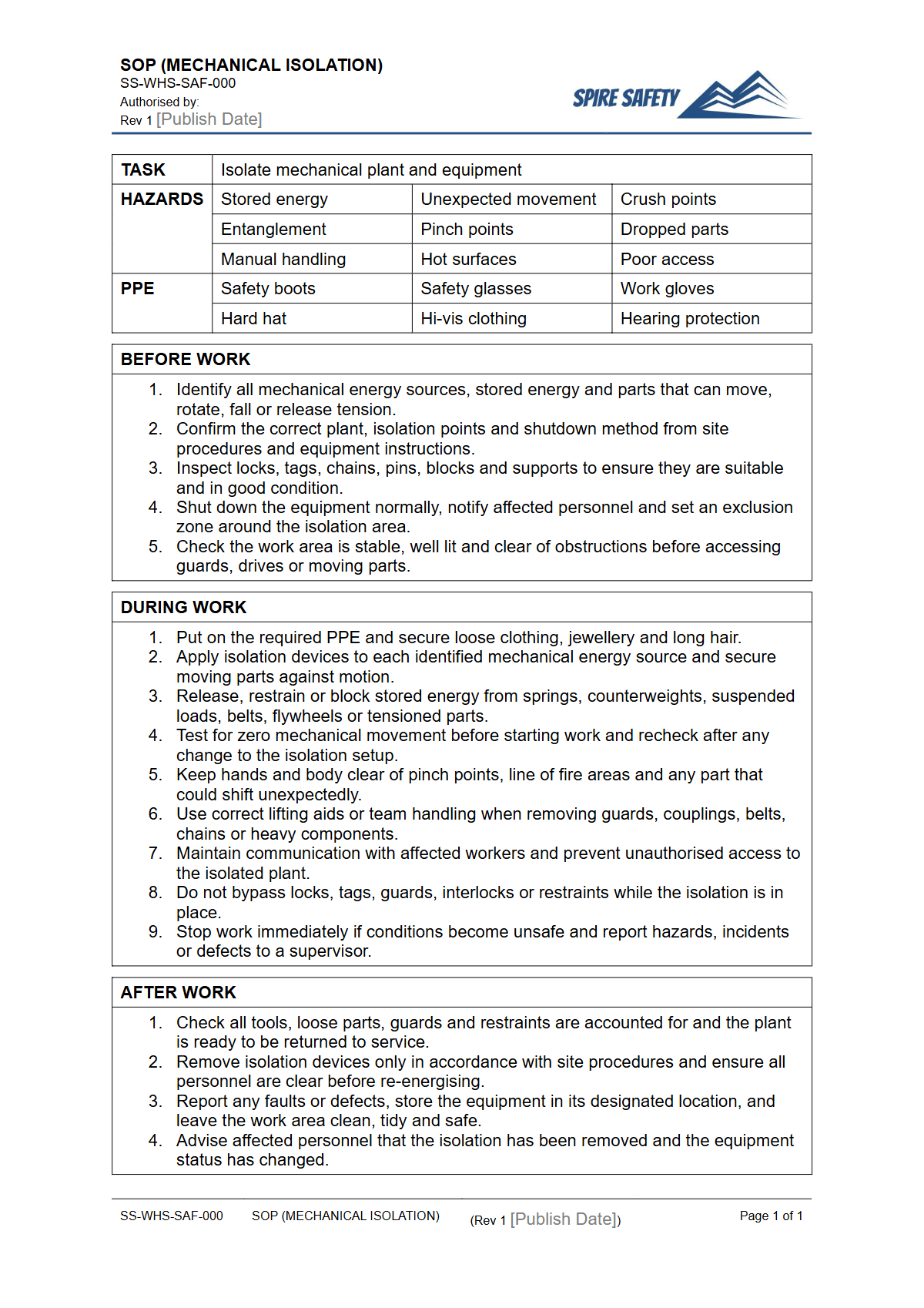
Purpose of the Free Safe Operating Procedure (Mechanical Isolation) Template
Working on or near machinery exposes workers to significant risks from the unexpected start-up of equipment or the release of stored hazardous energy. This Free Safe Operating Procedure (Mechanical Isolation) Template provides a structured starting point for organisations to develop a documented process for safely isolating plant and machinery.
The primary purpose of this Safe Operating Procedure is to prevent incidents by ensuring equipment is brought to a zero-energy state before any maintenance, cleaning, or repair work begins. It outlines the sequence of actions required to de-energise, isolate, lock, and tag energy sources effectively.
Formalising this process helps protect workers from hazards such as electric shock, burns, crushing, cutting, and entanglement. A well-defined SOP ensures that every person involved understands their role and responsibilities, promoting consistent and safe work practices across the business.
Implementing robust procedures like this is a fundamental component of effective WHS management systems, demonstrating a proactive approach to risk control.
Video walkthrough
How to use the Free Safe Operating Procedure (Mechanical Isolation) Template
This downloadable document provides a comprehensive framework, but it requires careful customisation to be effective in your specific operational environment. After downloading the DOCX file, you should adapt it by detailing the specific types of machinery, energy sources, isolation points, and verification methods unique to your workplace.
This process should involve consultation with workers who perform the tasks, their supervisors, and health and safety representatives (HSRs).
Important: This document is a template and must be customised to your workplace. We are not WHS consultants, and this template does not constitute legal advice.
You must consult with qualified professionals to ensure the final document is appropriate for your specific machinery, processes, and legislative obligations. A generic procedure is not a substitute for a risk-based, site-specific safety system.
Once customised, the procedure should be approved, communicated to all relevant personnel through training, and made readily accessible at the point of use. For machinery with complex isolation requirements, this SOP can be supplemented with equipment-specific guides, such as a Conveyer System SOP, to provide more granular detail.
When to Use a Mechanical Isolation Procedure
A formal isolation and lockout/tagout procedure is not just for major repairs. It should be applied whenever a worker is required to place any part of their body in a 'danger zone' where they could be harmed by moving machinery or the release of energy. Common situations include:
- Performing scheduled maintenance, servicing, or repairs.
- Cleaning equipment, especially internal parts.
- Clearing jams or blockages from machinery.
- Inspecting parts that are normally in motion.
- Installing or removing equipment and components.
- Any task that requires a guard or safety device to be bypassed or removed.
The principles outlined in this template are applicable to a wide range of plant, from simple machines to complex integrated systems. Many pieces of workshop equipment, for instance, have multiple energy sources that need to be managed, a process that can be detailed in a specific document like a Free Air Compressor SOP.
Who Should Use This Safe Operating Procedure
This Safe Operating Procedure should be used by personnel who are trained, competent, and explicitly authorised by the organisation to perform isolation tasks. Key roles involved in the process typically include:
- Authorised Persons: Individuals specifically trained and deemed competent to apply and remove isolation locks and tags. They are the only ones permitted to perform the isolation.
- Affected Persons: Machine operators and other workers who may be in the area and whose work is impacted by the isolation. They must be notified before isolation begins and after it is complete.
- Supervisors and Managers: Responsible for overseeing the work, ensuring the SOP is followed correctly, and issuing any associated permits to work.
Competency for performing mechanical isolation must be verified and documented. Regular reviews and checks are essential to ensure procedures remain effective and are being followed correctly in practice.
A systematic review of these critical safety documents is a key activity during a WHS compliance auditing program.
This document is just one of many tools available to improve workplace safety. For more templates and guides covering a range of equipment and tasks, explore our complete free WHS resources library.
Common mistakes
Common mistakes to avoid
- Assuming 'off' means 'safe' without verifying zero energy state (testing for dead).
- Failing to isolate all energy sources, especially secondary ones like pneumatic, hydraulic, or gravitational energy.
- Poor communication during shift handovers, leading to locks being removed prematurely.
- Using personal padlocks or non-standard devices instead of designated, standardised isolation locks.
Legal references
Legal considerations
The following legal requirements may be relevant to this type of work.
- Work Health and Safety Act (Harmonised) — Provides the primary duties for protecting workers and other people from work health and safety risks.
- Work Health and Safety Regulations (Harmonised) — Sets out requirements supporting the management of workplace hazards and risks.
The following codes may be relevant to this type of work.
- Managing WHS Risks Code of Practice — Provides practical guidance on identifying hazards, assessing risks and applying effective controls.
- Work Health and Safety Consultation, Cooperation and Coordination Code of Practice — Provides practical guidance on consulting workers and coordinating with other duty holders.
- Managing the Work Environment and Facilities Code of Practice — Provides practical guidance on safe work environments, workplace facilities and related controls.
Did you know
The Danger of Stored Energy
Many workplace incidents occur not from the primary power source, but from stored energy. A disconnected machine can still move due to stored pressure in a hydraulic line, compressed air, or the force of gravity on a raised component.
Isolation as a High-Level Control
In the hierarchy of control, isolation is considered an engineering control, which is more effective than administrative controls (like SOPs alone) or PPE. The SOP is the administrative process that ensures the engineering control is applied correctly.
FAQ
Frequently asked questions
01What is the difference between mechanical isolation and lockout/tagout (LOTO)?
02Does this template cover all types of hazardous energy?
03Who is considered a 'competent person' for mechanical isolation?
04How often should a Safe Operating Procedure for mechanical isolation be reviewed?
Share this resource
Free Safe Operating Procedure (Mechanical Isolation) Template
Browse Categories
How To Use It
- 1Download and open in Word or PDF.
- 2Replace the placeholders with your business details.
- 3Get it reviewed by a WHS specialist before rollout.
Need it customised?
Our WHS consultants can adapt this template to your site, run a gap analysis, or audit what you already have in place.
Book a Free Consultation WHS consulting servicesor call 1300 156 382
Related templates
- Free Safe Operating Procedure (Mechanical Press) Template
- Free Safe Operating Procedure (Mechanical Room Clean) Template
- Free Safe Operating Procedure (Medical Gas Cylinder) Template
- Free Safe Operating Procedure (Medication Fridge Clean) Template
- Free Safe Operating Procedure (Mesh Bender) Template
- Free Safe Operating Procedure (Mesh Cutter) Template