
Free Safe Operating Procedure (Meat Slicer) Template
Effectively manage the risks of operating a commercial meat slicer with our detailed Safe Operating Procedure template. Download your free DOCX or PDF now.
Free Safe Operating Procedure (Meat Slicer) Template
DOCX • 126 KB + PDF
Updated Oct 2026
No signup required
Purpose of the Free Safe Operating Procedure (Meat Slicer) Template
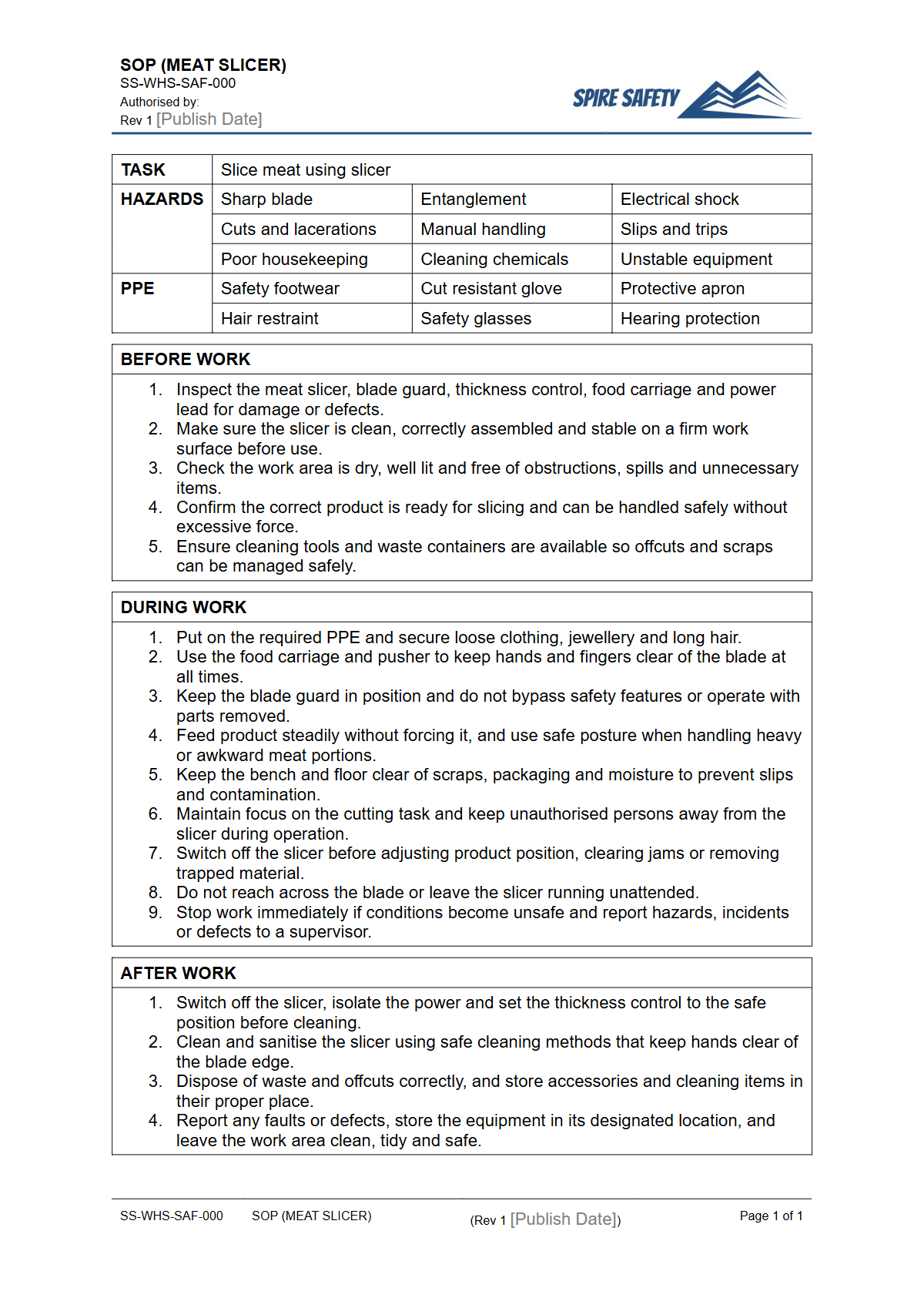
Operating a commercial meat slicer presents significant health and safety risks, primarily severe lacerations and amputations. This Free Safe Operating Procedure (Meat Slicer) Template provides a structured framework to help you document and implement a safe system of work.
A well-drafted SOP is a critical tool for any business in the hospitality, retail, or food processing sectors, forming a key component of your overall safety management approach. It outlines the required steps for pre-operational checks, safe operation, and post-use cleaning and maintenance, ensuring all workers follow a consistent and safe process.
The purpose of this document is to formalise the expected behaviours and control measures required to minimise risk. By clearly defining every step, from checking blade guards to correct shutdown procedures, you create an accountable and safety-conscious work environment.
Integrating this SOP into your broader WHS management systems helps demonstrate your organisation's commitment to providing a safe workplace and meeting your duties under WHS legislation.
Key elements covered in the template:
- Required Personal Protective Equipment (PPE) such as cut-resistant gloves.
- Pre-operational safety checks, including guard integrity and machine stability.
- A sequential guide for the task of slicing.
- Procedures for clearing jams and minor adjustments.
- Detailed steps for safe cleaning and sanitising, including de-energisation.
- Emergency procedures and shutdown instructions.
Video walkthrough
How to use the Free Safe Operating Procedure (Meat Slicer) Template
This document is a comprehensive starting point, not a finished product. To be effective, you must customise it to reflect the specific meat slicer models used in your workplace and your unique operational environment.
Incorporate details from the manufacturer’s operating manual, identify site-specific hazards through a risk assessment, and consult with your workers during the drafting process. Worker consultation is essential for creating practical and effective safety documents.
We strongly recommend a step-by-step review process:
- Download: Select the DOCX format for easy editing.
- Customise: Add your company name, logo, and relevant site details. Walk through each section and modify the content to match your equipment and processes. For example, your cleaning process may differ, or you may require specific types of PPE.
- Consult: Review the draft with experienced operators and supervisors. Their feedback is invaluable for ensuring the procedure is practical and addresses real-world challenges. This process is similar to developing other procedural documents, like a Conveyer System SOP for a food production line.
- Approve and Train: Once finalised, have the document approved by management. Use the SOP as the foundation for training all new and existing operators. Ensure every trained worker signs off to acknowledge their understanding.
- Review: Schedule regular reviews of the SOP (e.g., annually, or after an incident) to ensure it remains current and effective.
When to use a Meat Slicer SOP
A Safe Operating Procedure for a meat slicer should be a living document integrated into your daily operations. It is not a document to be filed away and forgotten.
Use it actively as a primary reference tool during several key activities. It should be the basis for all initial operator training and for any refresher courses, ensuring a consistent safety message.
Supervisors can use it for pre-start toolbox talks to reinforce critical safety checks before work begins.
The SOP also serves as a benchmark for performance and behaviour. During safety observations or inspections, supervisors can reference the documented procedure to verify that work is being performed correctly.
Furthermore, regular checks against documented procedures are a core part of any internal or external WHS compliance auditing program. In the unfortunate event of an incident or near-miss involving a meat slicer, the SOP becomes an essential document for the investigation, helping to identify whether the procedure was followed and if it needs revision.
Who should use this Safe Operating Procedure
This SOP is intended for a range of personnel within any organisation that uses commercial meat slicers, from small delicatessens to large-scale food processing plants. The primary users are the workers who operate the equipment.
The SOP provides them with clear, step-by-step instructions to perform their tasks safely. Supervisors and managers are also key users, as they are responsible for ensuring workers are trained on the procedure and adhere to it consistently.
They use the SOP as a tool for training, monitoring, and enforcing safe work practices.
WHS managers and safety representatives will use this template as part of their toolkit for developing and implementing the organisation's overall safety system. They are often responsible for facilitating the customisation, review, and approval process.
Business owners and Persons Conducting a Business or Undertaking (PCBUs) have an overarching duty of care; by implementing robust SOPs, they can help ensure they are taking reasonably practicable steps to manage workplace risks. The principles of machinery safety, particularly around sharp, fast-moving parts, are universal, whether you're documenting procedures for a meat slicer or a Circular Saw SOP.
For more templates and safety guides, explore our complete free WHS resources library, which offers a wide range of documents to support your safety management efforts.
Common mistakes
Common mistakes to avoid
- Bypassing or removing the blade guard during operation.
- Failing to unplug the machine before cleaning, servicing, or clearing a jam.
- Using hands instead of the designated food pusher or carriage to guide the product.
- Neglecting to wear appropriate cut-resistant gloves when handling or cleaning the blade.
Legal references
Legal considerations
The following legal requirements may be relevant to this type of work.
- Work Health and Safety Act (Harmonised) — Provides the primary duties for protecting workers and other people from work health and safety risks.
- Work Health and Safety Regulations (Harmonised) — Sets out requirements supporting the management of workplace hazards and risks.
The following codes may be relevant to this type of work.
- Managing WHS Risks Code of Practice — Provides practical guidance on identifying hazards, assessing risks and applying effective controls.
- Work Health and Safety Consultation, Cooperation and Coordination Code of Practice — Provides practical guidance on consulting workers and coordinating with other duty holders.
- Managing the Work Environment and Facilities Code of Practice — Provides practical guidance on safe work environments, workplace facilities and related controls.
Did you know
A Leading Cause of Injury
Amputations from food slicers are one of the most common and preventable machine-related injuries in the hospitality and food retail industries, often occurring during cleaning when safety guards are removed.
Young Worker Hazard
Due to the high risk of serious injury, Australian WHS regulations often include specific restrictions or prohibitions on workers under the age of 18 operating powered meat slicers.
FAQ
Frequently asked questions
01What are the most critical safety features of a meat slicer?
02How often should a meat slicer SOP be reviewed?
03Is specific training required to use a meat slicer?
04Can I use this template for any brand of meat slicer?
Share this resource
Free Safe Operating Procedure (Meat Slicer) Template
Browse Categories
How To Use It
- 1Download and open in Word or PDF.
- 2Replace the placeholders with your business details.
- 3Get it reviewed by a WHS specialist before rollout.
Need it customised?
Our WHS consultants can adapt this template to your site, run a gap analysis, or audit what you already have in place.
Book a Free Consultation WHS consulting servicesor call 1300 156 382
Related templates
- Free Safe Operating Procedure (Meat Tenderiser) Template
- Free Safe Operating Procedure (Meat Tray Handling) Template
- Free Safe Operating Procedure (Meat Trimming) Template
- Free Safe Operating Procedure (Mechanical Isolation) Template
- Free Safe Operating Procedure (Mechanical Press) Template
- Free Safe Operating Procedure (Mechanical Room Clean) Template