
Free Safe Operating Procedure (Meat Tray Handling) Template
Formalise safety protocols for handling meat trays with our structured Safe Operating Procedure template. Download the free DOCX and PDF to get started.
Free Safe Operating Procedure (Meat Tray Handling) Template
DOCX • 126 KB + PDF
Updated Oct 2026
No signup required
Purpose of the Free Safe Operating Procedure (Meat Tray Handling) Template
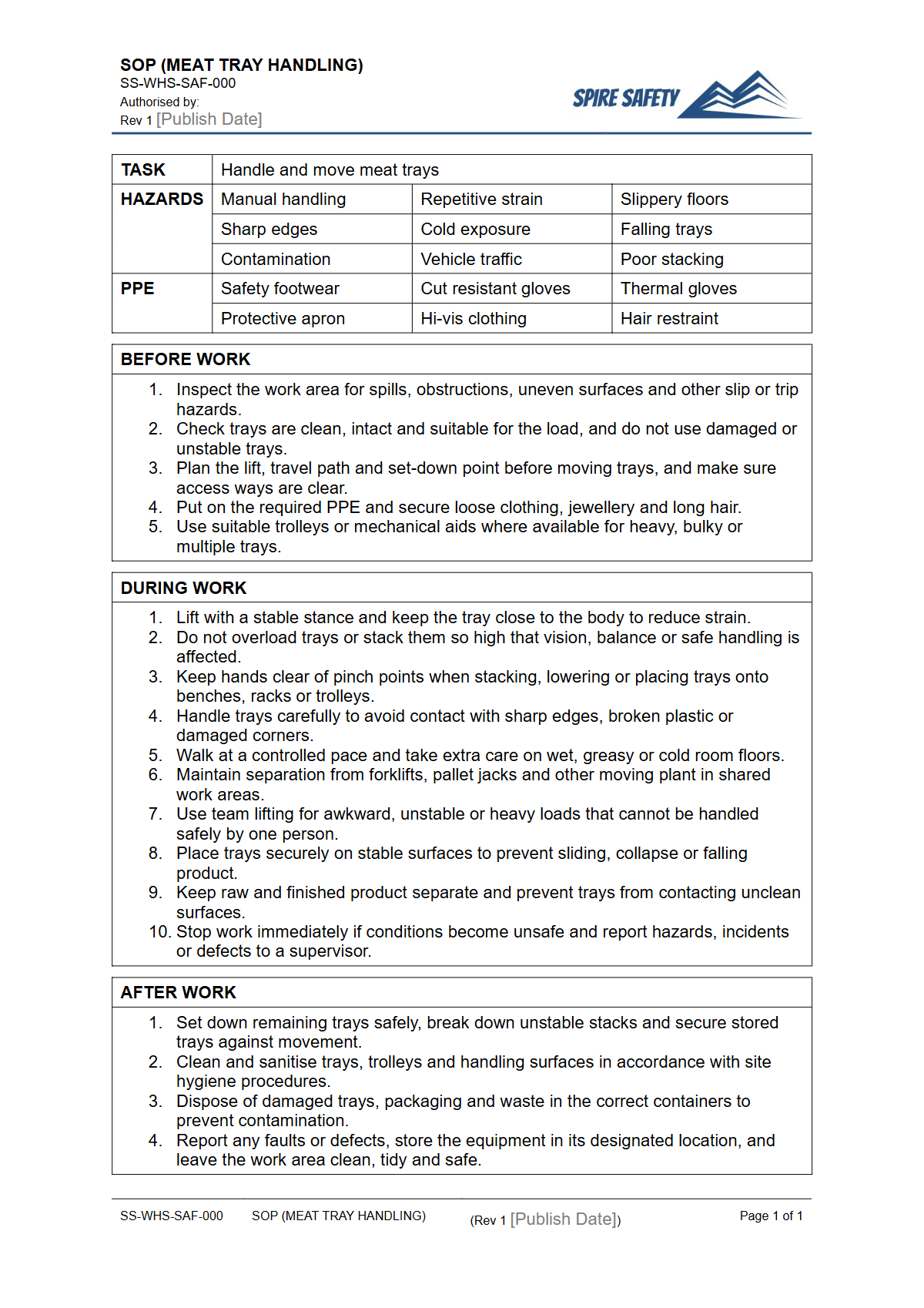
Handling meat trays, whether in a butchery, supermarket, or food processing facility, involves specific risks that must be managed to ensure worker safety. Our Free Safe Operating Procedure (Meat Tray Handling) Template provides a structured framework for documenting the required safety measures.
The primary hazards associated with this task include musculoskeletal injuries from hazardous manual tasks (lifting, carrying, pushing), slips and falls from liquid spills, and potential cuts or lacerations from damaged trays or associated equipment. This document helps your organisation systematically identify these risks and outline clear, step-by-step controls to mitigate them.
A well-developed Safe Operating Procedure (SOP) is a fundamental component of a safe system of work. It serves as a practical tool for training, supervision, and operational consistency, forming a crucial part of your overall safety management efforts.
Integrating task-specific SOPs like this one helps build more robust and effective WHS management systems, demonstrating a clear commitment to proactive risk management and fulfilling your duty of care.
Video walkthrough
How to use the Free Safe Operating Procedure (Meat Tray Handling) Template
This template is available for immediate download in both DOCX and PDF formats. The DOCX version is fully editable, allowing you to tailor it to the unique context of your workplace.
While this document is aligned with Australian WHS principles, it is essential to customise it to reflect your specific processes, equipment, and environment. We've provided a comprehensive starting point, but you must consult with your team and adapt this document to the specific hazards and controls relevant to your operations.
To effectively use the template, begin by conducting a risk assessment for the task of handling meat trays. Involve the workers who perform the task daily, as their input is invaluable for identifying practical hazards and effective controls.
Document the agreed-upon steps, safety precautions, required personal protective equipment (PPE), and emergency procedures. If tray handling is part of a larger mechanised process, you may need to integrate this procedure with others, such as a free Conveyer System SOP, to ensure safety across all stages of the operation.
When to use this Safe Operating Procedure
An SOP for meat tray handling should be a core part of your daily operations and safety lifecycle. It is essential for inducting and training new employees, ensuring they understand the established safe methods from their first day.
It also serves as a critical tool for refresher training for existing staff and as a reference point before commencing non-routine or complex handling tasks. The document should be readily accessible to all relevant workers in the areas where meat trays are handled.
Furthermore, the SOP should be reviewed and updated regularly—at least annually, or whenever there is a change in workplace procedures, equipment, or environment. It must also be reviewed following any incident or near miss involving meat tray handling to incorporate any lessons learned.
Regular reviews are a key activity in a cycle of continuous improvement and may be checked during a formal WHS compliance auditing process.
Who should use this Safe Operating Procedure
This document is intended for use by multiple roles within an organisation. WHS managers and supervisors are responsible for developing, implementing, and reviewing the SOP, ensuring it is accurate and effectively communicated.
They must use it as the basis for training and for monitoring that safe work practices are being followed. Workers who handle meat trays are the primary end-users; they must understand and follow the procedures outlined in the SOP to protect their own health and safety and that of their colleagues.
For organisations with complex processing lines or significant manual handling risks, developing and implementing effective control measures can be challenging. In these situations, seeking external expertise can provide clarity and assurance.
Engaging with specialists for WHS consulting can help you navigate specific challenges and ensure your safety systems are practical, effective, and aligned with industry best practice. Explore our free WHS resources library for more templates and guides to support your safety objectives.
Common mistakes
Common mistakes to avoid
- Using the downloaded template without customising it for the specific workplace.
- Failing to consult with workers who perform the task when drafting the procedure.
- Not providing adequate training and supervision to ensure the SOP is understood and followed.
- Treating the SOP as a one-time administrative task instead of a live document that requires regular review.
Legal references
Legal considerations
The following legal requirements may be relevant to this type of work.
- Work Health and Safety Act (Harmonised) — Provides the primary duties for protecting workers and other people from work health and safety risks.
- Work Health and Safety Regulations (Harmonised) — Sets out requirements supporting the management of workplace hazards and risks.
The following codes may be relevant to this type of work.
- Managing WHS Risks Code of Practice — Provides practical guidance on identifying hazards, assessing risks and applying effective controls.
- Work Health and Safety Consultation, Cooperation and Coordination Code of Practice — Provides practical guidance on consulting workers and coordinating with other duty holders.
- Managing the Work Environment and Facilities Code of Practice — Provides practical guidance on safe work environments, workplace facilities and related controls.
Did you know
Manual Task Injuries
Musculoskeletal disorders resulting from hazardous manual tasks are the most common type of workplace injury in Australia, accounting for a significant portion of serious workers' compensation claims each year.
FAQ
Frequently asked questions
01What are the main hazards when handling meat trays?
02Is a Safe Operating Procedure a legal requirement in Australia?
03How often should an SOP for meat tray handling be reviewed?
04Who should be involved in creating a Safe Operating Procedure?
Share this resource
Free Safe Operating Procedure (Meat Tray Handling) Template
Browse Categories
How To Use It
- 1Download and open in Word or PDF.
- 2Replace the placeholders with your business details.
- 3Get it reviewed by a WHS specialist before rollout.
Need it customised?
Our WHS consultants can adapt this template to your site, run a gap analysis, or audit what you already have in place.
Book a Free Consultation WHS consulting servicesor call 1300 156 382
Related templates
- Free Safe Operating Procedure (Meat Trimming) Template
- Free Safe Operating Procedure (Mechanical Isolation) Template
- Free Safe Operating Procedure (Mechanical Press) Template
- Free Safe Operating Procedure (Mechanical Room Clean) Template
- Free Safe Operating Procedure (Medical Gas Cylinder) Template
- Free Safe Operating Procedure (Medication Fridge Clean) Template