
Free Safe Operating Procedure (Meat Trimming) Template
Formalise your safety protocols for meat trimming tasks with our professional template. Download your free Safe Operating Procedure to get started today.
Free Safe Operating Procedure (Meat Trimming) Template
DOCX • 126 KB + PDF
Updated Oct 2026
No signup required
Purpose of the Free Safe Operating Procedure (Meat Trimming) Template
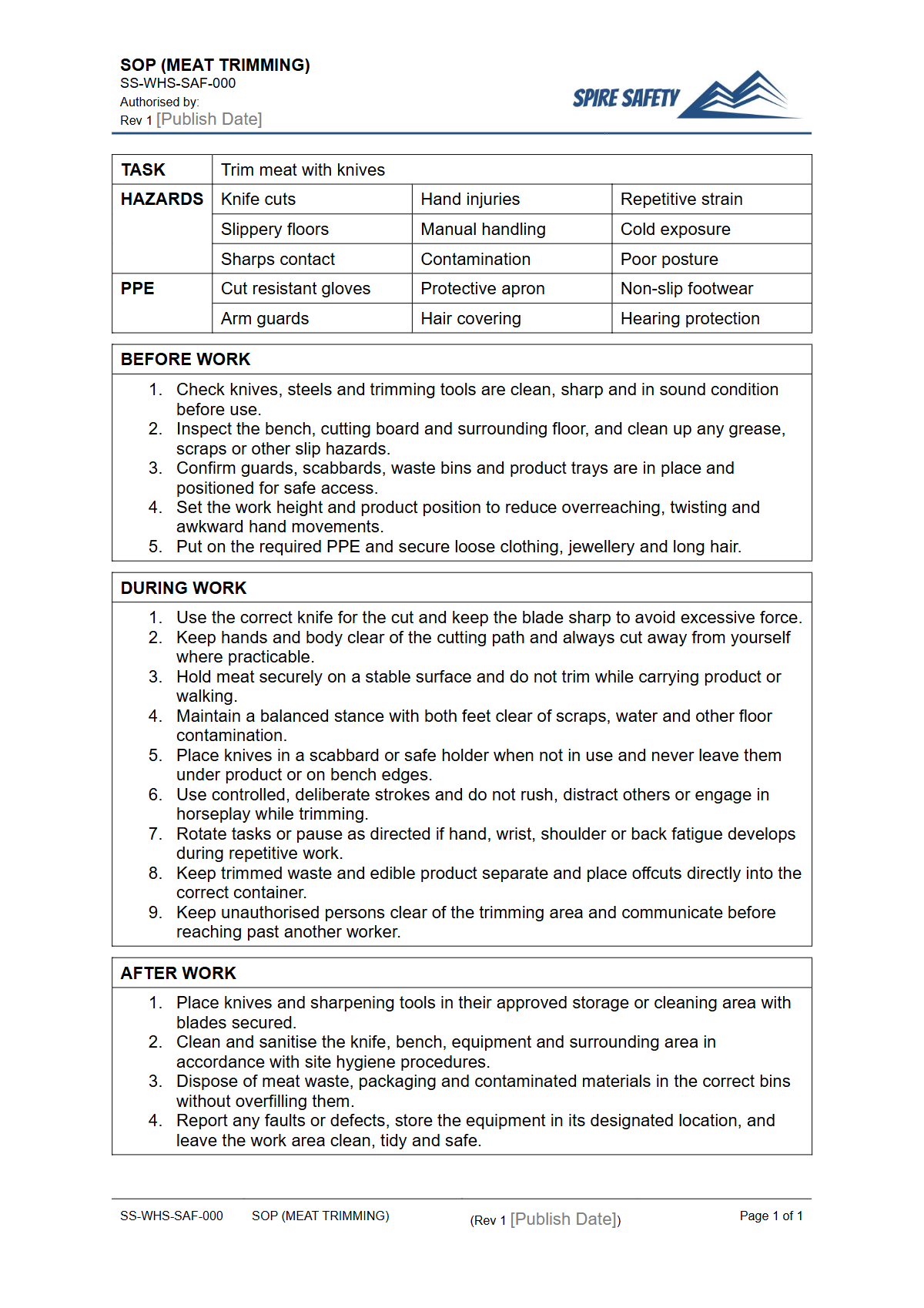
This Free Safe Operating Procedure (Meat Trimming) Template provides a structured framework for documenting the safety requirements for trimming meat in a commercial setting. Its primary purpose is to clearly outline the step-by-step process, identify potential hazards, and specify the control measures necessary to ensure worker safety.
By using this SOP, organisations can standardise their approach to a high-risk task, reducing the likelihood of cuts, musculoskeletal disorders, and other common injuries in the meat processing industry.
The document is designed as a practical starting point, aligned with Australian WHS principles. It covers key areas including pre-operational checks, personal protective equipment (PPE), the trimming process itself, and cleaning procedures.
For operations that integrate trimming with automated lines, this procedure should be used alongside specific machinery documents, such as a conveyer system SOP, to ensure all aspects of the workflow are covered.
Video walkthrough
How to use the Free Safe Operating Procedure (Meat Trimming) Template
Begin by downloading the template in your preferred format (DOCX for easy editing or PDF). The key to an effective SOP is customisation.
This document provides a solid foundation, but you must adapt it to reflect the specific knives, equipment, workstation design, and types of meat processed in your workplace. We cannot know your unique site conditions or internal procedures.
Engage in consultation with the workers who perform the trimming tasks. Their direct experience is invaluable for identifying practical risks and effective controls.
Once customised, the final SOP should be used as a primary training tool for new employees and for refresher training for existing staff. The signed-off document becomes an official record of your organisation’s required safety process.
Integrating this SOP into a comprehensive WHS management system helps ensure that safety documentation is systematically managed, reviewed, and improved over time.
When to use it
A Safe Operating Procedure for meat trimming should be in place and actively used before any worker undertakes the task. It is a critical document for several key operational moments:
- Induction and Training: Use the finalised SOP to train new workers and verify their understanding before they begin work.
- Refresher Training: Periodically review the SOP with experienced workers to reinforce safe work habits and communicate any process changes.
- Incident Investigation: If an incident or near-miss occurs, the SOP serves as a benchmark to determine if procedures were followed and whether they need to be updated.
- Audits and Reviews: The SOP is a key piece of evidence during safety inspections and WHS compliance audits, demonstrating a formalised approach to managing risk.
Who should use it
This template is intended for use by Persons Conducting a Business or Undertaking (PCBUs) and their management teams within the food processing, butchery, and hospitality sectors. Specifically:
- WHS Managers and Safety Officers are responsible for adapting the template, ensuring it meets regulatory expectations, and integrating it into the broader safety system.
- Supervisors and Team Leaders must use the SOP to train their teams, supervise tasks, and enforce the specified safety controls on the floor.
- Workers are the end-users who must be trained on and follow the procedures outlined in the SOP to perform their work safely.
For businesses needing support in customising this document or developing other safety procedures, engaging professional WHS consulting services can provide expert guidance and ensure your systems are robust and practical. You can also explore our free WHS resources library for other useful templates and guides.
Common mistakes
Common mistakes to avoid
- Using knives that are dull, which requires more force and increases the risk of the blade slipping.
- Failing to provide or enforce the use of appropriate PPE, such as cut-resistant gloves and mesh aprons.
- Neglecting to adjust workstation height to suit the individual worker, leading to poor posture and ergonomic injuries.
- Inadequate cleaning procedures that result in slippery floors and increase the risk of slips, trips, and falls.
Legal references
Legal considerations
The following legal requirements may be relevant to this type of work.
- Work Health and Safety Act (Harmonised) — Provides the primary duties for protecting workers and other people from work health and safety risks.
- Work Health and Safety Regulations (Harmonised) — Sets out requirements supporting the management of workplace hazards and risks.
The following codes may be relevant to this type of work.
- Managing WHS Risks Code of Practice — Provides practical guidance on identifying hazards, assessing risks and applying effective controls.
- Work Health and Safety Consultation, Cooperation and Coordination Code of Practice — Provides practical guidance on consulting workers and coordinating with other duty holders.
- Managing the Work Environment and Facilities Code of Practice — Provides practical guidance on safe work environments, workplace facilities and related controls.
Did you know
Cut-Resistant Gloves
Cut-resistant gloves are rated on a scale (e.g., EN388 or ANSI/ISEA 105). Higher numbers offer greater protection, which is crucial for the non-knife hand in trimming operations.
Ergonomic Strain
Repetitive Strain Injury (RSI) is a major risk in meat processing. Job rotation, regular micro-breaks, and adjustable workstations are simple but effective controls to reduce ergonomic strain.
FAQ
Frequently asked questions
01What hazards are involved in meat trimming?
02Is a Safe Operating Procedure a legal requirement for meat trimming?
03How often should a meat trimming SOP be reviewed?
04Can I use this template for any type of meat trimming?
Share this resource
Free Safe Operating Procedure (Meat Trimming) Template
Browse Categories
How To Use It
- 1Download and open in Word or PDF.
- 2Replace the placeholders with your business details.
- 3Get it reviewed by a WHS specialist before rollout.
Need it customised?
Our WHS consultants can adapt this template to your site, run a gap analysis, or audit what you already have in place.
Book a Free Consultation WHS consulting servicesor call 1300 156 382
Related templates
- Free Safe Operating Procedure (Mechanical Isolation) Template
- Free Safe Operating Procedure (Mechanical Press) Template
- Free Safe Operating Procedure (Mechanical Room Clean) Template
- Free Safe Operating Procedure (Medical Gas Cylinder) Template
- Free Safe Operating Procedure (Medication Fridge Clean) Template
- Free Safe Operating Procedure (Mesh Bender) Template