
Free Safe Operating Procedure (Meat Tenderiser) Template
Download our free Safe Operating Procedure (Meat Tenderiser) template to formalise safe work practices.
Free Safe Operating Procedure (Meat Tenderiser) Template
DOCX • 126 KB + PDF
Updated Oct 2026
No signup required
Purpose of the Free Safe Operating Procedure (Meat Tenderiser) Template
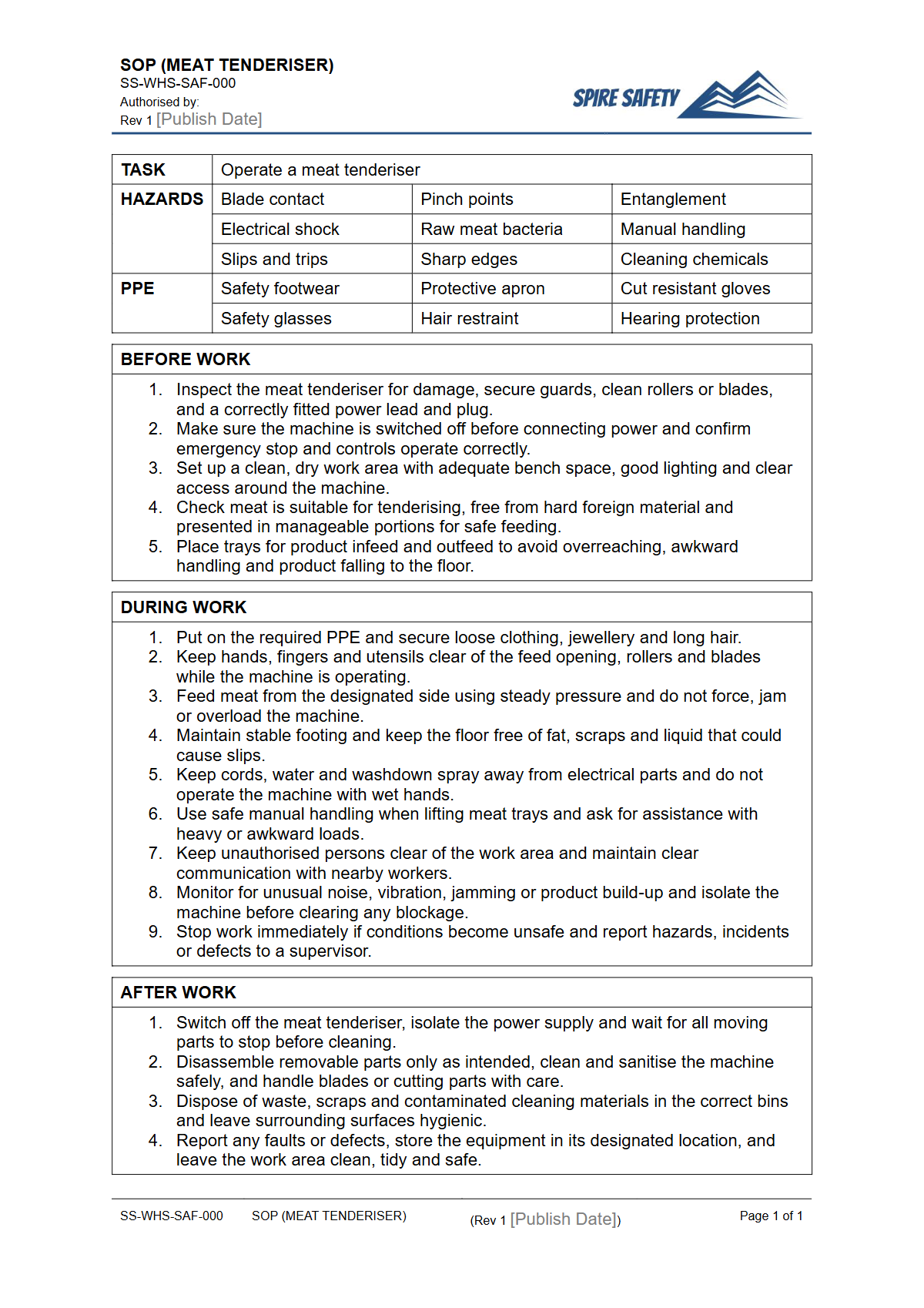
This Free Safe Operating Procedure (Meat Tenderiser) Template provides a structured framework for documenting the safe use of electric or manual meat tenderisers in a commercial setting. Found in butcheries, restaurants, and food processing facilities, these machines pose significant risks, including amputation, laceration, and entanglement from moving blades or needles.
A documented SOP is a critical tool for managing these hazards, ensuring all workers follow a consistent, safe method for operation, cleaning, and maintenance.
Implementing a clear SOP helps your organisation meet its primary duty of care under WHS legislation. It serves as a key training resource for new employees and a vital reference for experienced operators.
Formalising procedures demonstrates a commitment to a proactive safety culture and forms an essential part of your overall WHS management system, helping to minimise the risk of serious injury and operational downtime.
Video walkthrough
How to use the Free Safe Operating Procedure (Meat Tenderiser) Template
Our Safe Operating Procedure (Meat Tenderiser) Template is provided as a starting point. It is formatted in an easy-to-edit DOCX file that you can adapt to the specific equipment and processes in your workplace.
The template prompts you to detail required personal protective equipment (PPE), pre-start safety checks, step-by-step operating instructions, and procedures for cleaning and shutdown.
Important: This document must be customised to reflect your specific operational context. You should incorporate the make and model of your meat tenderiser, identify site-specific hazards, and align the procedure with your existing risk assessments.
We strongly advise consulting the manufacturer's instruction manual and involving operators in the drafting process to ensure the final SOP is practical and effective. For complex operations or if you require assistance with risk assessments, consider engaging professional WHS consulting services.
When to use a Safe Operating Procedure
An SOP for a meat tenderiser should be developed before the equipment is first used and be readily available at all times. It is a 'live' document that requires regular review and updates, particularly when:
- A new model of meat tenderiser is introduced.
- The work environment or process changes.
- An incident, near miss, or new hazard is identified.
- Legislative requirements or industry best practices are updated.
- Consultation with workers highlights a need for improvement.
Regular reviews, often conducted annually, ensure the procedure remains relevant and effective. Comparing practices for high-risk bladed equipment, such as those detailed in our FREE Circular Saw SOP (Safe Operating Procedure) Template, can provide valuable insights into robust safety protocols.
Who should use this Safe Operating Procedure
This SOP should be used by all personnel involved with the meat tenderiser, from operators to cleaning and maintenance staff. Specifically:
- Workers and Operators: Must be trained on the SOP and follow it precisely during operation, cleaning, and daily checks.
- Supervisors and Managers: Are responsible for ensuring operators are trained and competent, that the SOP is followed correctly, and for conducting regular reviews of the procedure. Periodic verification of compliance can be supported through formal WHS compliance auditing.
- Maintenance Personnel: Must follow the specified lockout-tagout and de-energisation procedures within the SOP before commencing any service or repair work.
If the tenderiser is part of a larger production line, it is also important to understand how it interacts with other machinery. Procedures for connected equipment, such as what you might find in a FREE Conveyer System SOP (Safe Operating Procedure) Template, should be cross-referenced to ensure seamless and safe workflow. You can find more templates like these in our complete free WHS resources library.
Common mistakes
Common mistakes to avoid
- Using the template without customising it for the specific machine model and work environment.
- Failing to de-energise and follow lockout-tagout procedures before cleaning or maintenance.
- Bypassing or disabling safety guards, interlocks, or emergency stops to speed up work.
- Neglecting to provide practical, hands-on training and competency assessment alongside the written document.
Legal references
Legal considerations
The following legal requirements may be relevant to this type of work.
- Work Health and Safety Act (Harmonised) — Provides the primary duties for protecting workers and other people from work health and safety risks.
- Work Health and Safety Regulations (Harmonised) — Sets out requirements supporting the management of workplace hazards and risks.
The following codes may be relevant to this type of work.
- Managing WHS Risks Code of Practice — Provides practical guidance on identifying hazards, assessing risks and applying effective controls.
- Work Health and Safety Consultation, Cooperation and Coordination Code of Practice — Provides practical guidance on consulting workers and coordinating with other duty holders.
- Managing the Work Environment and Facilities Code of Practice — Provides practical guidance on safe work environments, workplace facilities and related controls.
Did you know
A Leading Cause of Injury
Lacerations and cuts are one of the most common types of injury in the food processing and hospitality industries, often resulting from contact with machinery like slicers, grinders, and tenderisers.
The Hierarchy of Control
A Safe Operating Procedure is an 'administrative control'. While important, it is considered less effective than 'engineering controls' (like fixed guards and interlock switches) that physically prevent contact with hazards.
FAQ
Frequently asked questions
01What should be included in an SOP for a meat tenderiser?
02How often should we review our meat tenderiser Safe Operating Procedure?
03Is an SOP enough to manage the risks of a meat tenderiser?
04Who is responsible for training workers on the meat tenderiser SOP?
Share this resource
Free Safe Operating Procedure (Meat Tenderiser) Template
Browse Categories
How To Use It
- 1Download and open in Word or PDF.
- 2Replace the placeholders with your business details.
- 3Get it reviewed by a WHS specialist before rollout.
Need it customised?
Our WHS consultants can adapt this template to your site, run a gap analysis, or audit what you already have in place.
Book a Free Consultation WHS consulting servicesor call 1300 156 382
Related templates
- Free Safe Operating Procedure (Meat Tray Handling) Template
- Free Safe Operating Procedure (Meat Trimming) Template
- Free Safe Operating Procedure (Mechanical Isolation) Template
- Free Safe Operating Procedure (Mechanical Press) Template
- Free Safe Operating Procedure (Mechanical Room Clean) Template
- Free Safe Operating Procedure (Medical Gas Cylinder) Template