
Free Safe Operating Procedure (Meal Delivery Rounds) Template
Download our Free Safe Operating Procedure for Meal Delivery Rounds template. This resource helps you document safe work practices for drivers and food handlers.
Free Safe Operating Procedure (Meal Delivery Rounds) Template
DOCX • 126 KB + PDF
Updated Oct 2026
No signup required
Purpose of the Free Safe Operating Procedure (Meal Delivery Rounds) Template
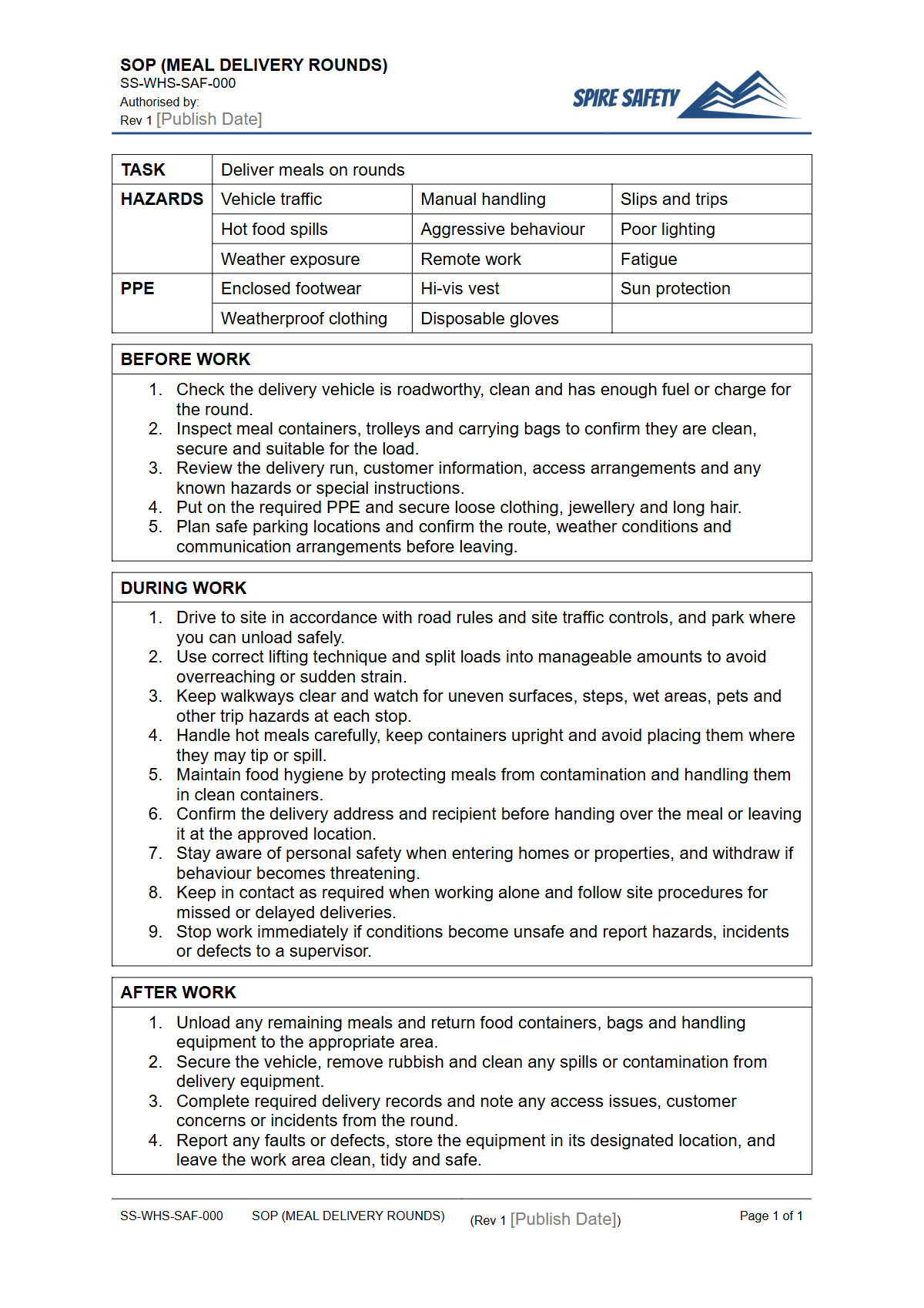
Organisations providing meal delivery services, such as aged care facilities, hospitals, and community support programs, face a unique set of WHS risks. Our Free Safe Operating Procedure (Meal Delivery Rounds) Template provides a structured starting point for documenting the required steps to perform this task safely.
The primary purpose of this SOP is to minimise risks to workers and clients by providing clear, step-by-step instructions for every stage of the delivery process. This helps reduce the likelihood of incidents such as vehicle accidents, musculoskeletal injuries from manual handling, food safety breaches, and negative outcomes during client interactions.
A well-drafted SOP for meal delivery rounds covers critical areas including pre-start vehicle checks, correct loading and unloading techniques, food temperature management, defensive driving practices, and procedures for what to do if a client is unresponsive. By standardising these processes, you create a consistent benchmark for safe behaviour, which is essential for training, supervision, and demonstrating due diligence.
This formalised approach is a cornerstone of an effective safety management system, ensuring every worker understands the identified hazards and the controls in place to protect them.
Key Hazards in Meal Delivery
This Safe Operating Procedure template prompts you to consider and control a variety of hazards, including:
- Driving Risks: Fatigue, distraction, traffic incidents, and adverse weather conditions.
- Manual Tasks: Lifting and carrying eskies, food containers, or trays, leading to sprains and strains.
- Slips, Trips, and Falls: Navigating footpaths, stairs, and client properties in various conditions.
- Food Safety: Temperature abuse, cross-contamination, and poor hygiene.
- Psychosocial Hazards: Dealing with distressed or unwell clients, time pressures, and working alone.
- Vehicle-related Hazards: Poorly maintained vehicles, incorrect loading, and securing of items.
Video walkthrough
How to use the Free Safe Operating Procedure (Meal Delivery Rounds) Template
This document is provided in both DOCX and PDF formats for your convenience. The DOCX file is fully editable, allowing you to adapt it to your specific operational needs.
To ensure this procedure is effective, it must accurately reflect your workplace environment and processes.
Important: This is a template only. It provides a framework aligned with Australian WHS practice but is not a complete, ready-to-use document.
We strongly advise that you customise this document to reflect the specific vehicles, equipment, routes, client needs, and risks in your workplace. Consultation with your workers during this customisation process is critical to its success.
The template is organised into logical sections:
- Document Control: Fields for version number, review dates, and authorisations.
- Personal Protective Equipment (PPE): Specifies required PPE such as high-visibility clothing, appropriate footwear, and gloves.
- Pre-Operational Checks: A checklist for vehicle safety (tyres, lights, fuel) and equipment checks (esky temperature, cleanliness). Tasks like routine tyre inflation may require a separate Air Compressor Safe Operating Procedure.
- Operating Sequence: Detailed steps for loading the vehicle, route planning, safe driving, delivering meals (including client interaction protocols), and returning to base.
- Post-Operational Tasks: Procedures for cleaning equipment, vehicle shutdown, and reporting any incidents or client concerns.
- Emergency Procedures: Clear instructions for handling vehicle breakdowns, accidents, or medical emergencies involving clients.
When to use a Meal Delivery SOP
A Safe Operating Procedure for meal delivery rounds should be a core part of your daily operations and safety management. It is a practical tool used for training new drivers and volunteers, ensuring they understand the expected safety standards from day one.
It also serves as an excellent resource for periodic refresher training for existing staff. Workers should have easy access to the SOP as a reference guide before and during their shifts.
Furthermore, the document becomes an essential piece of evidence during safety incident investigations and should be reviewed as part of your internal WHS compliance auditing program to ensure it remains current and effective.
Integrating SOPs into Your Safety System
An SOP should not exist in isolation. It is a vital component of a comprehensive WHS management system that systematically identifies and controls risks across your entire organisation.
While this SOP covers a service-based task, your safety system must address all activities. For example, a large central kitchen preparing the meals may require a conveyer system SOP for its packing line.
Similarly, a facility managing its own logistics might need a Telehandler SOP for unloading bulk food supplies. Integrating all these procedures ensures a holistic approach to safety, where every task, big or small, has a documented safe process.
You can explore many other templates in our free WHS resources library to support your system.
Common mistakes
Common mistakes to avoid
- Using the template 'as is' without customising it for specific vehicles, routes, and client needs.
- Failing to consult with drivers and food handlers when developing or updating the procedure.
- Not providing practical training and verifying that workers understand and can follow the SOP.
- Neglecting to include clear steps for managing client-related issues, like what to do if a client does not answer the door or appears unwell.
Legal references
Legal considerations
The following legal requirements may be relevant to this type of work.
- Work Health and Safety Act (Harmonised) — Provides the primary duties for protecting workers and other people from work health and safety risks.
- Work Health and Safety Regulations (Harmonised) — Sets out requirements supporting the management of workplace hazards and risks.
The following codes may be relevant to this type of work.
- Managing WHS Risks Code of Practice — Provides practical guidance on identifying hazards, assessing risks and applying effective controls.
- Work Health and Safety Consultation, Cooperation and Coordination Code of Practice — Provides practical guidance on consulting workers and coordinating with other duty holders.
- Managing the Work Environment and Facilities Code of Practice — Provides practical guidance on safe work environments, workplace facilities and related controls.
Did you know
A Major Cause of Injury
Vehicle incidents are a leading cause of work-related fatalities in Australia. Implementing robust procedures like pre-start checks and safe driving rules is a critical control.
Food Safety is WHS
Maintaining the correct food temperature during delivery is not just a food safety requirement; it's also a WHS issue. It protects both the health of the vulnerable client and the worker from liability.
FAQ
Frequently asked questions
01Is a Safe Operating Procedure a legal requirement for meal delivery in Australia?
02What's the difference between a Safe Operating Procedure (SOP) and a Safe Work Method Statement (SWMS)?
03How often should we review our Meal Delivery Rounds SOP?
04Can this template be used for volunteer drivers as well as paid staff?
Share this resource
Free Safe Operating Procedure (Meal Delivery Rounds) Template
Browse Categories
How To Use It
- 1Download and open in Word or PDF.
- 2Replace the placeholders with your business details.
- 3Get it reviewed by a WHS specialist before rollout.
Need it customised?
Our WHS consultants can adapt this template to your site, run a gap analysis, or audit what you already have in place.
Book a Free Consultation WHS consulting servicesor call 1300 156 382
Related templates
- Free Safe Operating Procedure (Meal Service Setup) Template
- Free Safe Operating Procedure (Meat Hook Handling) Template
- Free Safe Operating Procedure (Meat Slicer) Template
- Free Safe Operating Procedure (Meat Tenderiser) Template
- Free Safe Operating Procedure (Meat Tray Handling) Template
- Free Safe Operating Procedure (Meat Trimming) Template