
Free Safe Operating Procedure (Mattress Handling) Template
Manage hazardous manual tasks involved in moving mattresses with our free template. Download our Safe Operating Procedure for Mattress Handling to get started.
Free Safe Operating Procedure (Mattress Handling) Template
DOCX • 126 KB + PDF
Updated Oct 2026
No signup required
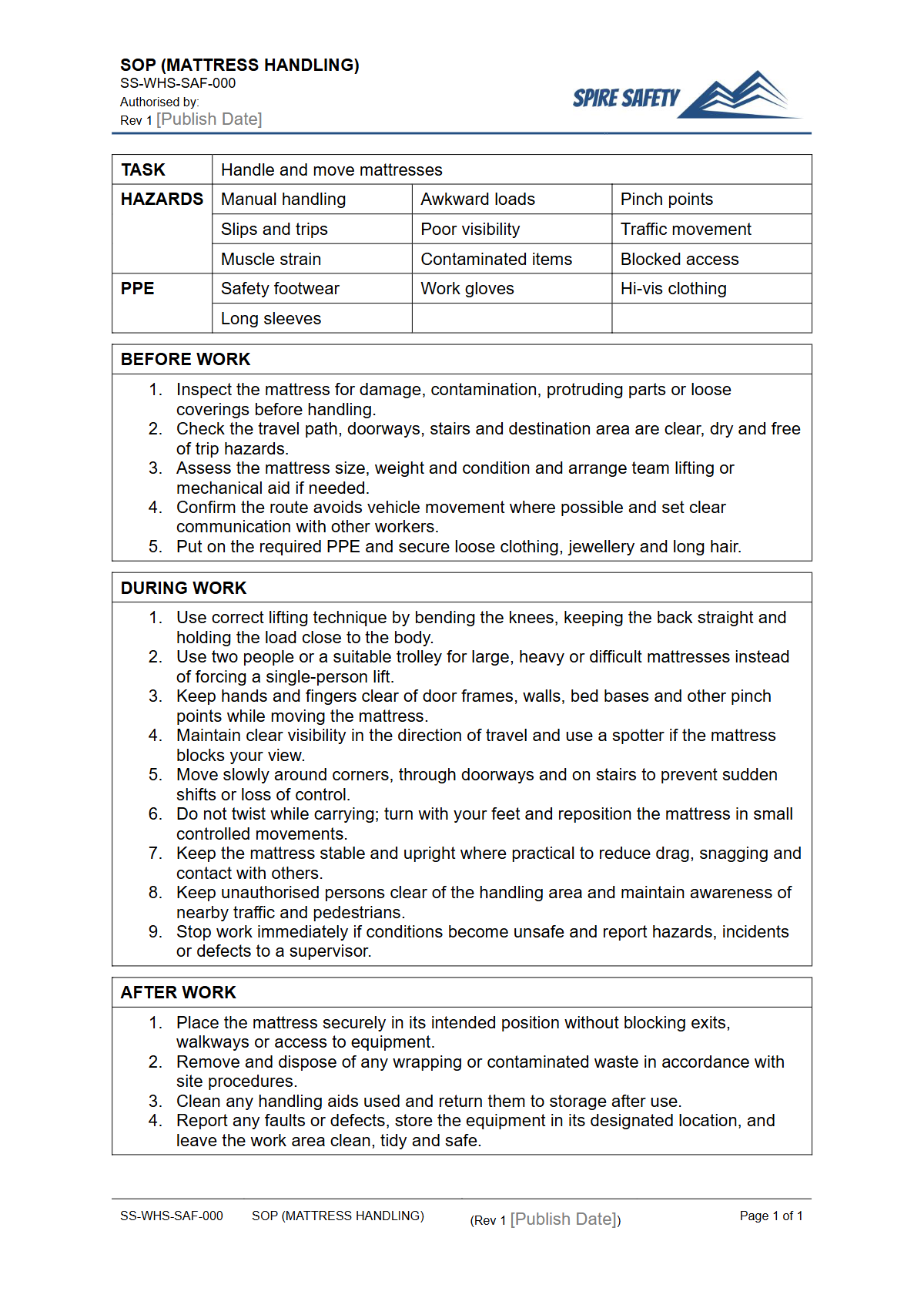
Purpose of the Free Safe Operating Procedure (Mattress Handling) Template
The primary purpose of this Safe Operating Procedure for mattress handling is to provide a clear, step-by-step guide to performing the task safely. Handling mattresses, which are often bulky, heavy, and awkward, presents significant risks for musculoskeletal disorders (MSDs), including sprains and strains to the back, neck, and shoulders.
This document helps persons conducting a business or undertaking (PCBUs) fulfil their duty of care by systematically identifying hazards and outlining control measures.
Using a structured SOP helps standardise safe work practices, ensuring all workers follow the same approved process. It serves as a critical training tool for new employees and a refresher for existing staff, reinforcing correct lifting techniques, the use of mechanical aids, and team lifting protocols.
Formalising these procedures is a fundamental component of building robust WHS management systems that proactively manage risk rather than reacting to incidents.
Video walkthrough
How to use the Free Safe Operating Procedure (Mattress Handling) Template
This template is provided as a fully editable DOCX file, designed for easy customisation to reflect the specific conditions of your workplace. A PDF version is also available for straightforward printing and distribution.
To use this resource effectively, download the document and methodically work through each section, replacing the placeholder text with your site-specific details.
This includes identifying the exact types of mattresses handled, the environment (e.g., warehouse, delivery truck, hotel room), the specific mechanical aids available (like trolleys or stair climbers), and the emergency procedures relevant to your location. Consultation is key; involve the workers who perform the task daily to ensure the SOP is practical and reflects the realities of the job.
Important: This is a template that provides a structured starting point. We have not been to your workplace or assessed your specific risks.
You must adapt this document to your unique operational context, equipment, and legal obligations. If you are unsure how to conduct the necessary risk assessments or tailor the procedure, seeking professional WHS consulting is recommended.
When to use a Safe Operating Procedure for Mattress Handling
An SOP for mattress handling should be implemented wherever this task is performed routinely. This includes a wide range of industries and scenarios, such as:
- Logistics and Warehousing: For staff receiving, storing, picking, and loading mattresses.
- Retail: For sales assistants and back-of-house staff moving stock from storage to the shop floor or to a customer's vehicle.
- Delivery Services: For drivers and assistants performing two-person lifts into homes, often navigating stairs and tight spaces.
- Hospitality: For housekeeping and maintenance staff in hotels and motels who need to lift, turn, or replace mattresses.
- Waste Management and Recycling: For workers handling discarded mattresses at collection facilities.
For larger-scale logistics where mattresses are moved in bulk, this SOP should complement procedures for other equipment, such as a telehandler for managing palletised goods. It should be used as a core part of worker induction and task-specific training.
Who should use it
This Safe Operating Procedure should be used and understood by all individuals involved in the mattress handling process. Key personnel include:
- Workers: Delivery drivers, warehouse staff, hotel housekeepers, and retail employees who physically perform the task. They must be trained on the SOP and follow its instructions.
- Supervisors and Managers: They are responsible for implementing the SOP, providing adequate training, ensuring mechanical aids are available and maintained, and monitoring compliance.
- WHS Representatives and Committees: They should be involved in the development and review of the SOP as part of the consultation process.
- PCBUs: Business owners and senior leaders hold the ultimate responsibility for providing a safe system of work, which this SOP helps to establish.
Implementing the SOP is the first step; verifying its effectiveness through tools like workplace inspections and regular WHS compliance audits ensures the controls are working as intended. You can find more templates to support your safety system in our comprehensive free WHS resources library.
Common mistakes
Common mistakes to avoid
- Failing to customise the template with site-specific equipment, environments, and personnel.
- Neglecting to consult with the workers who actually perform the task during the drafting and review process.
- Treating the SOP as a box-ticking exercise without providing proper training, supervision, and verification of understanding.
- Not providing or maintaining appropriate mechanical aids (e.g., trolleys, lifting straps) and defaulting to manual lifting.
Legal references
Legal considerations
The following legal requirements may be relevant to this type of work.
- Work Health and Safety Act (Harmonised) — Provides the primary duties for protecting workers and other people from work health and safety risks.
- Work Health and Safety Regulations (Harmonised) — Sets out requirements supporting the management of workplace hazards and risks.
The following codes may be relevant to this type of work.
- Managing WHS Risks Code of Practice — Provides practical guidance on identifying hazards, assessing risks and applying effective controls.
- Work Health and Safety Consultation, Cooperation and Coordination Code of Practice — Provides practical guidance on consulting workers and coordinating with other duty holders.
- Managing the Work Environment and Facilities Code of Practice — Provides practical guidance on safe work environments, workplace facilities and related controls.
Did you know
A Common Injury
According to Safe Work Australia, injuries resulting from manual handling are the most common type of workplace injury in the country. They account for a significant portion of all serious workers' compensation claims each year.
FAQ
Frequently asked questions
01What are the main WHS risks of handling mattresses?
02Is a Safe Operating Procedure for mattress handling legally required in Australia?
03How often should an SOP for mattress handling be reviewed?
04Can I use this template for other large or bulky items?
Share this resource
Free Safe Operating Procedure (Mattress Handling) Template
Browse Categories
How To Use It
- 1Download and open in Word or PDF.
- 2Replace the placeholders with your business details.
- 3Get it reviewed by a WHS specialist before rollout.
Need it customised?
Our WHS consultants can adapt this template to your site, run a gap analysis, or audit what you already have in place.
Book a Free Consultation WHS consulting servicesor call 1300 156 382
Related templates
- Free Safe Operating Procedure (Meal Cart Cleaning) Template
- Free Safe Operating Procedure (Meal Cart Handling) Template
- Free Safe Operating Procedure (Meal Delivery Rounds) Template
- Free Safe Operating Procedure (Meal Service Setup) Template
- Free Safe Operating Procedure (Meat Hook Handling) Template
- Free Safe Operating Procedure (Meat Slicer) Template