
Free Safe Operating Procedure (Material Cage) Template
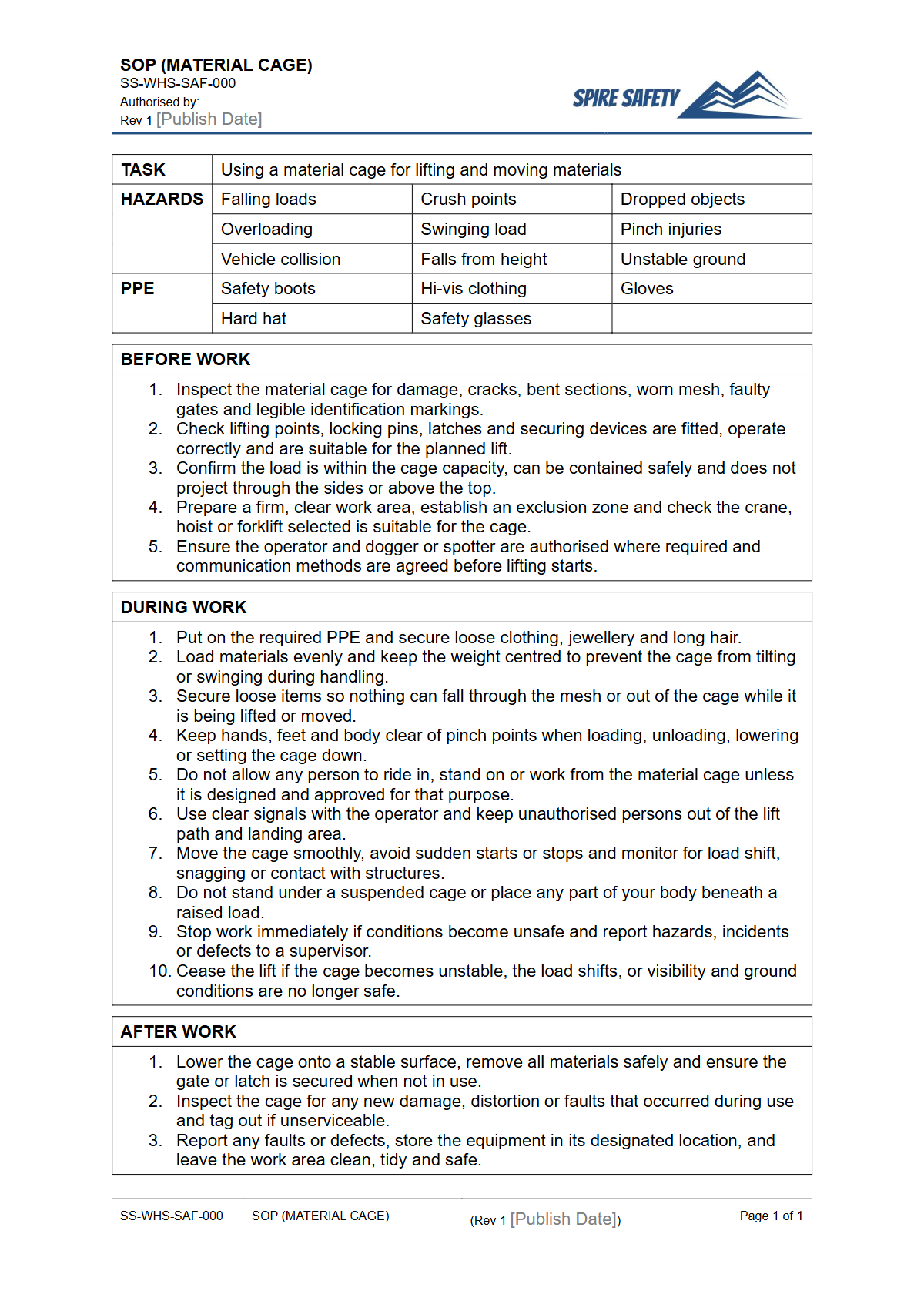
Download our free Safe Operating Procedure (Material Cage) Template.
Free Safe Operating Procedure (Material Cage) Template
DOCX • 126 KB + PDF
Updated Oct 2026
No signup required
Purpose of the Free Safe Operating Procedure (Material Cage) Template
A material cage, often called a crane box or lifting cage, is essential for safely transporting tools, equipment, and materials on construction and industrial sites. Operating one without clear guidelines introduces significant risks, including dropped objects and equipment damage.
This free Safe Operating Procedure (Material Cage) Template provides a structured starting point for documenting the required steps to use this equipment safely. By establishing a clear, repeatable process, you can standardise operations, train workers effectively, and manage the associated hazards in your workplace.
The template is designed to be adapted into a site-specific document that forms a critical part of your overall safety management. A well-drafted SOP demonstrates a commitment to proactive risk management and helps meet your WHS obligations to provide a safe system of work.
It outlines key safety checks, operational steps, and emergency protocols, ensuring everyone interacting with the material cage understands their responsibilities. For businesses looking to integrate such procedures into a broader framework, understanding how they fit within comprehensive WHS management systems is a crucial next step.
Video walkthrough
How to use the Free Safe Operating Procedure (Material Cage) Template
This resource is available for instant download in both DOCX and PDF formats. The DOCX version is fully editable, allowing you to tailor the content to your specific operational needs.
You can add your company branding, insert details about the specific material cages in use at your site, and reference relevant site-specific rules or emergency procedures.
Important: This is a template, not a finished document. You must customise it to reflect your specific equipment, site conditions, personnel, and risk profile.
We are not WHS consultants providing advice with this template; you must conduct your own risk assessment and ensure the final document is fit for purpose and aligns with your legal obligations. A generic procedure is not sufficient to ensure safety.
When to use a Material Cage SOP
A Safe Operating Procedure for material cages should be an integral part of your daily site operations. It is not a document to be filed away and forgotten. It should be used:
- During planning: Before any lifting operations involving a material cage are scheduled.
- For training: As a core training document for new workers, crane operators, dogmen, and riggers who will be involved in the lift.
- As a pre-task reference: Workers should review the SOP as part of their pre-start checks or toolbox talks to refresh their understanding of the risks and controls.
- For audits and reviews: The SOP serves as a benchmark against which actual work practices can be measured. Regular reviews ensure the procedure remains current with equipment, processes, and regulations. It is also a key document reviewed during formal WHS compliance auditing.
Just as you would document the safe use of earthmoving equipment, such as with a SOP for chainsaw operation, a material cage requires the same level of procedural discipline.
Who should use this Safe Operating Procedure
Once customised, the Material Cage SOP is intended for all personnel involved in the lifting operation. This includes:
- Crane Operators: To understand the specific requirements for attaching, lifting, and detaching the cage.
- Dogmen and Riggers: Who are responsible for inspecting the cage, slinging the load correctly, securing the contents, and guiding the lift.
- Site Supervisors and Foremen: To oversee the operation, ensure the SOP is being followed, and verify that all safety controls are in place.
- WHS Managers and Advisors: To use as a tool for risk assessments, incident investigations, and safety training development.
The procedure is a communication tool that ensures every person involved shares a common understanding of how to perform the task safely. Many sites use a variety of plant, and having clear procedures for each is essential; similar principles apply to our FREE Telehandler SOP Template.
If your worksite uses a variety of machinery, it's beneficial to maintain a consistent format for all your procedures. You can explore our entire free WHS resources library to find templates for other common plant and equipment.
Common mistakes
Common mistakes to avoid
- Using a material cage to transport personnel – this is strictly prohibited.
- Exceeding the manufacturer's specified Working Load Limit (WLL).
- Failing to properly secure or evenly distribute the contents inside the cage.
- Using a cage that is damaged, has missing data plates, or has not been inspected and certified.
Legal references
Legal considerations
The following legal requirements may be relevant to this type of work.
- Work Health and Safety Act (Harmonised) — Provides the primary duties for protecting workers and other people from work health and safety risks.
- Work Health and Safety Regulations (Harmonised) — Sets out requirements supporting the management of workplace hazards and risks.
The following codes may be relevant to this type of work.
- Managing WHS Risks Code of Practice — Provides practical guidance on identifying hazards, assessing risks and applying effective controls.
- Work Health and Safety Consultation, Cooperation and Coordination Code of Practice — Provides practical guidance on consulting workers and coordinating with other duty holders.
- Managing the Work Environment and Facilities Code of Practice — Provides practical guidance on safe work environments, workplace facilities and related controls.
Did you know
A Critical Distinction
Australian Standards and WHS Regulations make a strict distinction between material cages and personnel cages (man boxes). Using a material cage to lift a person is a serious breach and can result in severe penalties, as they lack the required safety features like secondary suspension systems.
The Danger of Dropped Objects
Dropped objects are a leading cause of serious injury and fatalities on construction sites. A properly secured material cage is a primary engineering control designed to mitigate this specific, high-consequence risk during lifting operations.
FAQ
Frequently asked questions
01What is a Safe Operating Procedure for a material cage?
02Is a material cage the same as a man cage (work box)?
03Who is responsible for creating a material cage SOP?
04How often should an SOP for material cages be reviewed?
Share this resource
Free Safe Operating Procedure (Material Cage) Template
Browse Categories
How To Use It
- 1Download and open in Word or PDF.
- 2Replace the placeholders with your business details.
- 3Get it reviewed by a WHS specialist before rollout.
Need it customised?
Our WHS consultants can adapt this template to your site, run a gap analysis, or audit what you already have in place.
Book a Free Consultation WHS consulting servicesor call 1300 156 382
Related templates
- Free Safe Operating Procedure (Material Hoist) Template
- Free Safe Operating Procedure (Material Lift) Template
- Free Safe Operating Procedure (Mattress Handling) Template
- Free Safe Operating Procedure (Meal Cart Cleaning) Template
- Free Safe Operating Procedure (Meal Cart Handling) Template
- Free Safe Operating Procedure (Meal Delivery Rounds) Template