
Free Safe Operating Procedure (Material Hoist) Template
Download our free Safe Operating Procedure (Material Hoist) Template to formalise your safety processes. It's a structured starting point for your WHS system.
Free Safe Operating Procedure (Material Hoist) Template
DOCX • 126 KB + PDF
Updated Oct 2026
No signup required
Purpose of the Free Safe Operating Procedure (Material Hoist) Template
Operating a material hoist involves significant risks, including structural failure, falling objects, and operator error. This Safe Operating Procedure (SOP) for Material Hoists provides a comprehensive framework for documenting the required steps to use this equipment safely and efficiently on your worksite.
By implementing a clear procedure, you establish consistent, safe work practices that help minimise the risk of injury to operators and other personnel. A well-drafted SOP is a critical component of any risk management strategy and demonstrates a commitment to workplace health and safety.
Using this template helps you clearly define responsibilities, outline mandatory pre-start checks, specify safe operating sequences, and detail shutdown and emergency procedures. Formalising these steps ensures that all operators, regardless of experience level, have a clear reference for correct usage.
It also serves as a vital training tool for new employees and a foundation for building more comprehensive and robust WHS management systems within your organisation.
Video walkthrough
How to use the Free Safe Operating Procedure (Material Hoist) Template
This template is provided in both DOCX and PDF formats for your convenience. The DOCX version is fully editable, allowing you to tailor the content to the specific make and model of the material hoist used at your workplace, as well as your site-specific conditions and hazards.
It is crucial that you customise this document before implementation. We provide this template as a starting point, but we cannot know the unique risks present in your work environment.
You must add, remove, and modify sections to ensure the final SOP accurately reflects your operational reality.
To effectively use this resource, a competent person should review the manufacturer's operating manual for your specific material hoist and incorporate all relevant warnings and instructions. Consult with operators and supervisors to ensure the documented steps are practical and address real-world challenges.
For sites with a variety of lifting equipment, it is important to develop distinct procedures for each. For example, the operation of a hoist differs significantly from other vertical lifting plant, which may be covered by our Telehandler SOP template.
When to use a Material Hoist Safe Operating Procedure
A Material Hoist SOP should be developed and implemented before any worker is permitted to operate the equipment. It forms a core part of the training and induction process for new operators.
The SOP should be readily accessible at or near the hoist's location for easy reference during daily operations. It is not a document to be filed away; it is a live tool for active risk management.
It should also be reviewed whenever a new model of hoist is introduced, if there is a change in the work environment, or following any incident or near miss involving the equipment.
Associated machinery on site should also have its own documented procedures to ensure a holistic approach to safety. Material hoists are often used alongside other powered equipment, making it essential to manage all risks. Documenting all high-risk tasks is crucial, which is why we also provide resources like a free Air Compressor SOP template.
Who should use this Safe Operating Procedure
This SOP template is designed for use by Persons Conducting a Business or Undertaking (PCBUs), site managers, WHS advisors, and supervisors responsible for the health and safety of workers. These individuals should lead the customisation and implementation process.
Once finalised, the SOP is a mandatory reference document for all personnel who operate, work near, or supervise the use of the material hoist. It serves as the benchmark for safe operation, providing clear instructions that operators must follow.
Ensuring that documented procedures are being correctly followed is a key safety function. This is often verified through workplace inspections and observations.
For a more formalised approach to verifying safety performance against your documented systems, consider engaging professional WHS compliance auditing services to identify any gaps.
What's covered in the template?
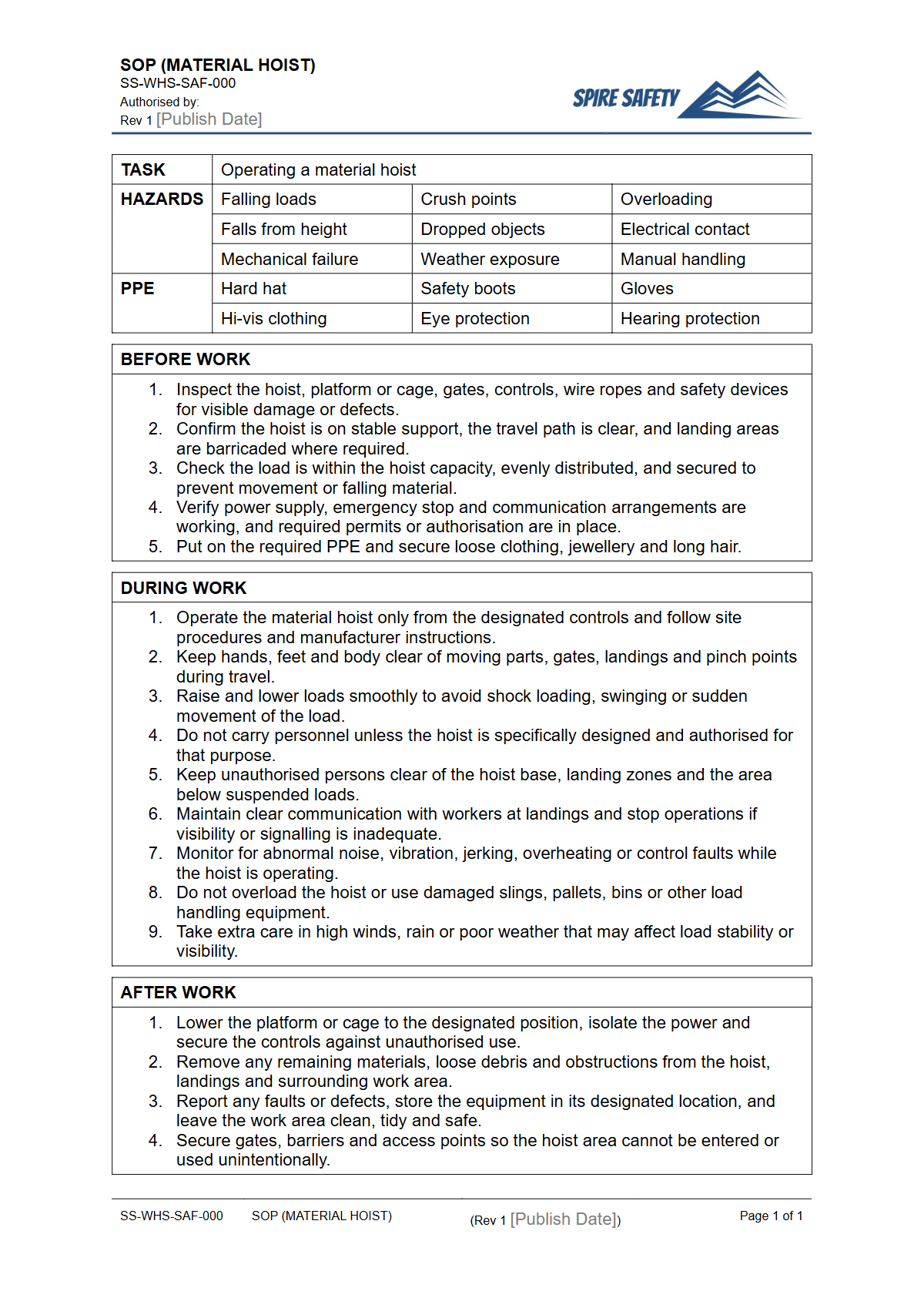
Our Material Hoist SOP template provides a structured format to guide your documentation process. Key sections include:
- Required Personal Protective Equipment (PPE): Specifies the necessary PPE for operators and workers in the vicinity.
- Risk Assessment: Lists common hazards associated with material hoist operation (e.g., falling objects, entanglement, structural collapse) and prompts you to add site-specific risks.
- Pre-Operational Checks: A step-by-step checklist for inspecting the hoist before use, covering structural integrity, controls, safety gates, and emergency stops.
- Operating Procedure: A sequential guide to safely loading, lifting, unloading, and lowering materials.
- Shutdown Procedure: Instructions for securing the hoist at the end of a shift or work period.
- Emergency Procedures: Critical steps to take in the event of a malfunction, power failure, or other emergency.
While this procedure focuses on a specific type of vertical lift, many sites also rely on different equipment for moving goods, such as those covered in our Conveyer System SOP. Standardising your safety documentation across all plant and equipment creates a more predictable and safer workplace. Find more helpful documents in our free WHS resources library to continue building your safety system.
Common mistakes
Common mistakes to avoid
- Overloading the hoist platform beyond its specified safe working load (SWL).
- Failing to conduct and document daily pre-start inspections before the first use of the day.
- Using a hoist designated for materials only to transport workers, even for short distances.
- Operating the hoist on uneven or unstable ground without proper packing and levelling.
Legal references
Legal considerations
The following legal requirements may be relevant to this type of work.
- Work Health and Safety Act (Harmonised) — Provides the primary duties for protecting workers and other people from work health and safety risks.
- Work Health and Safety Regulations (Harmonised) — Sets out requirements supporting the management of workplace hazards and risks.
The following codes may be relevant to this type of work.
- Managing WHS Risks Code of Practice — Provides practical guidance on identifying hazards, assessing risks and applying effective controls.
- Work Health and Safety Consultation, Cooperation and Coordination Code of Practice — Provides practical guidance on consulting workers and coordinating with other duty holders.
- Managing the Work Environment and Facilities Code of Practice — Provides practical guidance on safe work environments, workplace facilities and related controls.
Did you know
A Critical Distinction
A material hoist is designed exclusively for transporting goods and materials. Using one to carry personnel is strictly prohibited and extremely dangerous, as they lack the specific safety features required for human transport, such as those found on a personnel hoist (or 'alimax').
Incident Statistics
According to Safe Work Australia, incidents involving being hit by falling objects are a leading cause of fatalities and serious injuries in the construction industry. Properly secured loads and controlled exclusion zones around hoists are critical controls.
FAQ
Frequently asked questions
01What is a material hoist Safe Operating Procedure (SOP)?
02Is a Safe Operating Procedure a legal requirement in Australia?
03How often should a material hoist SOP be reviewed?
04Who is responsible for training workers on the material hoist SOP?
Share this resource
Free Safe Operating Procedure (Material Hoist) Template
Browse Categories
How To Use It
- 1Download and open in Word or PDF.
- 2Replace the placeholders with your business details.
- 3Get it reviewed by a WHS specialist before rollout.
Need it customised?
Our WHS consultants can adapt this template to your site, run a gap analysis, or audit what you already have in place.
Book a Free Consultation WHS consulting servicesor call 1300 156 382
Related templates
- Free Safe Operating Procedure (Material Lift) Template
- Free Safe Operating Procedure (Mattress Handling) Template
- Free Safe Operating Procedure (Meal Cart Cleaning) Template
- Free Safe Operating Procedure (Meal Cart Handling) Template
- Free Safe Operating Procedure (Meal Delivery Rounds) Template
- Free Safe Operating Procedure (Meal Service Setup) Template