
Free Safe Operating Procedure (Mast Climber) Template
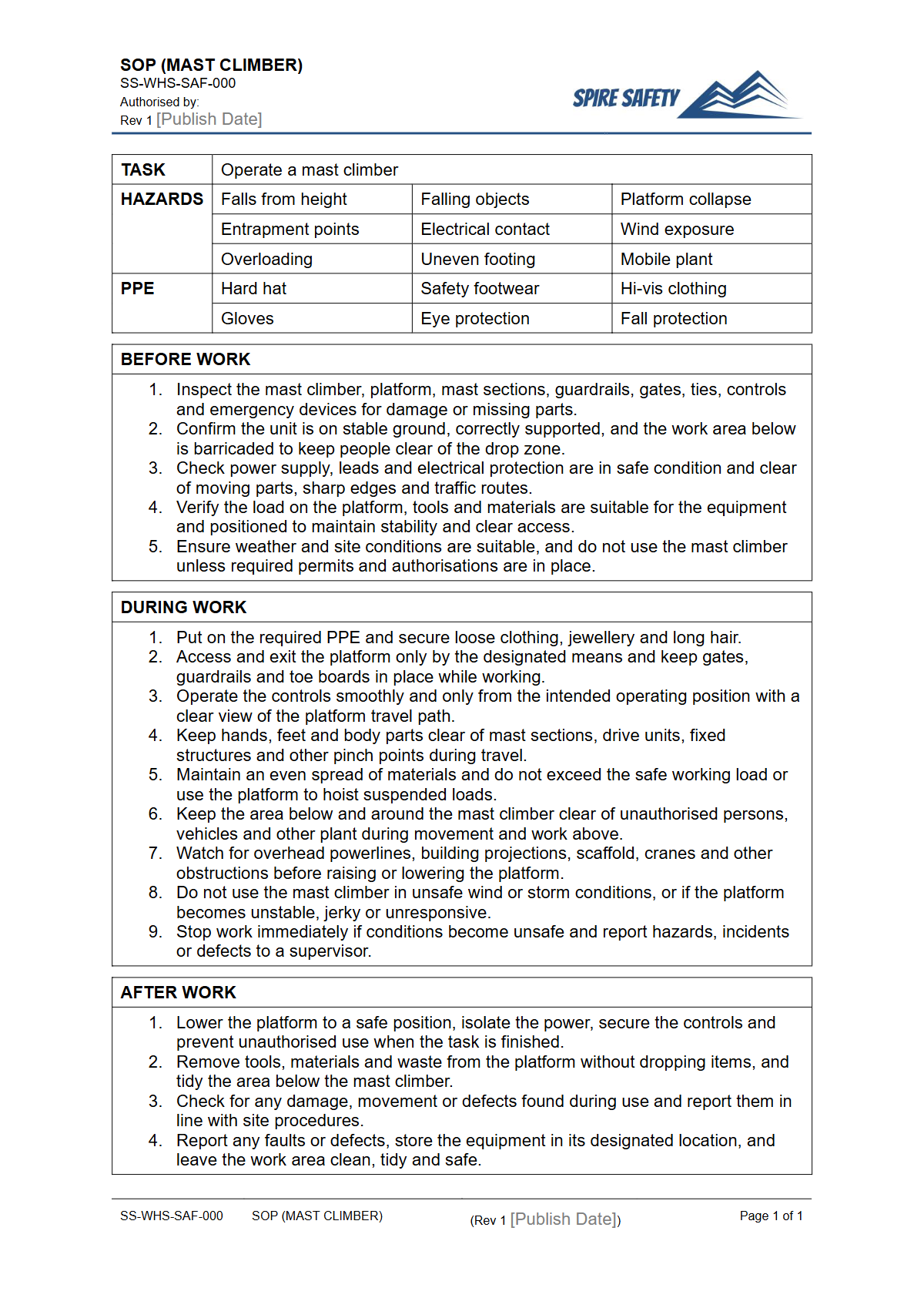
Download our free Safe Operating Procedure (Mast Climber) template.
Free Safe Operating Procedure (Mast Climber) Template
DOCX • 126 KB + PDF
Updated Oct 2026
No signup required
Purpose of the Free Safe Operating Procedure (Mast Climber) Template
Operating a mast climbing work platform (MCWP) is a high-risk activity that requires clear, documented processes to manage the significant dangers involved, primarily the risk of falls from height and structural failure. This Free Safe Operating Procedure (Mast Climber) Template provides a structured starting point for your organisation to formalise the steps for the safe operation, inspection, and shutdown of this plant.
An SOP serves as a key administrative control, translating your risk assessment findings into a practical, step-by-step guide for workers.
A well-drafted Safe Operating Procedure is a critical component in a systematic approach to health and safety. It helps standardise work practices, ensuring every operator follows the same safety-critical steps every time.
Using this template helps you establish a baseline for training, competency assessment, and supervision. Documenting your procedures is a fundamental part of building robust WHS management systems that actively reduce risk in the workplace.
Video walkthrough
How to use the Free Safe Operating Procedure (Mast Climber) Template
This document is available as a DOCX file, which is fully editable, and a PDF for easy printing and distribution. To use it effectively, you must add details specific to your workplace and the exact model of mast climber in use.
Generic procedures are insufficient for managing specific risks.
Important: This is a template, not a finished document. To be effective and support your safety obligations, you must customise it.
We've provided a structured starting point, but you need to add specific details about your site, the model of mast climber in use, your personnel, and your established emergency procedures. Consult the manufacturer's instructions, relevant Australian Standards, and your site-specific risk assessments to ensure all controls are captured.
While this SOP is tailored for mast climbers, similar documented processes are essential for other high-risk plant commonly found on site. For example, your site may also require our FREE Telehandler SOP Template to manage the risks associated with that specific piece of equipment.
When to use a Safe Operating Procedure
An SOP for a mast climber should be a living document integrated into daily operations. It is not a 'set and forget' piece of paperwork.
Use it during worker induction and training to establish safe behaviour from the outset. It should also be a key reference document for operators conducting pre-start checks, and for supervisors planning and authorising work at height.
The procedure should be readily available at the location where the mast climber is being operated. In the event of an incident or near-miss, the SOP provides a benchmark against which actual work practices can be compared, aiding in the investigation process.
The document should be reviewed periodically, and always after an incident, when new hazards are identified, or when the equipment or work environment changes.
Who should use this Safe Operating Procedure
The primary users of this SOP are the competent and authorised operators of the mast climbing work platform. They must understand and follow the specified steps for pre-start checks, safe setup, operation, and shutdown.
Supervisors and managers are also key users, as they are responsible for ensuring the procedures are implemented, monitored, and enforced on-site.
Persons Conducting a Business or Undertaking (PCBUs) have a duty to provide and maintain safe systems of work. Developing and implementing SOPs like this one is a practical way to fulfil that duty.
Safety professionals can use this template as part of their toolkit for risk management and procedural development across the organisation. The effectiveness of these procedures can be verified through processes like WHS compliance auditing to ensure they are being followed correctly.
It's important to develop tailored procedures for all types of plant and equipment, from complex machinery down to basic tools. For instance, even seemingly simple tasks like using a ladder benefit from a documented procedure, which is why we also provide resources like our FREE Step Ladder SOP Template. By standardising procedures for all tasks, you create a more consistent and predictable safety culture. You can find more templates like this in our free WHS resources library.
Common mistakes
Common mistakes to avoid
- Using a generic SOP without customising it for the specific site and mast climber model.
- Failing to properly train operators on the contents of the SOP and verify their understanding.
- Neglecting to complete the pre-start inspections and regular maintenance checks documented in the procedure.
- Not making the SOP easily accessible to operators and supervisors at the point of use.
Legal references
Legal considerations
The following legal requirements may be relevant to this type of work.
- Work Health and Safety Act (Harmonised) — Provides the primary duties for protecting workers and other people from work health and safety risks.
- Work Health and Safety Regulations (Harmonised) — Sets out requirements supporting the management of workplace hazards and risks.
The following codes may be relevant to this type of work.
- Managing WHS Risks Code of Practice — Provides practical guidance on identifying hazards, assessing risks and applying effective controls.
- Work Health and Safety Consultation, Cooperation and Coordination Code of Practice — Provides practical guidance on consulting workers and coordinating with other duty holders.
- Managing the Work Environment and Facilities Code of Practice — Provides practical guidance on safe work environments, workplace facilities and related controls.
Did you know
Wind is a Major Hazard
Most mast climbers have strict operational wind speed limits specified by the manufacturer. High winds can exert significant force on the platform's surface area and structure, making operation unsafe and potentially causing catastrophic failure if limits are exceeded.
Not Just for Construction
While common on building sites, mast climbing work platforms (MCWPs) are also used extensively for building maintenance, facade inspections, glazing, and industrial applications where temporary vertical access is needed over a large area.
FAQ
Frequently asked questions
01Is a Safe Operating Procedure legally required for a mast climber?
02What's the difference between a SWMS and an SOP for a mast climber?
03How often should our mast climber SOP be reviewed?
04Can I use this template for other types of Elevating Work Platforms (EWPs)?
Share this resource
Free Safe Operating Procedure (Mast Climber) Template
Browse Categories
How To Use It
- 1Download and open in Word or PDF.
- 2Replace the placeholders with your business details.
- 3Get it reviewed by a WHS specialist before rollout.
Need it customised?
Our WHS consultants can adapt this template to your site, run a gap analysis, or audit what you already have in place.
Book a Free Consultation WHS consulting servicesor call 1300 156 382
Related templates
- Free Safe Operating Procedure (Material Cage) Template
- Free Safe Operating Procedure (Material Hoist) Template
- Free Safe Operating Procedure (Material Lift) Template
- Free Safe Operating Procedure (Mattress Handling) Template
- Free Safe Operating Procedure (Meal Cart Cleaning) Template
- Free Safe Operating Procedure (Meal Cart Handling) Template