
Free Safe Operating Procedure (Mask Fit Check) Template
Download our Free Safe Operating Procedure (Mask Fit Check) Template. This customisable DOCX & PDF helps standardise respirator fit checking processes.
Free Safe Operating Procedure (Mask Fit Check) Template
DOCX • 126 KB + PDF
Updated Oct 2026
No signup required
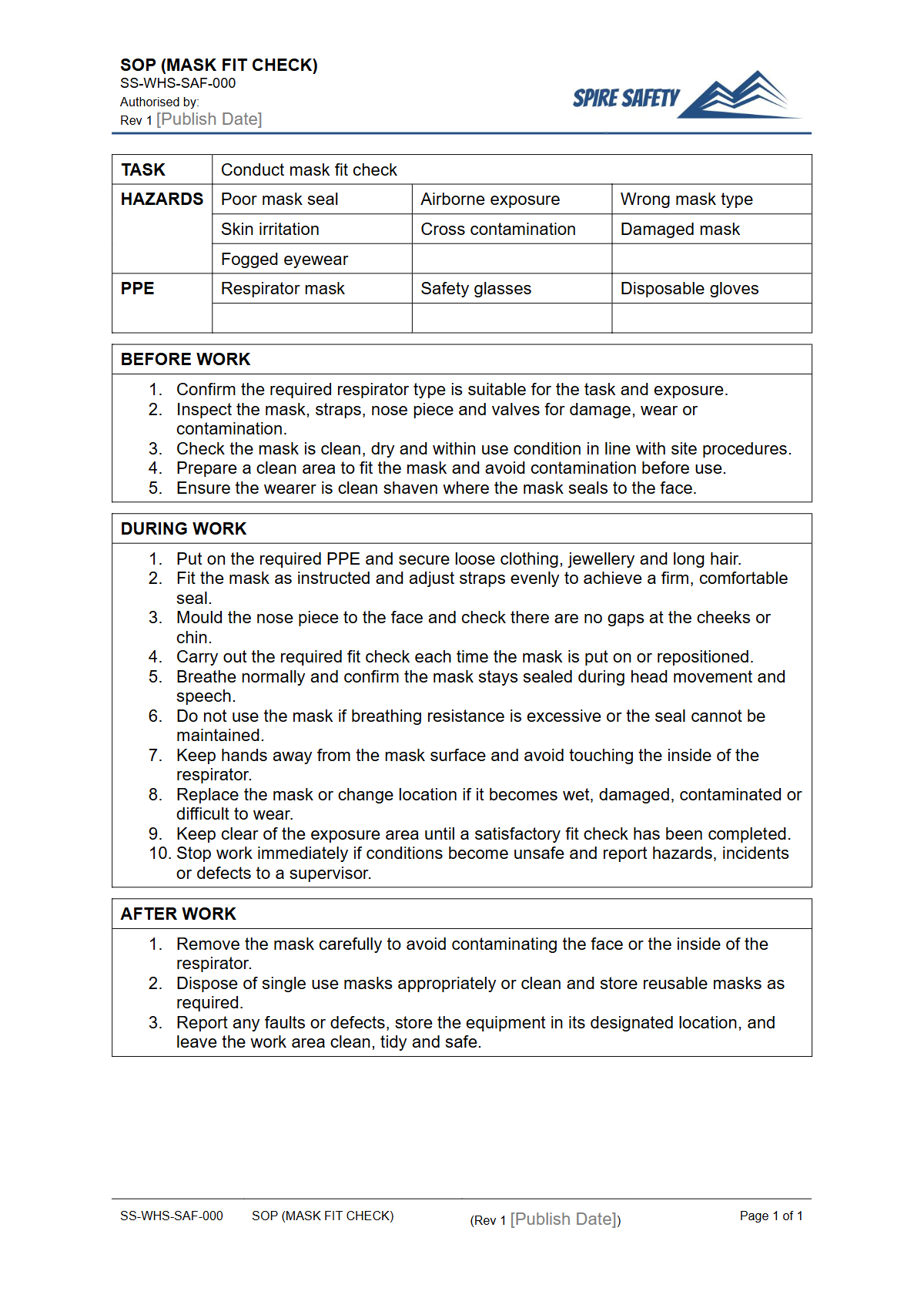
Purpose of the Free Safe Operating Procedure (Mask Fit Check) Template
Ensuring Respiratory Protective Equipment (RPE) provides the intended level of protection is critical in any workplace with airborne contaminants. This Free Safe Operating Procedure (Mask Fit Check) Template provides a structured framework for documenting the steps workers must follow to check for a proper seal on their tight-fitting respirator every time they wear it.
A consistent, documented procedure helps standardise this vital safety check, assists in worker training, and reinforces the importance of a correct fit. Using an SOP demonstrates a commitment to managing respiratory hazards and forms a key component of your broader safety documentation.
A user seal check (or fit check) is a quick action performed by the wearer, and it's different from a formal fit test, which is used to select the correct mask size and model. This SOP focuses exclusively on the user's pre-use check.
Implementing this procedure helps ensure that the protection offered by the RPE is not compromised by a poor seal, which could otherwise lead to hazardous exposures. It formalises a critical step that must be integrated into your organisation's overall WHS management systems to be effective.
Video walkthrough
How to use the Free Safe Operating Procedure (Mask Fit Check) Template
This Safe Operating Procedure template is designed as a comprehensive starting point. After downloading the DOCX or PDF file, you must adapt it to the specific context of your workplace.
The procedure should accurately reflect the types of respirators in use (e.g., disposable P2, half-face, or full-face reusable respirators), the specific manufacturer's instructions, and the unique environmental conditions your team faces. Consultation with workers who will be using the RPE is essential to create a practical and effective procedure.
To implement this document, review each section and add or remove details to match your operational requirements. For instance, you may add site-specific steps for cleaning and storing reusable respirators post-use.
Once customised, this SOP should be used as a training tool for all relevant personnel and be made readily accessible in the work area. This process is similar to customising other equipment-specific documents, such as our free Air Compressor SOP, to ensure they are relevant and useful on-site.
Important Customisation Note
Please note: This document is a template and must be customised to suit the specific RPE, tasks, and environment of your workplace. We are not responsible for its application or for ensuring its suitability for your specific circumstances.
Regular review and verification of its effectiveness, potentially as part of a formal WHS compliance auditing program, is recommended.
When to use it
A documented procedure for mask fit checks should be used and enforced in any situation where workers are required to wear tight-fitting respirators. A user seal check must be performed every time the respirator is put on, before entering the hazardous area or beginning the task.
This SOP is crucial for tasks that generate dust, fumes, mists, gases, or vapours that pose a respiratory health risk.
It is particularly important for workers involved in activities like cutting, grinding, or sanding, where a free Circular Saw SOP Template would also be relevant. The fit check SOP should be referenced during toolbox talks and pre-start meetings before any high-risk respiratory work commences, serving as a constant reminder of correct safety protocols.
Who should use it
This Safe Operating Procedure should be used by several key groups within an organisation. Primarily, it is for the workers who are required to wear tight-fitting RPE as part of their job.
They must be trained on the procedure and be competent in performing it correctly every time. Supervisors and team leaders are also key users, as they are responsible for ensuring their team members follow the procedure and for conducting spot-checks to verify correct application.
WHS managers, safety officers, and anyone responsible for developing and managing the organisation's respiratory protection program will use this template as a foundational document. It helps them standardise training and provide clear, unambiguous instruction across the workforce.
The principles of clear, repeatable steps are universal to all critical safety tasks, including those covered in an SOP for defibrillator operation. You can explore more procedural documents in our free WHS resources library to build a comprehensive safety system.
Common mistakes
Common mistakes to avoid
- Confusing a quick user seal check with a formal, annual fit test.
- Attempting to achieve a seal over stubble or beards, which makes a proper fit impossible.
- Not adjusting straps correctly to achieve firm, even pressure across the face.
- Failing to re-adjust the respirator and straps when a small air leak is detected.
Legal references
Legal considerations
The following legal requirements may be relevant to this type of work.
- Work Health and Safety Act (Harmonised) — Provides the primary duties for protecting workers and other people from work health and safety risks.
- Work Health and Safety Regulations (Harmonised) — Sets out requirements supporting the management of workplace hazards and risks.
The following codes may be relevant to this type of work.
- Managing WHS Risks Code of Practice — Provides practical guidance on identifying hazards, assessing risks and applying effective controls.
- Work Health and Safety Consultation, Cooperation and Coordination Code of Practice — Provides practical guidance on consulting workers and coordinating with other duty holders.
- Managing the Work Environment and Facilities Code of Practice — Provides practical guidance on safe work environments, workplace facilities and related controls.
Did you know
The Seal is Everything
Even a small gap from one day's worth of stubble, glasses, or incorrect strap tension can reduce a respirator's protective capability significantly, potentially rendering it ineffective against workplace contaminants.
Positive vs. Negative
The two common user seal check methods are the positive pressure check (exhaling gently while blocking the exhalation valve) and the negative pressure check (inhaling sharply while blocking the filters) to feel for air leaks.
FAQ
Frequently asked questions
01What's the difference between a mask fit check and a fit test?
02How often should a mask fit check be performed?
03Is this mask fit check procedure suitable for all types of masks?
04Do I need formal training to perform a mask fit check?
Share this resource
Free Safe Operating Procedure (Mask Fit Check) Template
Browse Categories
How To Use It
- 1Download and open in Word or PDF.
- 2Replace the placeholders with your business details.
- 3Get it reviewed by a WHS specialist before rollout.
Need it customised?
Our WHS consultants can adapt this template to your site, run a gap analysis, or audit what you already have in place.
Book a Free Consultation WHS consulting servicesor call 1300 156 382
Related templates
- Free Safe Operating Procedure (Masonry Saw) Template
- Free Safe Operating Procedure (Massage Room Cleaning) Template
- Free Safe Operating Procedure (Massage Table Cleaning) Template
- Free Safe Operating Procedure (Mast Climber) Template
- Free Safe Operating Procedure (Material Cage) Template
- Free Safe Operating Procedure (Material Hoist) Template