
Free Safe Operating Procedure (Masonry Saw) Template
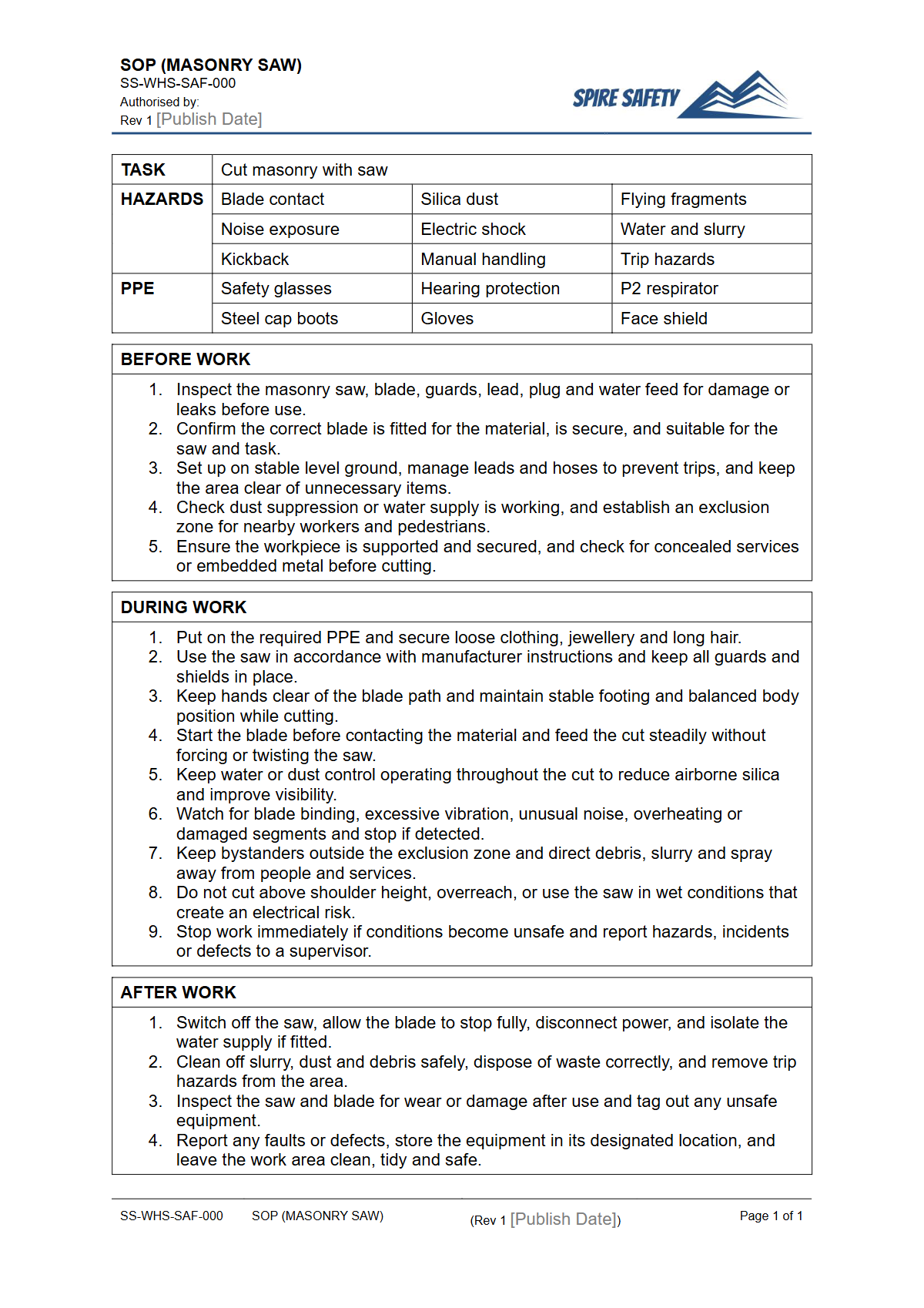
Download our Free Safe Operating Procedure (Masonry Saw) Template. This DOCX and PDF resource helps you outline safe work methods for using masonry saws.
Free Safe Operating Procedure (Masonry Saw) Template
DOCX • 126 KB + PDF
Updated Oct 2026
No signup required
Purpose of the Free Safe Operating Procedure (Masonry Saw) Template
Operating a masonry saw, also known as a block saw or brick saw, introduces significant workplace hazards, including exposure to respirable crystalline silica dust, severe cuts, noise, and vibration. This Free Safe Operating Procedure (Masonry Saw) Template provides a structured starting point for your business to document a safe system of work for this equipment.
A documented SOP is a fundamental tool for managing risk, standardising tasks, and ensuring workers are trained on the established safety protocols before they begin work.
Using a comprehensive SOP helps your organisation meet its duties under WHS legislation by formalising hazard identification, risk assessment, and the implementation of control measures. This includes specifying pre-start checks, detailing the step-by-step process for safe operation, and outlining shutdown procedures.
It serves as a critical reference for worker training, competency assessments, and ongoing supervision. For other high-risk tools, you may also require documents like our FREE Circular Saw SOP Template to ensure consistent safety standards are applied across all equipment.
What is included in this Masonry Saw SOP?
This template is designed as a comprehensive starting point and includes sections for:
- Designated responsible persons
- Required Personal Protective Equipment (PPE)
- Hazard identification and risk controls
- Step-by-step operational instructions
- Pre-start checks and inspections
- Maintenance and cleaning procedures
- Emergency response actions
Video walkthrough
How to use the Free Safe Operating Procedure (Masonry Saw) Template
This resource is available as a fully editable DOCX file, with a supplementary PDF for easy printing and distribution. To use it effectively, you must adapt its contents to the specific context of your workplace.
This involves identifying the particular make and model of the masonry saw in use, the materials being cut, the work environment, and your existing organisational procedures.
Important: This is a template only. We have provided a framework based on common WHS principles, but you are responsible for customising it.
You must conduct your own risk assessment and add, remove, or change information to ensure the final document accurately reflects your site-specific risks and control measures. A well-customised SOP is a vital component of your overall WHS management systems, demonstrating a proactive approach to safety.
When to use a Safe Operating Procedure for a Masonry Saw
A Safe Operating Procedure for a masonry saw should be developed, finalised, and communicated before any worker is permitted to use the equipment. It is not a document to be created after an incident has already occurred.
Its primary use is proactive, forming the basis of operator training and induction. The SOP should be readily available at the point of use for easy reference.
It is also a living document that requires regular review. A review should be triggered whenever there is a change to the equipment or work process, after an incident or near miss, or on a scheduled basis (e.g., annually) to ensure it remains current and effective.
For related plant, such as those covered by our Free Air Compressor SOP Template, a similar lifecycle of development and review should be followed.
Who should use this template
This template is intended for use by Persons Conducting a Business or Undertaking (PCBUs), site supervisors, WHS managers, and safety officers. These individuals are typically responsible for developing and implementing safe work systems.
Once customised, the final SOP is used by operators of the masonry saw as a key training and reference document to guide their work practices safely.
During safety audits, an auditor will often request SOPs as evidence that risks associated with high-risk plant have been systematically addressed. Having a well-developed and implemented SOP demonstrates procedural maturity. A formal WHS compliance audit can help identify gaps in your current documentation and practices. Our template helps you build a robust library of documents, which you can expand with other resources like our FREE Step Ladder SOP Template for common workplace equipment. You can explore our entire free WHS resources library for more templates to support your safety system.
Common mistakes
Common mistakes to avoid
- Using the saw for dry cutting without adequate dust extraction or respiratory protection.
- Failing to inspect the diamond blade for cracks, missing segments, or other damage before each use.
- Neglecting to wear all required PPE, especially P2/N95 respirators, safety glasses, and hearing protection.
- Using the template without customising it to the specific saw, materials, and work environment.
Legal references
Legal considerations
The following legal requirements may be relevant to this type of work.
- Work Health and Safety Act (Harmonised) — Provides the primary duties for protecting workers and other people from work health and safety risks.
- Work Health and Safety Regulations (Harmonised) — Sets out requirements supporting the management of workplace hazards and risks.
The following codes may be relevant to this type of work.
- Managing WHS Risks Code of Practice — Provides practical guidance on identifying hazards, assessing risks and applying effective controls.
- Work Health and Safety Consultation, Cooperation and Coordination Code of Practice — Provides practical guidance on consulting workers and coordinating with other duty holders.
- Managing the Work Environment and Facilities Code of Practice — Provides practical guidance on safe work environments, workplace facilities and related controls.
Did you know
Wet Cutting Efficiency
Using a wet cutting method on a masonry saw can suppress up to 95% of dangerous respirable crystalline silica dust at the source, making it a critical engineering control.
Noise Hazard
A typical masonry saw can operate at over 100 decibels (dB), well above the 85 dB exposure standard where hearing protection is mandatory. Prolonged exposure without protection can cause permanent hearing loss.
FAQ
Frequently asked questions
01What are the main hazards of using a masonry saw?
02Is a Safe Operating Procedure a legal requirement for a masonry saw in Australia?
03How often should a masonry saw SOP be reviewed?
04What is the most important control measure for silica dust when using a masonry saw?
Share this resource
Free Safe Operating Procedure (Masonry Saw) Template
Browse Categories
How To Use It
- 1Download and open in Word or PDF.
- 2Replace the placeholders with your business details.
- 3Get it reviewed by a WHS specialist before rollout.
Need it customised?
Our WHS consultants can adapt this template to your site, run a gap analysis, or audit what you already have in place.
Book a Free Consultation WHS consulting servicesor call 1300 156 382
Related templates
- Free Safe Operating Procedure (Massage Room Cleaning) Template
- Free Safe Operating Procedure (Massage Table Cleaning) Template
- Free Safe Operating Procedure (Mast Climber) Template
- Free Safe Operating Procedure (Material Cage) Template
- Free Safe Operating Procedure (Material Hoist) Template
- Free Safe Operating Procedure (Material Lift) Template