
Free Safe Operating Procedure (Marine Waste Segregation) Template
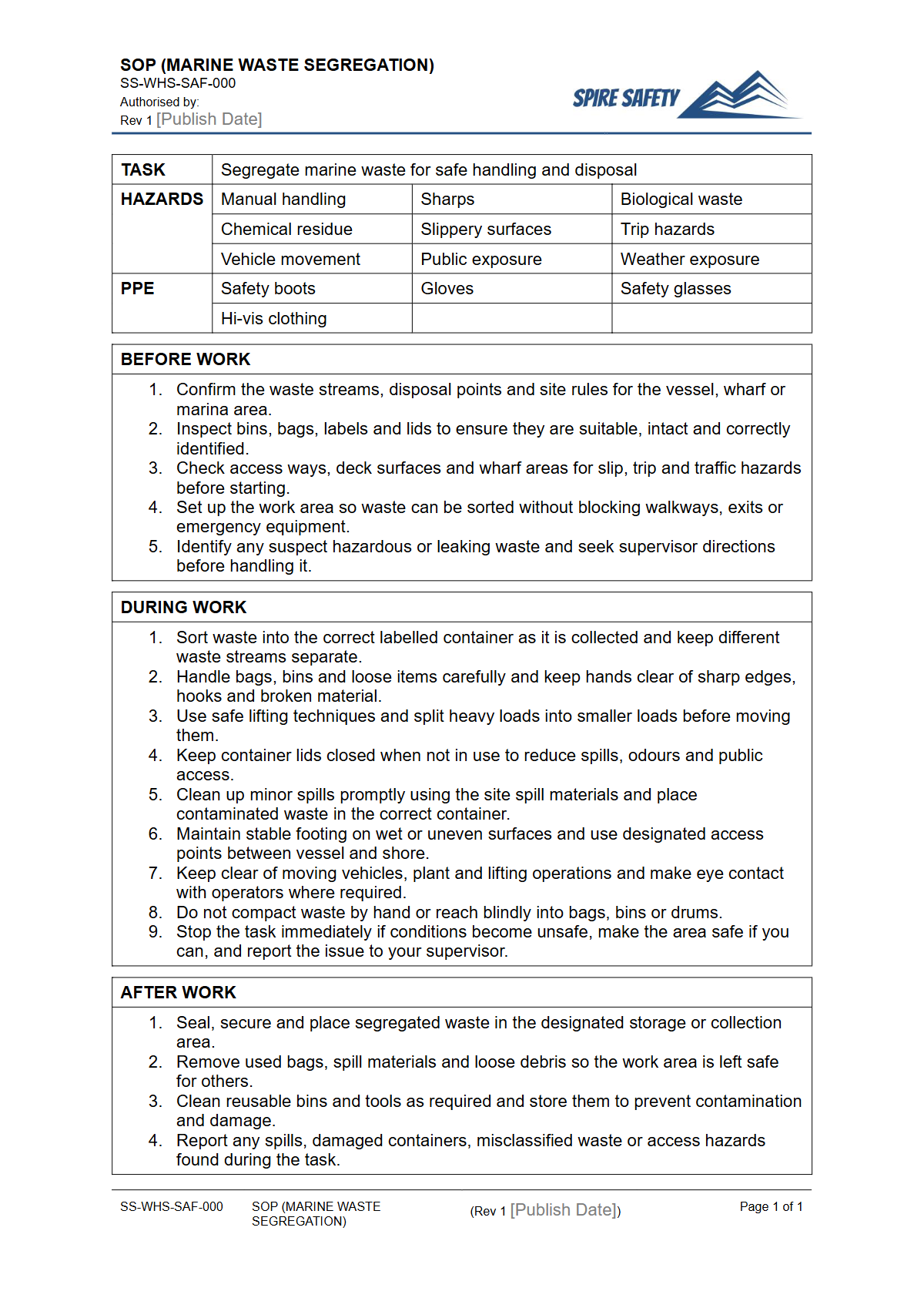
Download our free Safe Operating Procedure for Marine Waste Segregation. This DOCX template provides a framework for managing waste safely at sea.
Free Safe Operating Procedure (Marine Waste Segregation) Template
DOCX • 126 KB + PDF
Updated Oct 2026
No signup required
Purpose of the Free Safe Operating Procedure (Marine Waste Segregation) Template
Effective waste management aboard a marine vessel is a critical component of both environmental stewardship and workplace health and safety. This Free Safe Operating Procedure (Marine Waste Segregation) Template provides a structured starting point for Australian maritime operators to formalise their onboard waste handling processes.
The document is designed to help you outline step-by-step instructions for the correct segregation, storage, and preparation for disposal of various waste streams, including plastics, food waste, operational wastes, and cargo residues. Following a clear procedure helps minimise pollution risks, reduce workplace hazards like slips, trips, and exposure to harmful substances, and demonstrates a commitment to operational excellence.
It serves as an essential tool for meeting regulatory obligations under both maritime law (such as MARPOL) and Australian WHS legislation.
Properly documented procedures are a cornerstone of any effective safety framework. A well-defined SOP for waste segregation ensures all crew members understand their roles and responsibilities, leading to consistent and safe work practices.
This is particularly important in the dynamic and often challenging marine environment. Integrating this SOP can significantly improve your organisation's overall WHS management systems by providing clear, auditable evidence of your risk control measures for waste-related tasks.
Video walkthrough
How to use the Free Safe Operating Procedure (Marine Waste Segregation) Template
This Safe Operating Procedure comes as a customisable DOCX file, with a PDF version also available for easy printing and distribution. To get the most value from this resource, you should treat it as a foundational guide.
Begin by downloading the DOCX template and reviewing its contents against your vessel's specific layout, equipment, crew complement, and typical waste streams. The procedure should be adapted to detail your exact bin types and colour-coding systems, storage locations, and any equipment used in waste processing, such as compactors or shredders.
It is crucial to remember that this is a template, not a finished document. We strongly advise that you customise it thoroughly to reflect the specific vessel, crew, waste streams, and operational hazards present in your workplace.
Involve your crew in the customisation process to ensure the SOP is practical and reflects real-world operations. Once finalised, the document should be formally approved by the vessel's master or a designated safety officer, and integrated into your onboard training and induction programs. Any machinery used in waste processing, such as an air compressor for powering equipment, should also be covered by its own specific procedure, like our free Air Compressor SOP.
When to use a Safe Operating Procedure for Marine Waste Segregation
A documented SOP for marine waste segregation should be a permanent part of your vessel's operational and safety documentation. It is not a one-off document but a live procedure that requires regular attention. Key times to develop, use, or review this SOP include:
- Vessel Commissioning: Establishing baseline procedures before a vessel enters service or joins a new fleet.
- Crew Training and Induction: As a primary training tool to ensure new and existing crew members understand and follow correct waste handling protocols.
- Regulatory Audits: As evidence of a systematic approach to environmental and safety management during inspections by port state control or other authorities.
- Post-Incident Review: Following any incident or near-miss related to waste handling, such as a spill, injury, or improper disposal, to identify and correct procedural gaps.
- Annual Review: As part of a scheduled review of your entire safety management system to ensure it remains current and effective.
Regularly reviewing your procedures is a key part of maintaining safety standards. This process can be supported through formal WHS compliance auditing to identify any areas for improvement across your operations. If your SOP includes tasks at height, such as accessing high storage bins, ensure you also have documented step ladder use procedures.
Who should use this Safe Operating Procedure
This template is designed for a range of personnel within a maritime organisation. Primarily, it should be used by those responsible for creating and maintaining the vessel's Safety Management System (SMS) and Garbage Management Plan (GMP). This includes:
- Vessel Masters and Chief Officers: For overall responsibility of the vessel's compliance and the safety of the crew.
- Safety and Environmental Officers: For developing, implementing, and monitoring the effectiveness of the procedure.
- Engineers and Deck Officers: To ensure the procedures align with technical and operational realities.
- All Crew Members: As the end-users of the procedure, every person who generates or handles waste on board must be trained on and follow the SOP.
In the event of a medical emergency, such as exposure to hazardous waste, having clear procedures is vital. It's a good practice to ensure all safety documents are easily accessible, including procedures for emergency equipment like the Safe Operating Procedure for Defibrillator Operation. For more guidance on implementing safety documentation, browse our entire free WHS resources library.
Common mistakes
Common mistakes to avoid
- Failing to correctly categorise waste types (e.g., mixing plastics with food waste).
- Using incorrect, damaged, or poorly labelled bins for different waste streams.
- Inadequate training for crew on segregation procedures and associated hazards.
- Not including specific procedures for managing potentially hazardous waste, like oily rags or expired pyrotechnics.
Legal references
Legal considerations
The following legal requirements may be relevant to this type of work.
- Work Health and Safety Act (Harmonised) — Provides the primary duties for protecting workers and other people from work health and safety risks.
- Work Health and Safety Regulations (Harmonised) — Sets out requirements supporting the management of workplace hazards and risks.
The following codes may be relevant to this type of work.
- Managing WHS Risks Code of Practice — Provides practical guidance on identifying hazards, assessing risks and applying effective controls.
- Work Health and Safety Consultation, Cooperation and Coordination Code of Practice — Provides practical guidance on consulting workers and coordinating with other duty holders.
- Managing the Work Environment and Facilities Code of Practice — Provides practical guidance on safe work environments, workplace facilities and related controls.
Did you know
MARPOL Annex V
Under MARPOL Annex V, it is illegal to discharge all types of garbage into the sea from ships, with very few exceptions. The discharge of all plastics, including fishing gear, is banned worldwide.
FAQ
Frequently asked questions
01What is the difference between an SOP and a Garbage Management Plan (GMP)?
02Does this template cover hazardous waste segregation?
03Who is responsible for training crew on this SOP?
04How often should a Marine Waste Segregation SOP be reviewed?
Share this resource
Free Safe Operating Procedure (Marine Waste Segregation) Template
Browse Categories
How To Use It
- 1Download and open in Word or PDF.
- 2Replace the placeholders with your business details.
- 3Get it reviewed by a WHS specialist before rollout.
Need it customised?
Our WHS consultants can adapt this template to your site, run a gap analysis, or audit what you already have in place.
Book a Free Consultation WHS consulting servicesor call 1300 156 382
Related templates
- Free Safe Operating Procedure (Mask Fit Check) Template
- Free Safe Operating Procedure (Masonry Saw) Template
- Free Safe Operating Procedure (Massage Room Cleaning) Template
- Free Safe Operating Procedure (Massage Table Cleaning) Template
- Free Safe Operating Procedure (Mast Climber) Template
- Free Safe Operating Procedure (Material Cage) Template