
Free Safe Operating Procedure (Marine VHF Radio) Template
Download our Free Safe Operating Procedure (Marine VHF Radio) Template.
Free Safe Operating Procedure (Marine VHF Radio) Template
DOCX • 126 KB + PDF
Updated Oct 2026
No signup required
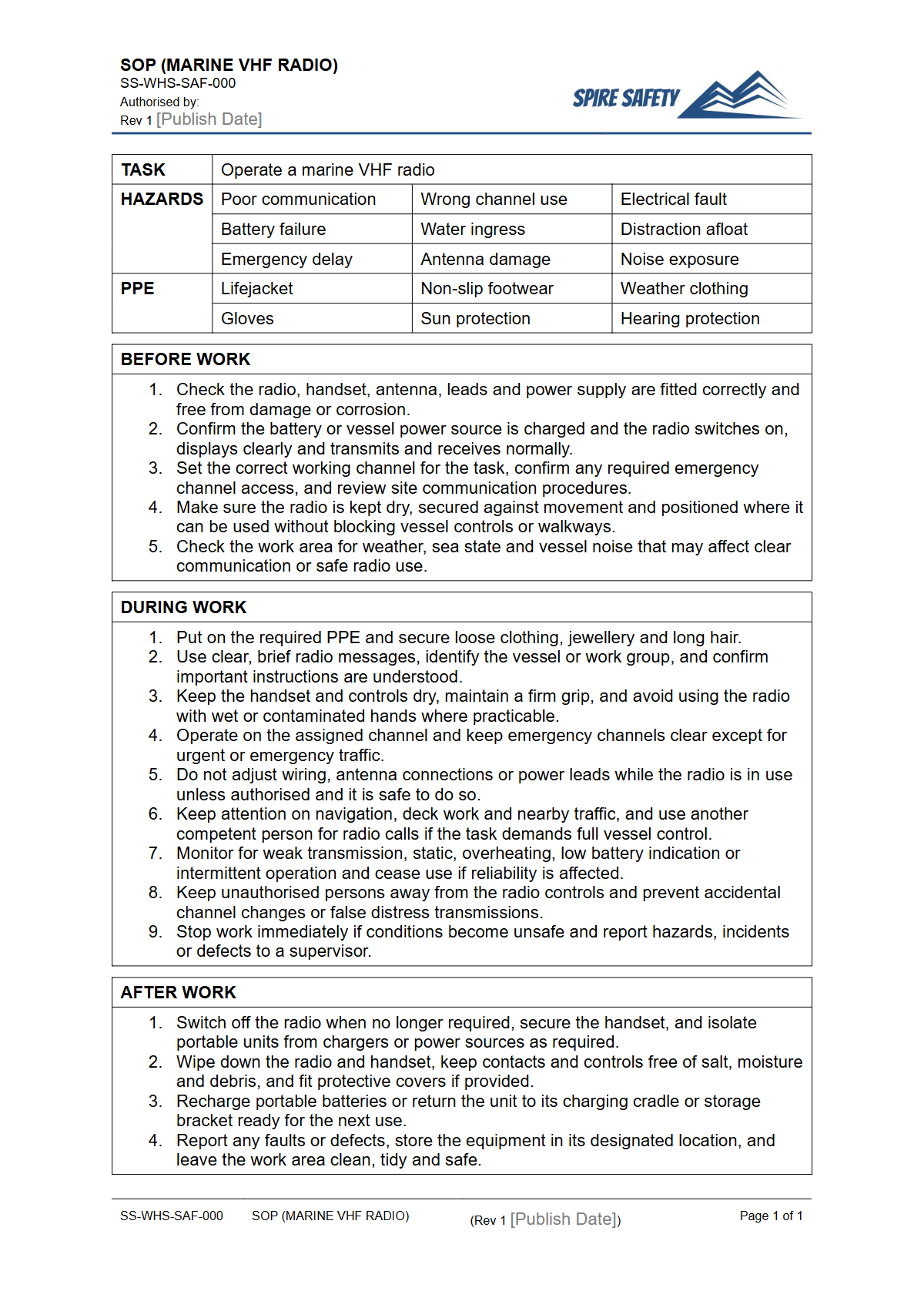
Purpose of the Free Safe Operating Procedure (Marine VHF Radio) Template
Effective communication is critical to maritime safety. This Free Safe Operating Procedure (Marine VHF Radio) Template provides a structured starting point for documenting the safe and correct use of Very High Frequency (VHF) radios on your vessel.
An SOP ensures that all crew members, regardless of experience, understand how to operate the radio correctly, especially during routine operations, and more critically, during an emergency. It formalises procedures for distress calls (Mayday), urgency messages (Pan Pan), and safety announcements (Securite), helping to prevent confusion when time is of the essence.
Implementing a clear and consistent SOP for critical equipment like a marine VHF radio is a fundamental component of a robust safety management system. It demonstrates a commitment to operational safety and helps standardise crew behaviour and response.
This document can be integrated into your broader WHS management systems, ensuring it aligns with your organisation's overall safety policies and objectives.
Video walkthrough
How to use the Free Safe Operating Procedure (Marine VHF Radio) Template
This template is available for download as a DOCX file for easy customisation or as a PDF for immediate use. While it is designed to be a comprehensive starting point aligned with Australian WHS principles, it is essential that you adapt it to your specific circumstances.
Important: This is a template, not a finished document. You must customise this Safe Operating Procedure to reflect the specific VHF radio models used on your vessel(s), your company’s unique communication protocols, the types of voyages undertaken, and the relevant local and national maritime regulations.
We recommend a competent person reviews and approves the final document before it is implemented. If you require assistance in tailoring this or other documents, our WHS consulting services can provide expert guidance.
When to use a Marine VHF Radio SOP
A Safe Operating Procedure for a marine VHF radio should be referenced during crew induction, included in regular safety training, and be readily accessible near the radio equipment for quick reference. It governs all uses of the radio, including:
- Emergency Communications: The primary and most critical use, guiding the user through making Mayday, Pan Pan, and Securite calls. This ensures all necessary information, like vessel identity, position, and nature of distress, is communicated clearly.
- Routine Communications: Ship-to-ship or ship-to-shore calls for operational purposes, such as arranging for a pilot, contacting a marina, or coordinating with other vessels.
- Receiving Information: Monitoring designated channels for weather updates, navigational warnings, and other maritime safety information (MSI).
- Radio Checks: Performing routine checks to ensure the equipment is functioning correctly.
Just as you would document the procedure for life-saving equipment, having a clear SOP for emergency communications is vital. It complements other emergency documents, like our Safe Operating Procedure (Defibrillator Operation) template.
Who should use this SOP
This SOP is intended for any person who may be required to operate a marine VHF radio as part of their duties or responsibilities on a vessel. This includes a wide range of roles within the maritime industry:
- Masters and Skippers
- Deck Officers and Mates
- Engineers
- Deckhands and General Crew
- Workers on barges or offshore platforms
- Charter boat operators
Essentially, any Person Conducting a Business or Undertaking (PCBU) with workers on a vessel has a duty to provide clear instruction and training on safety-critical equipment. Even for equipment that appears simple, like a Step Ladder SOP template, formal documentation ensures a consistent and safe approach across all operations.
Documenting procedures for all onboard equipment, including items like compressors using a free Air Compressor SOP, contributes to a culture of safety and diligence. You can browse our extensive free WHS resources library for more templates to support your safety management system.
Common mistakes
Common mistakes to avoid
- Using Channel 16 for routine, non-urgent conversations, which clogs the emergency frequency.
- Failing to conduct regular radio checks to confirm the equipment is operational.
- Speaking too quickly or not using the phonetic alphabet, leading to misunderstood messages.
- Forgetting to state the vessel's name, position, and nature of distress in an emergency call.
Legal references
Legal considerations
The following legal requirements may be relevant to this type of work.
- Work Health and Safety Act (Harmonised) — Provides the primary duties for protecting workers and other people from work health and safety risks.
- Work Health and Safety Regulations (Harmonised) — Sets out requirements supporting the management of workplace hazards and risks.
The following codes may be relevant to this type of work.
- Managing WHS Risks Code of Practice — Provides practical guidance on identifying hazards, assessing risks and applying effective controls.
- Work Health and Safety Consultation, Cooperation and Coordination Code of Practice — Provides practical guidance on consulting workers and coordinating with other duty holders.
- Managing the Work Environment and Facilities Code of Practice — Provides practical guidance on safe work environments, workplace facilities and related controls.
Did you know
Distress Channel
VHF Channel 16 is the international channel for distress, urgency, and safety calls. It is monitored 24/7 by coast guard stations and other vessels, but should never be used for routine chatter.
Line of Sight
VHF radio communication works on a 'line-of-sight' basis. The range is limited by the curvature of the earth and obstructions, with the height of the antenna being a critical factor in determining communication distance.
FAQ
Frequently asked questions
01What is a Marine VHF Radio SOP?
02Do I need a licence to operate a Marine VHF radio in Australia?
03What is the difference between a Mayday, Pan Pan, and Securite call?
04How often should we train our crew on the VHF radio SOP?
Share this resource
Free Safe Operating Procedure (Marine VHF Radio) Template
Browse Categories
How To Use It
- 1Download and open in Word or PDF.
- 2Replace the placeholders with your business details.
- 3Get it reviewed by a WHS specialist before rollout.
Need it customised?
Our WHS consultants can adapt this template to your site, run a gap analysis, or audit what you already have in place.
Book a Free Consultation WHS consulting servicesor call 1300 156 382
Related templates
- Free Safe Operating Procedure (Marine Waste Segregation) Template
- Free Safe Operating Procedure (Mask Fit Check) Template
- Free Safe Operating Procedure (Masonry Saw) Template
- Free Safe Operating Procedure (Massage Room Cleaning) Template
- Free Safe Operating Procedure (Massage Table Cleaning) Template
- Free Safe Operating Procedure (Mast Climber) Template