
Free Safe Operating Procedure (Marine Battery Change) Template
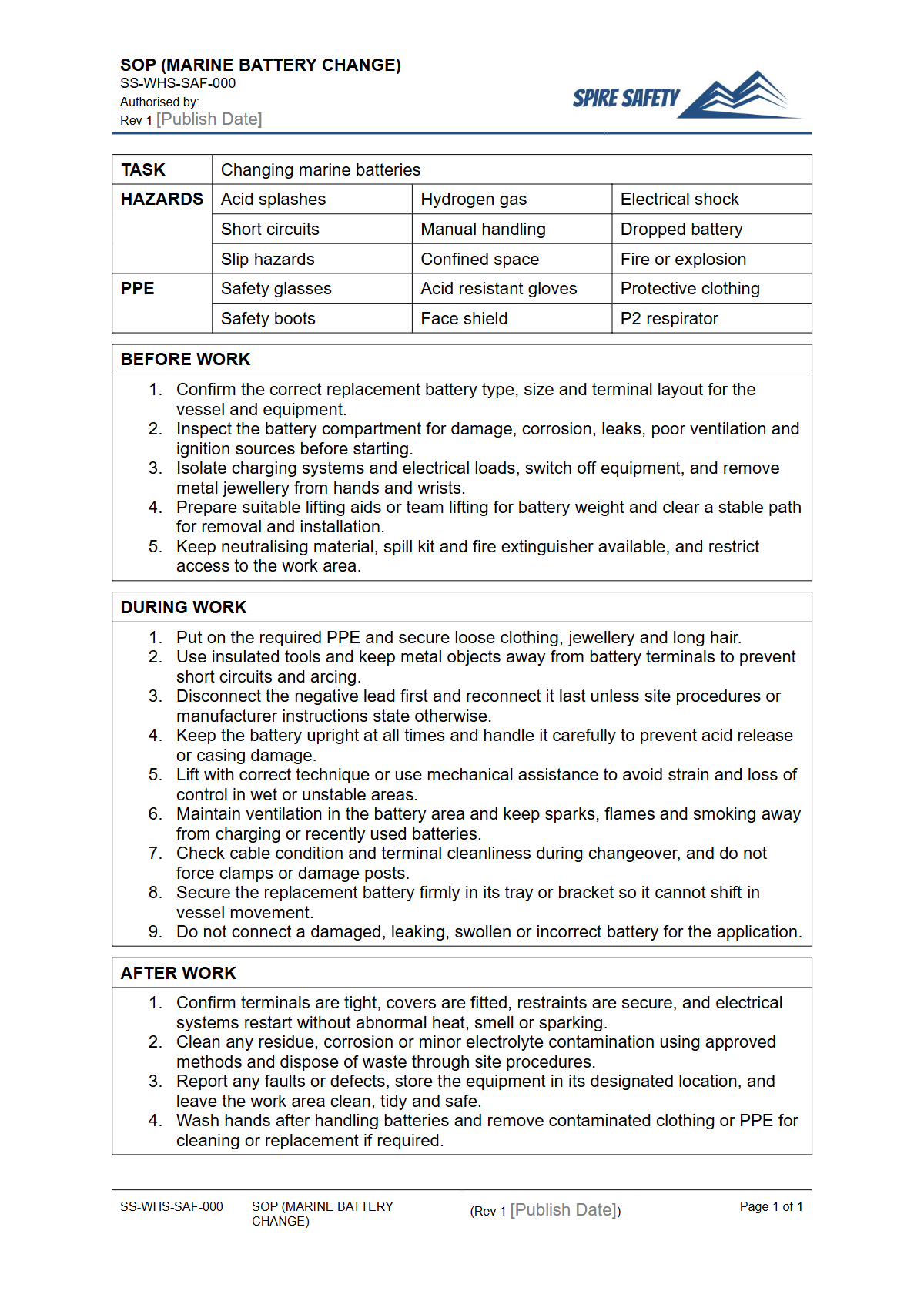
Download our free Safe Operating Procedure (Marine Battery Change) template. This DOCX & PDF resource helps document safety steps for handling marine batteries.
Free Safe Operating Procedure (Marine Battery Change) Template
DOCX • 126 KB + PDF
Updated Oct 2026
No signup required
Purpose of the Free Safe Operating Procedure (Marine Battery Change) Template
Effectively managing the risks associated with vessel maintenance is crucial for safety in the maritime industry. This free Safe Operating Procedure (Marine Battery Change) template provides a structured framework for documenting the process of safely removing and installing marine batteries.
Its primary purpose is to help your organisation establish and communicate a clear, step-by-step guide for workers, minimising exposure to significant hazards. These risks include electric shock, chemical burns from sulfuric acid, explosions from hydrogen gas ignition, and musculoskeletal injuries from manual handling.
By implementing a documented procedure, you create a consistent operational standard that supports your duty of care. This SOP serves as a critical component of your overall WHS management systems, demonstrating a proactive approach to risk control.
It guides workers on pre-operational checks, required personal protective equipment (PPE), the correct sequence for disconnecting and connecting terminals, and emergency procedures.
Video walkthrough
How to use the Free Safe Operating Procedure (Marine Battery Change) Template
This document is a template and must be customised to suit the specific context of your workplace. To use it effectively, download the DOCX file and consult with your workers and supervisors to tailor the content.
Your procedure should detail the specific types of vessels and batteries used, the location of battery compartments, and any unique environmental factors. Clearly list the exact PPE required, the tools to be used, and the emergency response steps, including the location of first aid kits and eyewash stations. A major risk like electrocution may require an immediate medical response, as detailed in our Free Safe Operating Procedure (Defibrillator Operation) Template.
We strongly recommend a consultation process where workers who perform the task provide input to ensure the SOP is practical and reflects real-world conditions. Once customised, the SOP should be used for training, inductions, and ongoing competency verification.
It is not a set-and-forget document; it should be reviewed regularly and updated after any incident or change in equipment or process.
When to use it
A Safe Operating Procedure for marine battery changes should be a standard reference document for all relevant personnel. It should be consulted before any battery removal or installation task commences.
It is an essential tool for training new employees and conducting refresher courses for experienced staff to ensure practices remain consistent and safe. The SOP should also be reviewed as part of any pre-start meeting or Job Safety Analysis (JSA) for non-routine maintenance activities involving the vessel's electrical system.
Furthermore, this procedure is invaluable during safety audits and reviews. If an incident or near-miss occurs during a battery change, the SOP provides a baseline against which to investigate behaviour and system failures.
Regularly reviewing and improving your SOPs is a cornerstone of a healthy safety culture and can be supported by external WHS consulting to identify gaps and opportunities for enhancement.
Who should use it
This template is designed for anyone responsible for the safety of vessel maintenance operations. This includes marine mechanics, shipwrights, marina maintenance staff, commercial fishing vessel operators, and charter boat skippers.
WHS managers and supervisors will find it essential for developing, implementing, and monitoring safe work practices within their organisation. It provides a formal basis for instruction and helps ensure that all workers, regardless of experience level, follow a standardised, low-risk procedure.
The SOP is also a useful resource for businesses aiming to build a comprehensive library of safety documents. You can explore our entire free WHS resources library for more templates to support your operational needs.
Depending on the vessel and where batteries are stored, access might involve working at heights, making our FREE Step Ladder SOP Template a useful companion document.
Additional Considerations
Beyond the core steps, a comprehensive SOP should cover battery charging, storage, and disposal. Old marine batteries are hazardous waste and must be disposed of through certified recycling channels, not in general waste.
The procedure should also specify cleanup steps for acid spills using a neutralising agent like sodium bicarbonate. When cleaning terminals or the battery bay, technicians may use specific equipment; ensure you have safe procedures for all tools, such as our Free Air Compressor SOP (Safe Operating Procedure) Template if compressed air is used.
Common mistakes
Common mistakes to avoid
- Using metal tools that can bridge the terminals, causing a short-circuit, sparks, and potential arcing.
- Failing to disconnect the negative (-) terminal first and reconnect it last, which increases the risk of an accidental short.
- Working in a poorly ventilated engine room or battery compartment where explosive hydrogen gas can accumulate.
- Not wearing appropriate Personal Protective Equipment (PPE), particularly eye protection and acid-resistant gloves.
Legal references
Legal considerations
The following legal requirements may be relevant to this type of work.
- Work Health and Safety Act (Harmonised) — Provides the primary duties for protecting workers and other people from work health and safety risks.
- Work Health and Safety Regulations (Harmonised) — Sets out requirements supporting the management of workplace hazards and risks.
The following codes may be relevant to this type of work.
- Managing WHS Risks Code of Practice — Provides practical guidance on identifying hazards, assessing risks and applying effective controls.
- Work Health and Safety Consultation, Cooperation and Coordination Code of Practice — Provides practical guidance on consulting workers and coordinating with other duty holders.
- Managing the Work Environment and Facilities Code of Practice — Provides practical guidance on safe work environments, workplace facilities and related controls.
Did you know
Hydrogen Hazard
A charging lead-acid battery releases highly flammable hydrogen gas. A single spark from a metal tool hitting a terminal or static electricity is enough to cause a dangerous explosion.
Battery Weight
Large marine batteries can easily weigh over 30kg. This weight poses a significant manual handling risk, potentially causing back or shoulder injuries if not lifted with correct technique or mechanical aids.
FAQ
Frequently asked questions
01What are the main hazards when changing a marine battery?
02What PPE is required for changing a marine battery?
03Are Safe Operating Procedures legally required in Australia?
04How should you dispose of an old marine battery safely?
Share this resource
Free Safe Operating Procedure (Marine Battery Change) Template
Browse Categories
How To Use It
- 1Download and open in Word or PDF.
- 2Replace the placeholders with your business details.
- 3Get it reviewed by a WHS specialist before rollout.
Need it customised?
Our WHS consultants can adapt this template to your site, run a gap analysis, or audit what you already have in place.
Book a Free Consultation WHS consulting servicesor call 1300 156 382
Related templates
- Free Safe Operating Procedure (Marine Deck Inspection) Template
- Free Safe Operating Procedure (Marine Hose Handling) Template
- Free Safe Operating Procedure (Marine VHF Radio) Template
- Free Safe Operating Procedure (Marine Waste Segregation) Template
- Free Safe Operating Procedure (Mask Fit Check) Template
- Free Safe Operating Procedure (Masonry Saw) Template