
Free Safe Operating Procedure (Manure Handling) Template
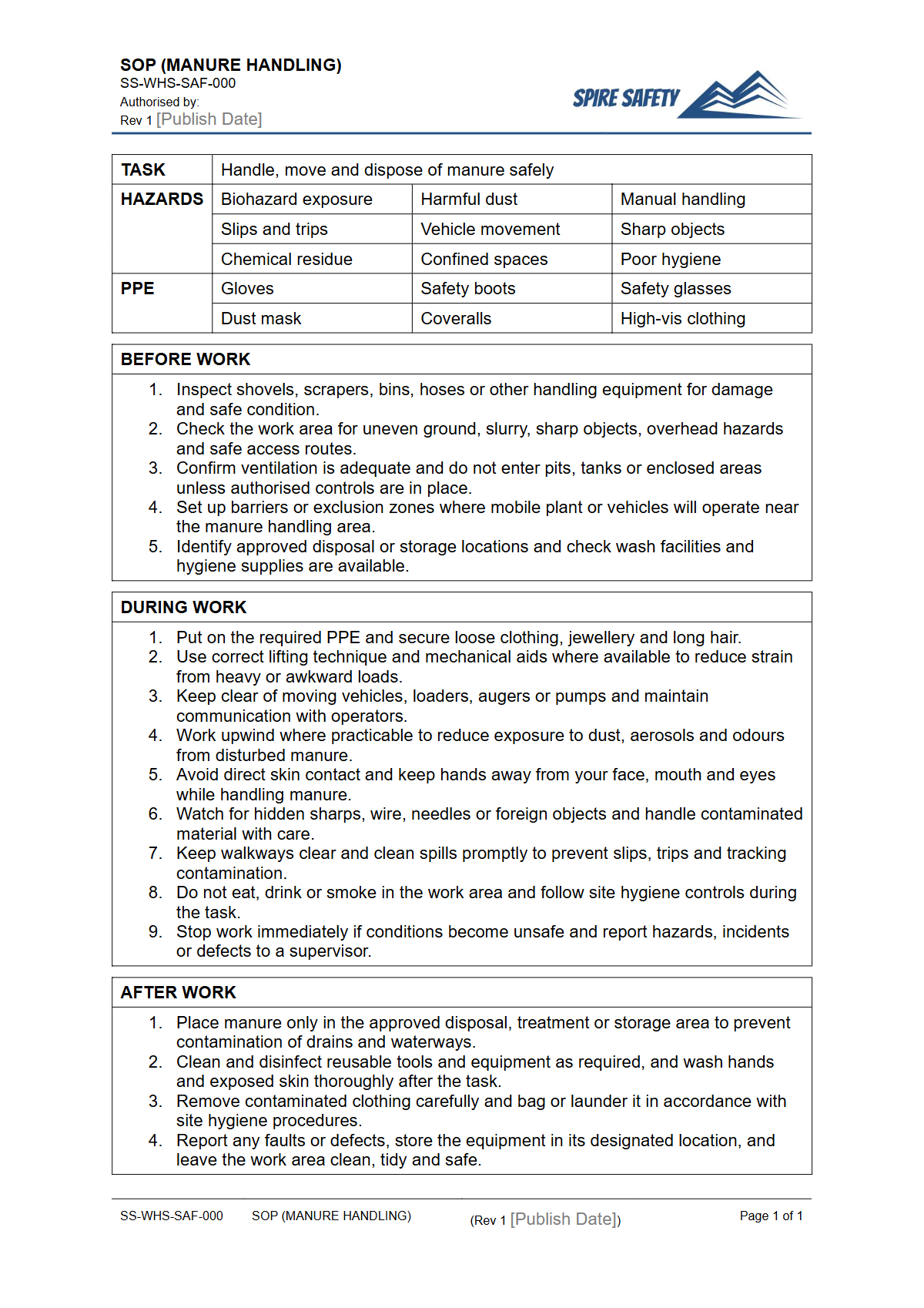
Download our free Safe Operating Procedure for Manure Handling. This customisable DOCX & PDF template helps farms and agricultural businesses manage risks.
Free Safe Operating Procedure (Manure Handling) Template
DOCX • 126 KB + PDF
Updated Oct 2026
No signup required
Purpose of the Free Safe Operating Procedure (Manure Handling) Template
Managing agricultural waste safely is a critical part of farm operations. This free Safe Operating Procedure (Manure Handling) Template provides a structured starting point for documenting the step-by-step process for handling manure safely.
Its purpose is to help persons conducting a business or undertaking (PCBUs) control risks and meet their duties under Australian WHS legislation. A well-defined SOP helps standardise procedures, reduce the risk of incidents, and provides a valuable tool for worker training and inductions.
Manure handling presents a unique combination of biological, chemical, and physical hazards. These include exposure to pathogens like E.
coli, airborne dust, toxic gases such as hydrogen sulfide and ammonia, and risks from operating heavy machinery. This template helps you outline control measures for these specific hazards, forming a key part of your safety management system. For related tasks, you may also find value in our Spreader SOP template.
Video walkthrough
How to use the Free Safe Operating Procedure (Manure Handling) Template
This template is designed for easy customisation. After downloading the DOCX or PDF file, you should adapt it to the specific context of your workplace.
This involves identifying the particular machinery used (e.g., tractors, loaders, pumps), the types of manure storage systems (e.g., pits, lagoons, stockpiles), and the environmental conditions at your site. A critical step in this process is consultation with your workers—the people who perform the task every day have invaluable insight into the real-world risks and practicalities.
Once customised, the SOP should be used as a practical guide for all personnel involved in manure handling. It serves as the foundation for training, task supervision, and incident investigation.
Integrating this document is a vital step in developing a robust WHS management system that actively protects your team.
Important: This document is a template and requires customisation. As a PCBU, it is your responsibility to ensure your safety documentation is tailored to the unique risks of your workplace.
We recommend a thorough risk assessment and consultation with your team to ensure all relevant hazards are addressed.
When to use this Safe Operating Procedure
A Safe Operating Procedure for manure handling should be a core document in any agricultural setting where this task occurs. It should be actively used in several key situations, including:
- Worker Training: For inducting new employees or training existing workers on the correct, safe methods for handling manure.
- Pre-Task Planning: As a reference before starting work, especially for non-routine or high-risk scenarios like entering a confined space or using new equipment.
- Toolbox Talks: As a basis for discussion during safety meetings to reinforce safe work practices and discuss any recent observations or concerns.
- Incident Investigations: To review whether established procedures were followed and to identify areas for improvement after a near miss or incident.
- Risk Assessments: To inform and be informed by the specialist WHS consulting and risk assessment process, ensuring controls are documented and implemented.
Key Safety Controls for Manure Handling
Your customised SOP should detail specific control measures. Key areas to address include:
- Personal Protective Equipment (PPE): Mandating the use of appropriate PPE, such as steel-capped boots, chemical-resistant gloves, safety eyewear, and respiratory protection (e.g., P2 dust masks). For confined spaces like pits, this will extend to gas monitors and potentially self-contained breathing apparatus.
- Ventilation: Ensuring adequate natural or mechanical ventilation in sheds, barns, and other enclosed areas where manure and gases can accumulate.
- Machinery Operation: Outlining pre-start checks, no-go zones, communication protocols, and safe operating techniques for all plant and equipment used. For other heavy machinery, see our Dozer Safe Operating Procedure.
- Confined Spaces: Implementing a strict confined space entry procedure for any tasks involving manure pits or tanks, including isolation, gas testing, and standby personnel.
- Hygiene: Detailing mandatory hand washing and personal decontamination procedures to prevent the spread of pathogens.
These controls are not 'set and forget'. Ensuring they remain effective over time through regular WHS compliance audits is crucial for maintaining a safe workplace.
Who should use this SOP?
This SOP is intended for all individuals involved in the management and execution of manure handling tasks on a farm or agricultural site. This includes:
- Farm Owners and Managers: Responsible for ensuring a safe system of work is developed, implemented, and reviewed.
- Supervisors: Tasked with providing instruction, ensuring procedures are followed correctly, and monitoring the work environment.
- Workers and Equipment Operators: The primary users of the SOP, who must understand and follow the documented procedures to protect themselves and their colleagues. Similar to our free Telehandler SOP, this document provides clarity and direction for those at the coalface.
- WHS Officers/Coordinators: Who use the document to facilitate training, conduct risk assessments, and maintain safety records.
By providing a clear, accessible guide, this SOP helps build a strong safety culture across the entire organisation. For more templates and safety guides, you can browse our complete free WHS resources library.
Common mistakes
Common mistakes to avoid
- Underestimating the risks of gases in confined spaces or enclosed sheds.
- Failing to use or maintain appropriate Personal Protective Equipment (PPE).
- Using a generic template without customising it for site-specific machinery and conditions.
- Neglecting proper personal hygiene practices after handling manure, increasing infection risk.
Legal references
Legal considerations
The following legal requirements may be relevant to this type of work.
- Work Health and Safety Act (Harmonised) — Provides the primary duties for protecting workers and other people from work health and safety risks.
- Work Health and Safety Regulations (Harmonised) — Sets out requirements supporting the management of workplace hazards and risks.
The following codes may be relevant to this type of work.
- Managing WHS Risks Code of Practice — Provides practical guidance on identifying hazards, assessing risks and applying effective controls.
- Work Health and Safety Consultation, Cooperation and Coordination Code of Practice — Provides practical guidance on consulting workers and coordinating with other duty holders.
- Managing the Work Environment and Facilities Code of Practice — Provides practical guidance on safe work environments, workplace facilities and related controls.
Did you know
Silent Dangers
Manure pits can produce high concentrations of hydrogen sulfide (H2S), a toxic gas that is heavier than air. It can quickly overcome a worker, often without them noticing the 'rotten egg' smell due to olfactory fatigue.
FAQ
Frequently asked questions
01What are the main hazards of handling manure?
02Is a Safe Operating Procedure a legal requirement for handling manure in Australia?
03What PPE is required for handling manure?
04How often should a Manure Handling SOP be reviewed?
Share this resource
Free Safe Operating Procedure (Manure Handling) Template
Browse Categories
How To Use It
- 1Download and open in Word or PDF.
- 2Replace the placeholders with your business details.
- 3Get it reviewed by a WHS specialist before rollout.
Need it customised?
Our WHS consultants can adapt this template to your site, run a gap analysis, or audit what you already have in place.
Book a Free Consultation WHS consulting servicesor call 1300 156 382
Related templates
- Free Safe Operating Procedure (Marina Bin Collection) Template
- Free Safe Operating Procedure (Marina Pontoon Cleaning) Template
- Free Safe Operating Procedure (Marina Waste Handling) Template
- Free Safe Operating Procedure (Marine Battery Change) Template
- Free Safe Operating Procedure (Marine Deck Inspection) Template
- Free Safe Operating Procedure (Marine Hose Handling) Template