
Free Safe Operating Procedure (Marina Bin Collection) Template
Download our free Safe Operating Procedure (Marina Bin Collection) Template. This customisable DOCX & PDF helps standardise waste management tasks.
Free Safe Operating Procedure (Marina Bin Collection) Template
DOCX • 126 KB + PDF
Updated Oct 2026
No signup required
Purpose of the Free Safe Operating Procedure (Marina Bin Collection) Template
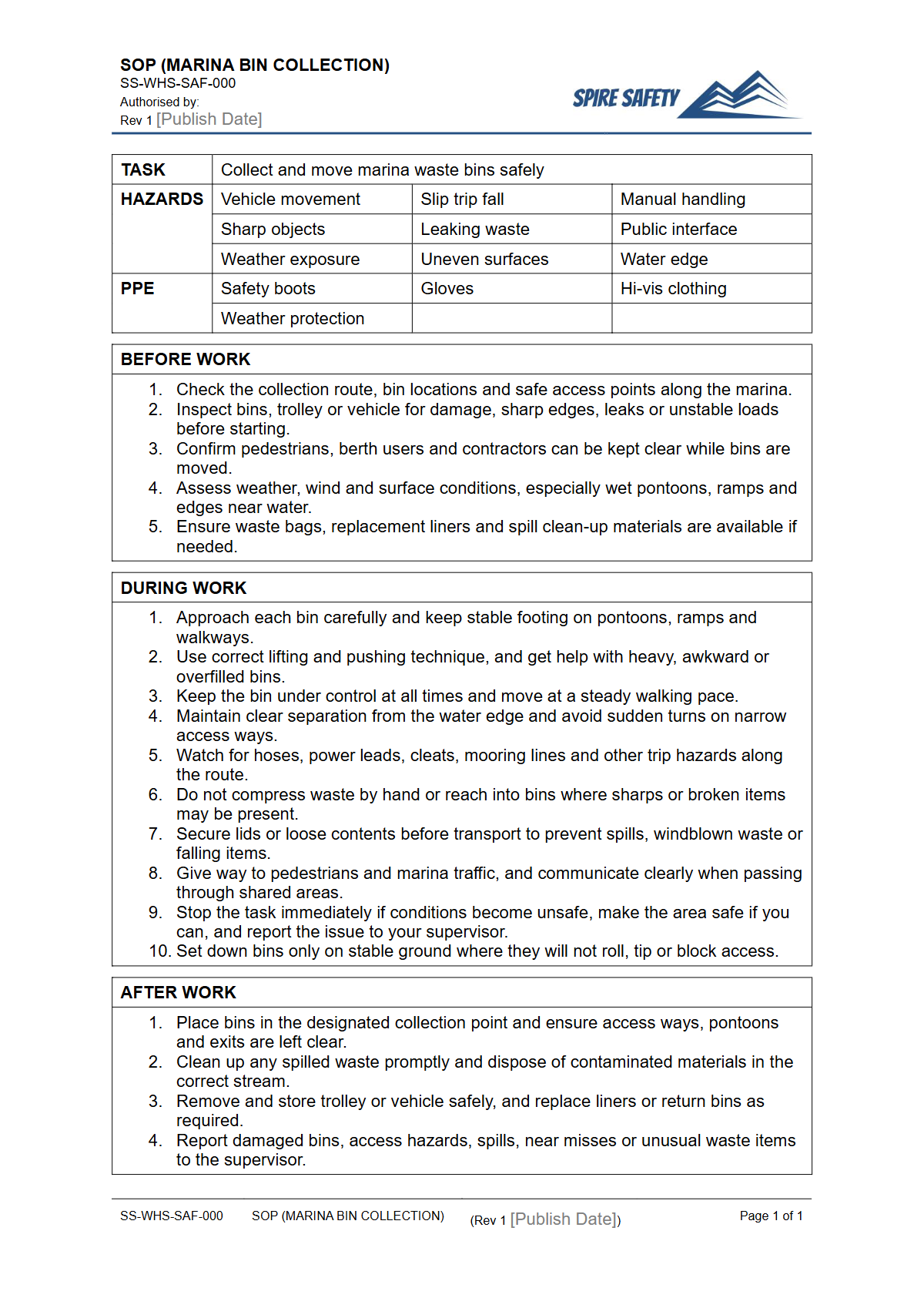
Managing waste in a marina environment presents unique health and safety challenges, from manual handling risks to navigating public spaces and working near water. This Free Safe Operating Procedure (Marina Bin Collection) Template provides a structured starting point for documenting a safe system of work for this essential task.
It helps standardise procedures, ensuring that all workers understand the identified hazards and the control measures required to manage them effectively.
Using a formal SOP helps a Person Conducting a Business or Undertaking (PCBU) meet their primary duty of care. It guides workers through the required steps, from pre-start checks of equipment like bin tugs or carts, to safely lifting and transporting bins, and managing potential spills.
This process is a critical component of a robust WHS management system, demonstrating a commitment to proactive risk management.
Video walkthrough
How to use the Free Safe Operating Procedure (Marina Bin Collection) Template
This resource is available as a DOCX file, which is fully editable in Microsoft Word or other compatible programs, and as a PDF for easy printing and distribution. To get the most value from this template, you must adapt it to the specific circumstances of your workplace.
Every marina is different, with unique layouts, equipment, and public traffic patterns.
Important: This is a template, not a finished document. Before use, we strongly recommend you conduct a site-specific risk assessment and customise this document in consultation with your workers.
You must ensure the final SOP accurately reflects your marina's specific bins, collection vehicles (e.g., golf carts, bin trailers), PPE requirements, and emergency procedures. Involving your team in the customisation process is a key part of fulfilling your duty to consult.
When to use this Safe Operating Procedure
A Safe Operating Procedure for marina bin collection should be a core part of your operational documentation. It is primarily used for the induction and training of new employees, ensuring they learn the correct, safe method from day one.
It also serves as a valuable tool for refresher training for existing staff, reinforcing safe work habits and introducing any changes to the process.
The SOP should be reviewed regularly as part of scheduled WHS compliance auditing activities. It must also be updated whenever a new hazard is identified, after an incident or near-miss occurs, or when new equipment or procedures for waste collection are introduced.
A current version should always be readily accessible to workers in the areas where the task is performed.
Who should use it
This SOP is intended for all personnel involved in or responsible for waste management activities in a marina setting. This includes:
- Marina Staff and Maintenance Teams: The primary users who will follow the step-by-step procedures to perform the task safely.
- Supervisors and Team Leaders: Responsible for ensuring workers are trained on the SOP and follow the outlined procedures. They use it as a benchmark for monitoring performance and conducting safety observations.
- WHS Managers and Coordinators: Use the SOP as a formal tool for risk management, training, and incident investigation. They are typically responsible for developing, reviewing, and approving the document.
Properly documenting all routine and non-routine tasks is essential for workplace safety. For example, procedures for responding to a medical emergency should be just as clear, which is why we also provide a free Safe Operating Procedure for defibrillator operation.
Key Hazards and Controls
Marina environments combine typical waste collection hazards with site-specific risks. The SOP should detail controls for:
- Manual Handling: Injuries from lifting heavy, awkward, or unstable bins. Controls include using mechanical aids, team lifts, and proper lifting techniques.
- Slips, Trips, and Falls: Wet or oily surfaces on pontoons, ramps, and pathways. Controls include non-slip footwear, good housekeeping, and ensuring adequate lighting.
- Working Near Water: The obvious risk of falling into the water. Controls can include the provision and use of life jackets, edge protection, and clear emergency response procedures for a person-overboard scenario.
- Biological Hazards: Contact with sharps, hazardous waste, or vermin. Controls include wearing appropriate PPE (e.g., gloves), clear procedures for managing contaminated waste, and regular pest control.
- Vehicle Movement: Collisions with people, infrastructure, or other vehicles, especially in areas with public access. Controls include traffic management plans, designated pathways, warning devices on vehicles, and speed limits.
It is important to have documented procedures for all equipment used on site, not just the primary vehicles. For instance, tasks may require using other tools, so having a step ladder SOP available ensures consistency in your safety documentation.
Even maintenance tasks require their own procedures, such as those outlined in our free Air Compressor SOP template. If you need more templates for different tasks or equipment, you can explore our entire free WHS resources library for more downloads.
Common mistakes
Common mistakes to avoid
- Failing to customise the template for site-specific hazards like pontoon gaps or public traffic.
- Not involving the workers who actually perform the task in the drafting and review process.
- Making the SOP too generic and not specifying the exact type of vehicle or PPE to be used.
- Forgetting to include emergency procedures, such as what to do in case of a major spill or a person falling in the water.
Legal references
Legal considerations
The following legal requirements may be relevant to this type of work.
- Work Health and Safety Act (Harmonised) — Provides the primary duties for protecting workers and other people from work health and safety risks.
- Work Health and Safety Regulations (Harmonised) — Sets out requirements supporting the management of workplace hazards and risks.
The following codes may be relevant to this type of work.
- Managing WHS Risks Code of Practice — Provides practical guidance on identifying hazards, assessing risks and applying effective controls.
- Work Health and Safety Consultation, Cooperation and Coordination Code of Practice — Provides practical guidance on consulting workers and coordinating with other duty holders.
- Managing the Work Environment and Facilities Code of Practice — Provides practical guidance on safe work environments, workplace facilities and related controls.
Did you know
Manual Handling Risk
According to Safe Work Australia, hazardous manual tasks are a leading cause of work-related injuries, with sprains and strains of joints and muscles accounting for the majority of these claims.
Waste Hierarchy
A good waste management plan follows the waste hierarchy: Avoid, Reduce, Reuse, Recycle, Recover, and finally, Dispose. An SOP for collection is part of the final 'dispose' step, but it should exist within a broader strategy.
FAQ
Frequently asked questions
01What is the difference between a SWMS and an SOP for marina bin collection?
02Does this marina bin collection SOP cover manual handling risks?
03How often should we review our Safe Operating Procedure for bin collection?
04Can I use this template for collecting liquid waste at a marina?
Share this resource
Free Safe Operating Procedure (Marina Bin Collection) Template
Browse Categories
How To Use It
- 1Download and open in Word or PDF.
- 2Replace the placeholders with your business details.
- 3Get it reviewed by a WHS specialist before rollout.
Need it customised?
Our WHS consultants can adapt this template to your site, run a gap analysis, or audit what you already have in place.
Book a Free Consultation WHS consulting servicesor call 1300 156 382
Related templates
- Free Safe Operating Procedure (Marina Pontoon Cleaning) Template
- Free Safe Operating Procedure (Marina Waste Handling) Template
- Free Safe Operating Procedure (Marine Battery Change) Template
- Free Safe Operating Procedure (Marine Deck Inspection) Template
- Free Safe Operating Procedure (Marine Hose Handling) Template
- Free Safe Operating Procedure (Marine VHF Radio) Template