
Free Safe Operating Procedure (Mannequin Handling) Template
Download our free Safe Operating Procedure (Mannequin Handling) template to manage manual handling risks.
Free Safe Operating Procedure (Mannequin Handling) Template
DOCX • 126 KB + PDF
Updated Oct 2026
No signup required
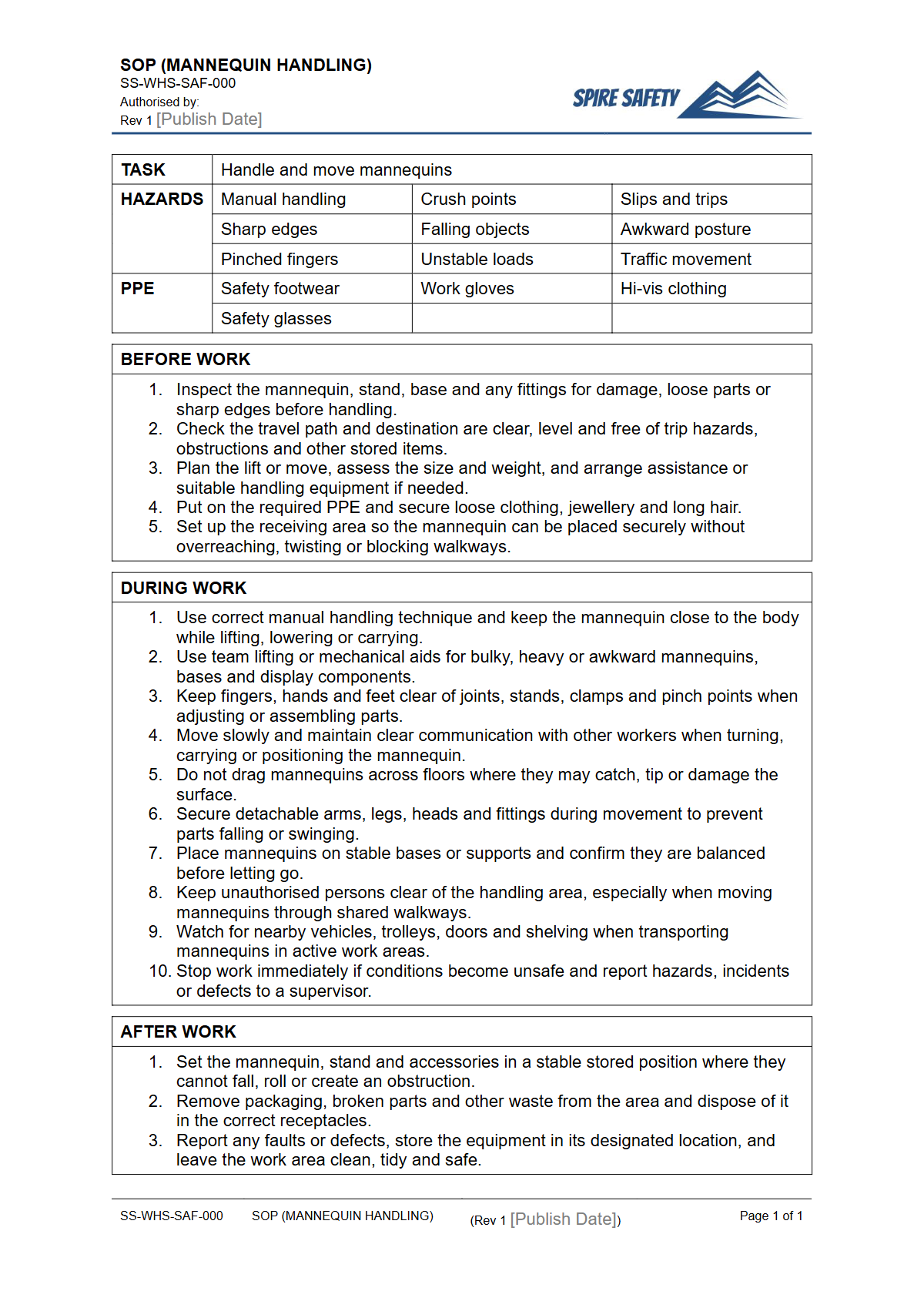
Purpose of the Free Safe Operating Procedure (Mannequin Handling) Template
This Free Safe Operating Procedure (Mannequin Handling) Template provides a structured framework for documenting the risks and controls associated with moving, positioning, and storing mannequins. While often overlooked, handling mannequins presents significant manual handling risks due to their awkward shapes, varying weights, and breakable components.
Improper handling can lead to musculoskeletal disorders (MSDs), such as sprains, strains, and back injuries. Using a dedicated SOP helps your organisation formalise safe work practices, ensure consistency in training, and demonstrate a commitment to worker safety.
This document is an essential tool for any business, particularly in retail, visual merchandising, and training environments, where this task is performed regularly.
Video walkthrough
How to use the Free Safe Operating Procedure (Mannequin Handling) Template
This Safe Operating Procedure for mannequin handling is provided as a fully editable DOCX file and a print-ready PDF. To use it effectively, you must conduct a specific risk assessment for the task at your workplace.
The template includes sections for outlining hazards, required personal protective equipment (PPE), and step-by-step instructions for safe lifting, carrying, and placement. It is crucial to adapt the content to reflect your specific types of mannequins, work environment, and control measures.
For businesses needing support with customisation or implementation, our professional WHS consulting services can provide expert guidance.
Important Customisation Note
Every workplace is unique. This template provides a solid foundation, but it is not a complete, out-of-the-box solution.
You must customise this document to align with your specific equipment, environment, and internal procedures. We are not responsible for any incidents that may occur from the use of this template; its effectiveness depends on your thorough and accurate customisation and implementation.
When to Use This SOP
A Safe Operating Procedure for mannequin handling should be developed, implemented, and referenced before workers undertake the task. It is particularly critical in settings such as:
- Retail stores during seasonal display changes or daily adjustments.
- Visual merchandising departments preparing for new campaigns.
- Stockrooms where mannequins are stored and retrieved.
- First aid and CPR training centres where resuscitation mannequins are used.
- Fashion design schools and photography studios.
By integrating the SOP into your induction and training programs, you ensure all relevant workers understand the required safety protocols. For scenarios involving medical training, it's also important to have documented procedures for related equipment, as shown in our SOP for defibrillator operation.
Who Should Use It
This template is designed for use by Persons Conducting a Business or Undertaking (PCBUs), managers, supervisors, and WHS representatives. These individuals are responsible for creating, reviewing, and implementing safe work systems.
The final, customised SOP should be made readily available to all workers tasked with handling mannequins, including retail assistants, visual merchandisers, stockroom staff, and trainers. Integrating such procedures is a key part of building structured WHS management systems that proactively manage workplace hazards.
Key Elements of Mannequin Handling Safety
A robust SOP for mannequin handling should address several key areas beyond just the physical lift. Consider including specific details on:
- Pre-Task Assessment: Checking the mannequin's weight, condition (any damage?), and centre of gravity. Planning the travel path to ensure it is clear of obstructions.
- Lifting Technique: Instructions for individual and team lifts. Emphasise bending the knees, keeping the back straight, and maintaining a firm grip.
- Mechanical Aids: Where applicable, detail the use of trolleys or dollies to move heavy or multiple mannequins, reducing the need for carrying.
- Storage: Define safe storage practices. Mannequins stored at height, for example, introduce risks of falling objects. Your procedures should align with other relevant safety documents, such as a safe step ladder use procedure.
Ensuring these procedures are consistently followed can be verified through regular WHS compliance auditing, which helps identify gaps and reinforce safe behaviours.
This template is just one example of the many documents available in our extensive library of free WHS resources, designed to help Australian businesses streamline their safety management.
Common mistakes
Common mistakes to avoid
- Failing to customise the template to reflect specific site hazards and mannequin types.
- Attempting a one-person lift for a mannequin that is too heavy or awkward, requiring a team lift.
- Not clearing the travel path of obstructions before moving the mannequin.
- Storing mannequins in unstable positions or at height without proper securing, creating a falling object hazard.
Legal references
Legal considerations
The following legal requirements may be relevant to this type of work.
- Work Health and Safety Act (Harmonised) — Provides the primary duties for protecting workers and other people from work health and safety risks.
- Work Health and Safety Regulations (Harmonised) — Sets out requirements supporting the management of workplace hazards and risks.
The following codes may be relevant to this type of work.
- Managing WHS Risks Code of Practice — Provides practical guidance on identifying hazards, assessing risks and applying effective controls.
- Work Health and Safety Consultation, Cooperation and Coordination Code of Practice — Provides practical guidance on consulting workers and coordinating with other duty holders.
- Managing the Work Environment and Facilities Code of Practice — Provides practical guidance on safe work environments, workplace facilities and related controls.
Did you know
Manual Handling Risks
According to Safe Work Australia, hazardous manual tasks are the leading cause of workplace injuries in Australia, responsible for a significant percentage of all serious workers' compensation claims.
FAQ
Frequently asked questions
01What are the main hazards of handling mannequins?
02Is a Safe Operating Procedure a legal requirement for mannequin handling?
03How often should we review our mannequin handling SOP?
04Can this mannequin handling template be used for staff training?
Share this resource
Free Safe Operating Procedure (Mannequin Handling) Template
Browse Categories
How To Use It
- 1Download and open in Word or PDF.
- 2Replace the placeholders with your business details.
- 3Get it reviewed by a WHS specialist before rollout.
Need it customised?
Our WHS consultants can adapt this template to your site, run a gap analysis, or audit what you already have in place.
Book a Free Consultation WHS consulting servicesor call 1300 156 382
Related templates
- Free Safe Operating Procedure (Manometer) Template
- Free Safe Operating Procedure (Manual Order Picking) Template
- Free Safe Operating Procedure (Manual Weed Removal) Template
- Free Safe Operating Procedure (Manure Handling) Template
- Free Safe Operating Procedure (Marina Bin Collection) Template
- Free Safe Operating Procedure (Marina Pontoon Cleaning) Template