
Free Safe Operating Procedure (Manual Order Picking) Template
Download our Free Safe Operating Procedure (Manual Order Picking) Template. This customisable DOCX & PDF helps document safe work practices. Get started today.
Free Safe Operating Procedure (Manual Order Picking) Template
DOCX • 126 KB + PDF
Updated Oct 2026
No signup required
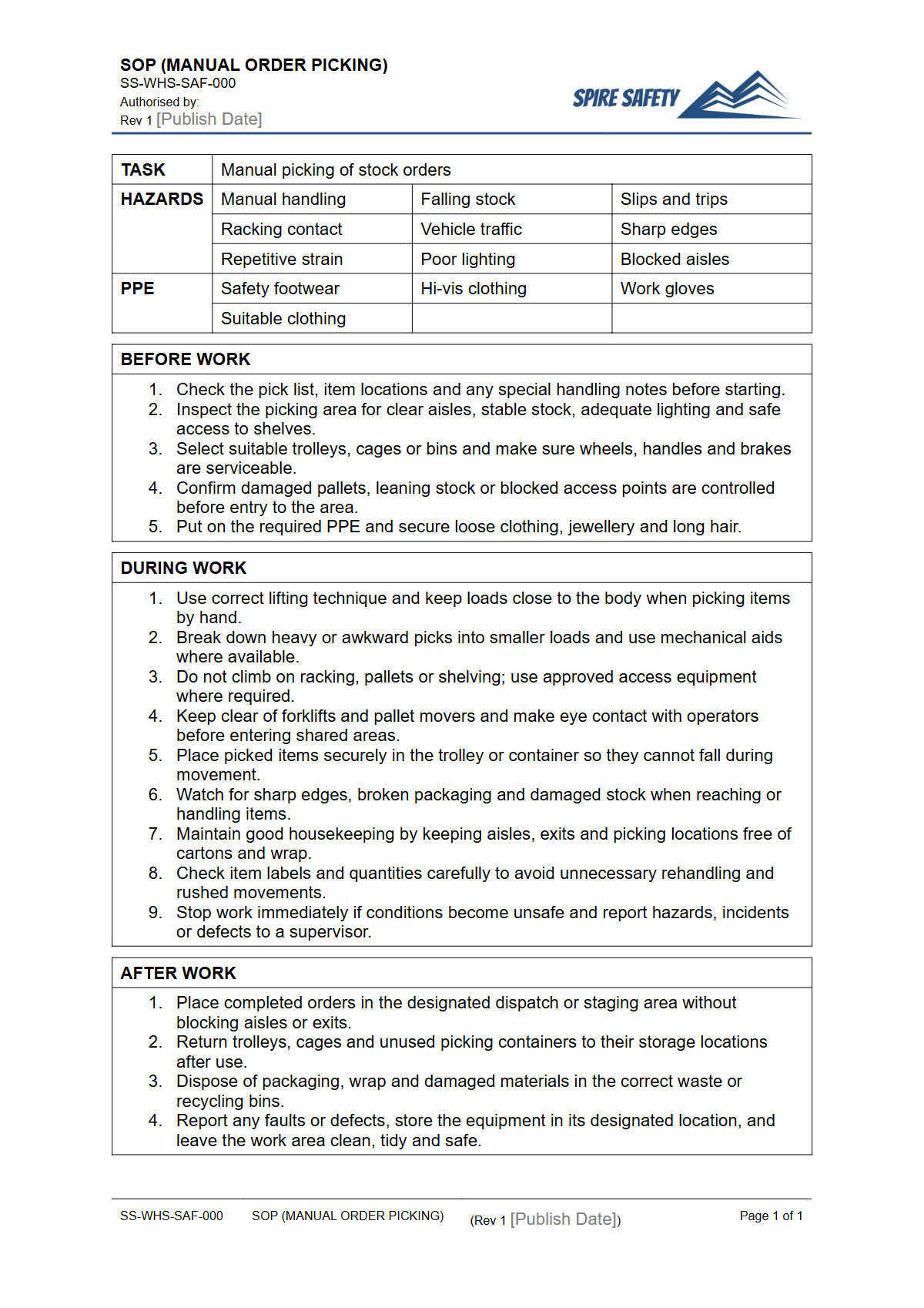
Purpose of the Free Safe Operating Procedure (Manual OrderPicking) Template
Manual order picking is a common task in warehouses, distribution centres, and retail environments, but it carries significant risks. This Free Safe Operating Procedure (Manual Order Picking) Template provides a structured framework to help your organisation document the safest way to perform these tasks.
By clearly outlining the steps, potential hazards, and required controls, you can systematically manage risks such as musculoskeletal disorders (MSDs) from repetitive lifting, bending, and reaching. A well-defined SOP is a critical component of your overall safety management system, demonstrating a commitment to worker health and safety.
Using this template helps formalise your approach to managing common warehouse hazards, including slips, trips, falls, and being struck by falling objects. It establishes a consistent, repeatable method for training new and existing staff, ensuring everyone understands the benchmark for safe performance.
Documented procedures also form a vital part of your risk management records and support investigations if an incident occurs. This SOP is intended for manual tasks; for mechanised equipment, you will require separate procedures, such as our FREE Telehandler SOP Template.
Video walkthrough
How to use the Free Safe Operating Procedure (Manual Order Picking) Template
This resource is provided as a fully editable DOCX file and a ready-to-use PDF. The DOCX version allows for complete customisation to align with your specific operational context.
It's designed to be a starting point, providing a logical structure based on Australian WHS principles and common industry practice.
IMPORTANT: This is a template only. We have provided a structured starting point, but you MUST customise this document to reflect the specific equipment (e.g., trolleys, pallet jacks), layout, products, and tasks at your workplace.
You must consult with your workers and other relevant stakeholders during this process to ensure the SOP is practical and effective.
To implement this SOP:
- Download the DOCX template.
- Conduct a risk assessment of your manual order picking activities to identify all relevant hazards.
- Customise the template by adding site-specific details, including the types of goods handled, required Personal Protective Equipment (PPE), and emergency procedures.
- Involve your workers in the review process to capture their valuable on-the-ground knowledge.
- Finalise and approve the SOP through your organisation's official channels.
- Train all relevant workers on the finalised SOP and ensure they can demonstrate competency.
- Schedule regular reviews to keep the procedure current. If you need assistance with customisation or implementing WHS management systems, professional support can be invaluable.
When to use it
A Safe Operating Procedure for manual order picking should be a living document, integrated into your daily operations. It should be formally used before any worker undertakes the task for the first time.
It serves as a primary training tool during induction and for any refresher training sessions, reinforcing correct technique and hazard awareness. This document is particularly important when using equipment as part of the picking process, such as ladders; for these specific tasks, consider using a dedicated procedure like our FREE Step Ladder SOP Template.
The SOP should also be reviewed and referenced after any incident or near miss related to order picking. This helps in identifying gaps in the procedure or training.
Furthermore, it must be updated whenever there is a change in the workplace, such as the introduction of new racking systems, different types of products, new handling equipment, or a change in the workflow. Regular reviews ensure it remains relevant and effective in preventing harm. If your warehouse or workshop environment includes other fixed plant, you may also need procedures for equipment like our Free Air Compressor SOP (Safe Operating Procedure) Template.
Who should use it
This SOP template is designed for a range of personnel within an organisation. WHS Managers and Advisors will use it as a foundational tool to build and formalise their safety processes.
Warehouse Managers, Supervisors, and Team Leaders are responsible for implementing the SOP on the floor, using it for training, and monitoring compliance. They play a key role in the customisation and review process, ensuring the procedure is practical for their teams.
Workers who perform manual order picking are the primary end-users. They should be trained on the SOP's contents and use it as a reference to perform their duties safely.
Finally, a Person Conducting a Business or Undertaking (PCBU) can use the finalised SOP to demonstrate how they are meeting their primary duty of care under WHS law to provide and maintain safe systems of work. You can explore our entire catalogue of procedural documents in our free WHS resources library to support your safety framework.
Common mistakes
Common mistakes to avoid
- Using a generic template without customising it for site-specific hazards and equipment.
- Failing to consult with workers who perform the task, missing crucial practical insights.
- Not providing adequate training on the finalised SOP, treating it as a 'tick-box' exercise.
- Neglecting to review and update the SOP after an incident or a change in process.
Legal references
Legal considerations
The following legal requirements may be relevant to this type of work.
- Work Health and Safety Act (Harmonised) — Provides the primary duties for protecting workers and other people from work health and safety risks.
- Work Health and Safety Regulations (Harmonised) — Sets out requirements supporting the management of workplace hazards and risks.
The following codes may be relevant to this type of work.
- Managing WHS Risks Code of Practice — Provides practical guidance on identifying hazards, assessing risks and applying effective controls.
- Work Health and Safety Consultation, Cooperation and Coordination Code of Practice — Provides practical guidance on consulting workers and coordinating with other duty holders.
- Managing the Work Environment and Facilities Code of Practice — Provides practical guidance on safe work environments, workplace facilities and related controls.
Did you know
A Leading Cause of Injury
According to Safe Work Australia, manual handling is a leading cause of serious workers' compensation claims. Musculoskeletal disorders resulting from these tasks can have a long-term, debilitating impact on workers.
FAQ
Frequently asked questions
01What is the difference between a SWMS and an SOP for manual order picking?
02How often should a manual order picking SOP be reviewed?
03Who is responsible for creating a Safe Operating Procedure?
04Can this template be used for automated picking systems?
Share this resource
Free Safe Operating Procedure (Manual Order Picking) Template
Browse Categories
How To Use It
- 1Download and open in Word or PDF.
- 2Replace the placeholders with your business details.
- 3Get it reviewed by a WHS specialist before rollout.
Need it customised?
Our WHS consultants can adapt this template to your site, run a gap analysis, or audit what you already have in place.
Book a Free Consultation WHS consulting servicesor call 1300 156 382
Related templates
- Free Safe Operating Procedure (Manual Weed Removal) Template
- Free Safe Operating Procedure (Manure Handling) Template
- Free Safe Operating Procedure (Marina Bin Collection) Template
- Free Safe Operating Procedure (Marina Pontoon Cleaning) Template
- Free Safe Operating Procedure (Marina Waste Handling) Template
- Free Safe Operating Procedure (Marine Battery Change) Template