
Free Safe Operating Procedure (Magnetic Stirrer) Template
Download our free Safe Operating Procedure (Magnetic Stirrer) Template to outline key safety steps for laboratory staff.
Free Safe Operating Procedure (Magnetic Stirrer) Template
DOCX • 126 KB + PDF
Updated Oct 2026
No signup required
Purpose of the Free Safe Operating Procedure (Magnetic Stirrer) Template
Get started with our Free Safe Operating Procedure (Magnetic Stirrer) Template, designed for laboratories and research facilities across Australia. This document provides a structured framework for outlining the safe use of magnetic stirrers, helping you manage risks associated with chemical mixing.
A properly developed SOP is a key administrative control measure, detailing step-by-step instructions to protect workers from hazards such as chemical exposure, splashes, vessel breakage, and potential fires or burns from hotplate models. It forms an essential part of your overall safety management, creating a repeatable and safe process for all users.
Video walkthrough
How to use the Free Safe Operating Procedure (Magnetic Stirrer) Template
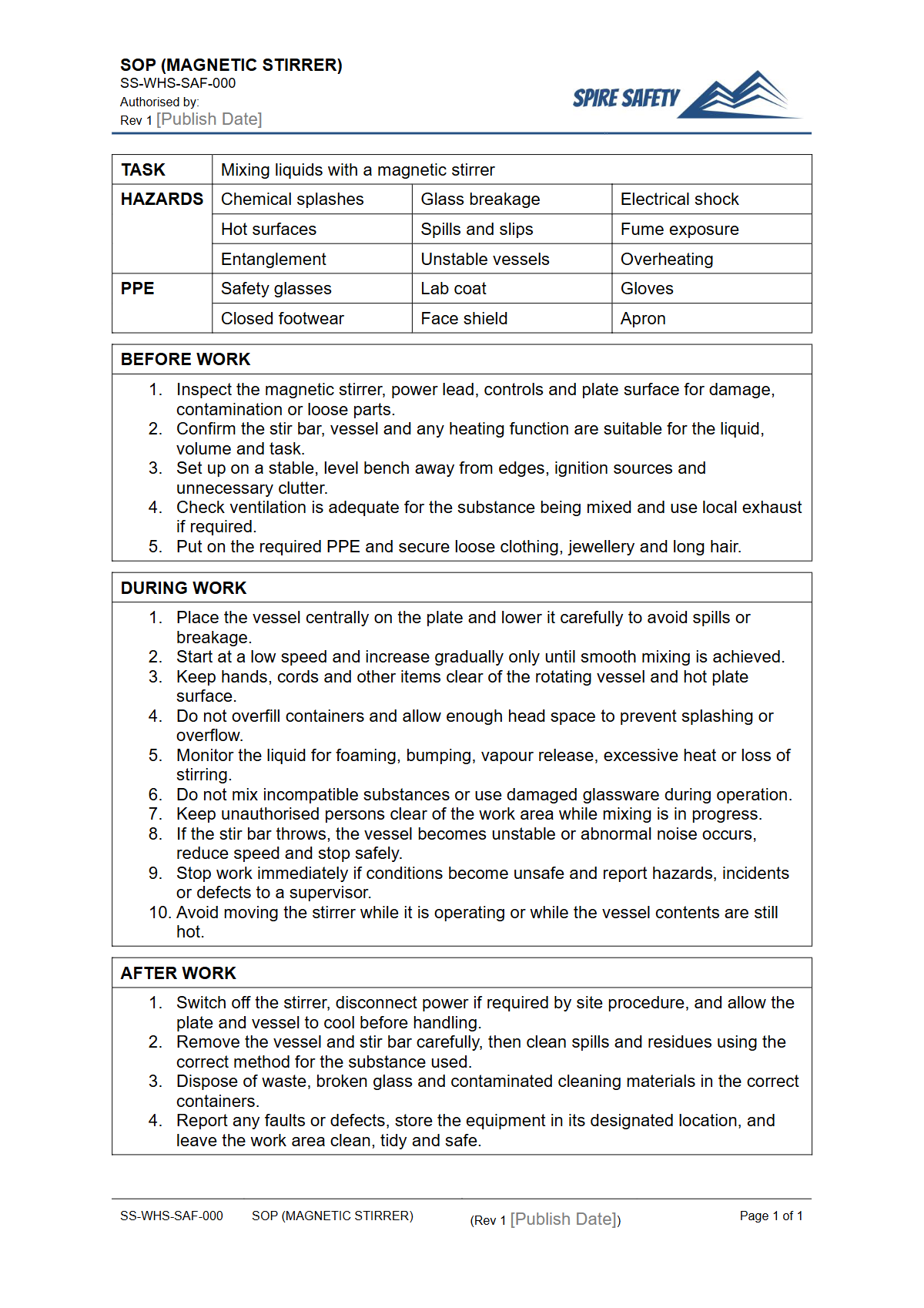
This Safe Operating Procedure for magnetic stirrers is provided as a fully editable Microsoft Word (DOCX) document and a printable PDF. To make it effective for your workplace, you must customise it with site-specific details.
This includes adding information about the specific models of stirrers you use, the types of chemicals being handled, your internal emergency contacts, and the required personal protective equipment (PPE). We have not included every possible hazard or control measure; you must conduct your own risk assessment and add any controls relevant to your specific tasks.
A generic procedure is not enough to ensure safety. It's vital to consult with your workers during this customisation process to ensure the final SOP is practical and reflects how the task is actually performed.
Key Elements of a Magnetic Stirrer SOP
Our template provides a logical structure to build your procedure, covering the full lifecycle of the task. A comprehensive SOP should include:
- Pre-Operational Checks: Steps to verify the equipment is safe before use. This includes inspecting the power cord for damage, checking the stirrer body and hotplate surface (if applicable) for contamination or defects, and examining all glassware (beakers, flasks) for cracks or chips that could lead to failure during operation.
- Operating Procedure: A sequential guide to performing the task safely. This covers placing the vessel securely in the centre of the plate, adding the stir bar, gradually increasing the rotation speed to prevent decoupling, and continuous monitoring of the process.
- Post-Operational Tasks: Instructions for shutting down and cleaning up. This includes ramping down the speed before turning the unit off, using a retriever to safely remove the stir bar, and cleaning the equipment and surrounding work area according to laboratory protocols.
In the event of a serious incident requiring medical intervention, clear and documented first aid processes are vital. Your site's emergency plan should include details on how to respond, potentially incorporating instructions from resources like our Free Safe Operating Procedure (Defibrillator Operation) Template if an AED is available onsite.
When to use it
A formal SOP for magnetic stirrer use is a valuable tool in several scenarios. It is essential for inducting and training new laboratory personnel, ensuring they understand the approved, safe method from day one.
The document should also be used for periodic refresher training for existing staff to prevent procedural drift and reinforce correct behaviour. It serves as a benchmark for supervisors conducting observations or safety checks.
Furthermore, in the event of an incident or near-miss involving a stirrer, the SOP becomes a critical reference document for the investigation, helping to identify whether the procedure was followed and if it needs to be updated.
Who should use it
This procedure is intended for a range of personnel within a laboratory or research environment. This includes:
- Laboratory Technicians and Researchers: The primary users who perform the task daily.
- Students and Research Assistants: Individuals who may be less experienced and require clear, unambiguous instruction.
- Laboratory Managers and Supervisors: Those responsible for training, oversight, and ensuring compliance with safety protocols.
- WHS/OHS Personnel: Safety professionals who develop, review, and audit safety documentation as part of the organisation's overall safety system.
General laboratory housekeeping is also critical. Ensure walkways are clear and that any necessary equipment, such as access ladders for high shelves, is used correctly.
For tasks involving ladders, a specific procedure like our FREE Step Ladder SOP Template can help standardise safe use.
Integrating SOPs into Your Broader Safety Framework
A single Safe Operating Procedure is just one component of a comprehensive safety strategy. For it to be truly effective, it must be embedded within your organisation's overarching WHS management systems. This system should cover everything from initial hazard identification and risk assessment to training, monitoring, and review, ensuring all safety documents work together cohesively.
Regularly reviewing your safety documentation is a key part of maintaining compliance and ensuring your controls remain effective. Periodic WHS compliance auditing can help identify gaps in your procedures and systems before they lead to an incident, ensuring documents like this SOP are kept current and relevant.
If developing or integrating these documents seems overwhelming, engaging external experts can provide clarity and support. Professional WHS consulting services can assist in tailoring procedures to your specific operational needs and regulatory obligations.
You can explore a wide range of other document templates to support different aspects of your workplace safety program. Browse our complete free WHS resources library to find checklists, risk assessments, and other SOP templates.
Common mistakes
Common mistakes to avoid
- Using a stir bar that is too large or small for the vessel, leading to poor mixing or breakage.
- Ramping up the rotation speed too quickly, causing the stir bar to 'decouple' and thrash erratically.
- Forgetting to inspect glassware for micro-cracks before use, increasing the risk of it shattering during operation.
- Using flammable liquids on a non-intrinsically safe hotplate stirrer without adequate risk controls.
Legal references
Legal considerations
The following legal requirements may be relevant to this type of work.
- Work Health and Safety Act (Harmonised) — Provides the primary duties for protecting workers and other people from work health and safety risks.
- Work Health and Safety Regulations (Harmonised) — Sets out requirements supporting the management of workplace hazards and risks.
The following codes may be relevant to this type of work.
- Managing WHS Risks Code of Practice — Provides practical guidance on identifying hazards, assessing risks and applying effective controls.
- Work Health and Safety Consultation, Cooperation and Coordination Code of Practice — Provides practical guidance on consulting workers and coordinating with other duty holders.
- Managing the Work Environment and Facilities Code of Practice — Provides practical guidance on safe work environments, workplace facilities and related controls.
Did you know
The 'Flea'
The encapsulated magnetic stir bar is often called a 'flea' because of the way it can jump around and is sometimes difficult to retrieve from a mixture.
Vortex Dangers
Stirring too vigorously can create a deep vortex, drawing air into the liquid. This can be undesirable or hazardous for air-sensitive chemical reactions.
FAQ
Frequently asked questions
01What are the main hazards of using a magnetic stirrer?
02How often should a Safe Operating Procedure for a magnetic stirrer be reviewed?
03Is a magnetic stirrer SOP a legal requirement in Australia?
04Can I use this template for a magnetic stirrer with a hot plate?
Share this resource
Free Safe Operating Procedure (Magnetic Stirrer) Template
Browse Categories
How To Use It
- 1Download and open in Word or PDF.
- 2Replace the placeholders with your business details.
- 3Get it reviewed by a WHS specialist before rollout.
Need it customised?
Our WHS consultants can adapt this template to your site, run a gap analysis, or audit what you already have in place.
Book a Free Consultation WHS consulting servicesor call 1300 156 382
Related templates
- Free Safe Operating Procedure (Mandoline Slicer) Template
- Free Safe Operating Procedure (Mandrel Reel) Template
- Free Safe Operating Procedure (Manhole Cover Check) Template
- Free Safe Operating Procedure (Manhole Cover Lifting) Template
- Free Safe Operating Procedure (Manifest Reconciliation) Template
- Free Safe Operating Procedure (Mannequin Handling) Template