
Free Safe Operating Procedure (Manhole Cover Check) Template
Download our free Safe Operating Procedure (Manhole Cover Check) Template. This customisable DOCX & PDF helps you document safe work methods. Get started now.
Free Safe Operating Procedure (Manhole Cover Check) Template
DOCX • 126 KB + PDF
Updated Oct 2026
No signup required
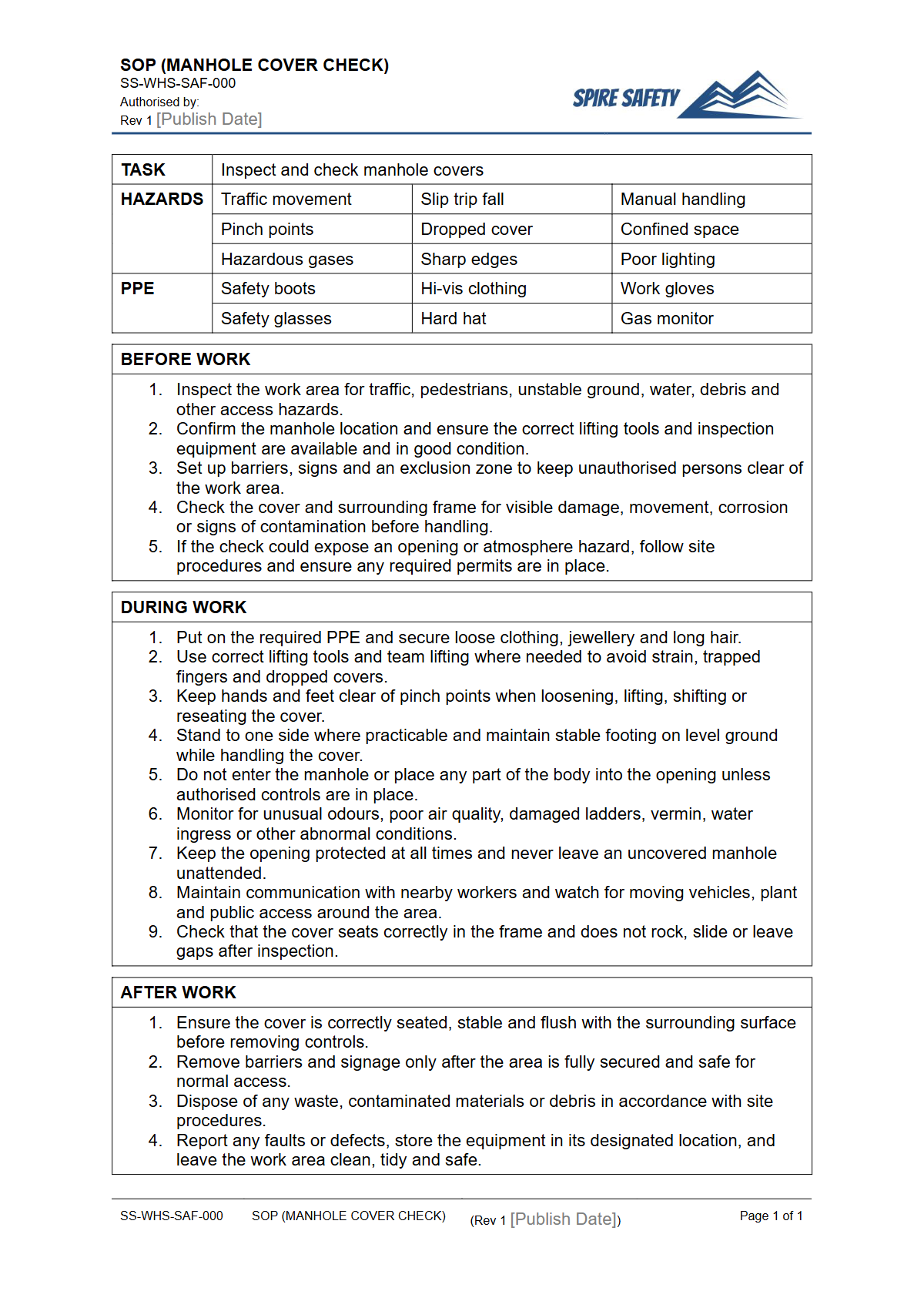
Purpose of the Free Safe Operating Procedure (Manhole Cover Check) Template
Effectively managing site safety involves identifying and controlling risks for all tasks, including seemingly simple ones like inspecting manhole covers. Our Free Safe Operating Procedure (Manhole Cover Check) Template provides a structured framework for documenting the required steps to perform this task safely.
Using this SOP helps prevent common incidents such as trips, falls into open pits, and manual handling injuries from lifting heavy covers. Formalising this process is a key component of robust WHS management systems, ensuring all workers follow a consistent, safe method.
This template is designed to guide you in outlining pre-operational checks, the step-by-step process for safely accessing and inspecting a manhole cover, and the post-task clean-up and reporting requirements. It serves as a critical tool for worker training and for demonstrating due diligence in managing workplace hazards.
Video walkthrough
How to use the Free Safe Operating Procedure (Manhole Cover Check) Template
This document is a starting point. To make it effective, you must customise it for your specific workplace.
Download the DOCX file and adapt it by adding your company name, specific site locations, and details about the types of manhole covers and lifting equipment used. Consultation is key; involve your workers in the drafting process to ensure the procedure is practical and reflects the realities of the task.
Just as our FREE Trencher SOP needs to be tailored to a specific machine and ground conditions, this SOP must be adapted to your unique environment.
Important Note:
This is a template and not a complete Safe Operating Procedure. It is the responsibility of the Person Conducting a Business or Undertaking (PCBU) to ensure that the procedure is tailored to the specific hazards and risks in their workplace. We recommend a comprehensive risk assessment is conducted before this SOP is implemented.
When to use this Safe Operating Procedure
A Manhole Cover Check SOP should be used as the primary reference document whenever workers are required to inspect, lift, or replace a manhole cover. It is particularly important in the following scenarios:
- Routine Site Inspections: As part of a regular maintenance or site safety schedule.
- Pre-Task Planning: Before commencing any work that involves or is near a manhole.
- Post-Incident: After heavy rainfall, flooding, or significant vehicle traffic that may have dislodged or damaged a cover.
- Worker Training and Induction: To train new employees or refresh existing workers on the correct procedure.
Regularly reviewing and updating your SOPs is also a crucial activity that can be verified during WHS compliance auditing to ensure they remain current and effective.
Who should use this Safe Operating Procedure
This SOP is intended for use by a range of personnel within an organisation. Primarily, it should be used by:
- Maintenance Staff and Technicians: The workers who physically perform the manhole cover checks.
- Site Supervisors and Foremen: Those responsible for overseeing work and ensuring procedures are followed correctly.
- WHS/HSE Officers: Safety professionals who develop, implement, and review safety documentation.
- Project Managers: To ensure safety protocols are integrated into project planning and execution.
Any worker whose role involves interacting with site infrastructure like manholes, even if it's just for access, should be familiar with this procedure. This complements other task-specific guides, such as our FREE Step Ladder SOP Template, which covers another common but high-risk task.
Key Elements of a Manhole Cover Check SOP
Our template prompts you to consider several critical safety elements. These include identifying required Personal Protective Equipment (PPE) like gloves and steel-capped boots, outlining the use of barricades and warning signs to control the work area, specifying correct manual or mechanical lifting techniques, and detailing emergency response actions.
Having clear procedures for emergencies, similar to the steps in a defibrillator operation SOP, is a vital part of any safety document.
By thoroughly documenting each stage, you create a clear and actionable guide that reduces ambiguity and enhances worker safety. You can find more templates like this one in our complete free WHS resources library to build out your safety management system.
Common mistakes
Common mistakes to avoid
- Using incorrect lifting techniques or no lifting tool, leading to severe back injuries.
- Failing to properly barricade the work area, exposing workers and the public to trip and fall hazards.
- Not inspecting the cover and frame for cracks or damage before lifting, which can lead to equipment failure.
- Leaving a manhole cover unseated ('rocking') after replacement, creating a new trip hazard.
Legal references
Legal considerations
The following legal requirements may be relevant to this type of work.
- Work Health and Safety Act (Harmonised) — Provides the primary duties for protecting workers and other people from work health and safety risks.
- Work Health and Safety Regulations (Harmonised) — Sets out requirements supporting the management of workplace hazards and risks.
The following codes may be relevant to this type of work.
- Managing WHS Risks Code of Practice — Provides practical guidance on identifying hazards, assessing risks and applying effective controls.
- Work Health and Safety Consultation, Cooperation and Coordination Code of Practice — Provides practical guidance on consulting workers and coordinating with other duty holders.
- Managing the Work Environment and Facilities Code of Practice — Provides practical guidance on safe work environments, workplace facilities and related controls.
Did you know
Lifting Forces
A standard heavy-duty cast iron manhole cover can weigh over 100 kilograms. This makes mechanical lifting aids or two-person lift procedures, as outlined in an SOP, essential to prevent serious manual handling injuries.
FAQ
Frequently asked questions
01Is a Safe Operating Procedure a legal requirement for checking manhole covers in Australia?
02What are the main hazards a Manhole Cover Check SOP should address?
03Can I use this template for entering a manhole?
04How often should manhole covers be inspected using this SOP?
Share this resource
Free Safe Operating Procedure (Manhole Cover Check) Template
Browse Categories
How To Use It
- 1Download and open in Word or PDF.
- 2Replace the placeholders with your business details.
- 3Get it reviewed by a WHS specialist before rollout.
Need it customised?
Our WHS consultants can adapt this template to your site, run a gap analysis, or audit what you already have in place.
Book a Free Consultation WHS consulting servicesor call 1300 156 382
Related templates
- Free Safe Operating Procedure (Manhole Cover Lifting) Template
- Free Safe Operating Procedure (Manifest Reconciliation) Template
- Free Safe Operating Procedure (Mannequin Handling) Template
- Free Safe Operating Procedure (Manometer) Template
- Free Safe Operating Procedure (Manual Order Picking) Template
- Free Safe Operating Procedure (Manual Weed Removal) Template